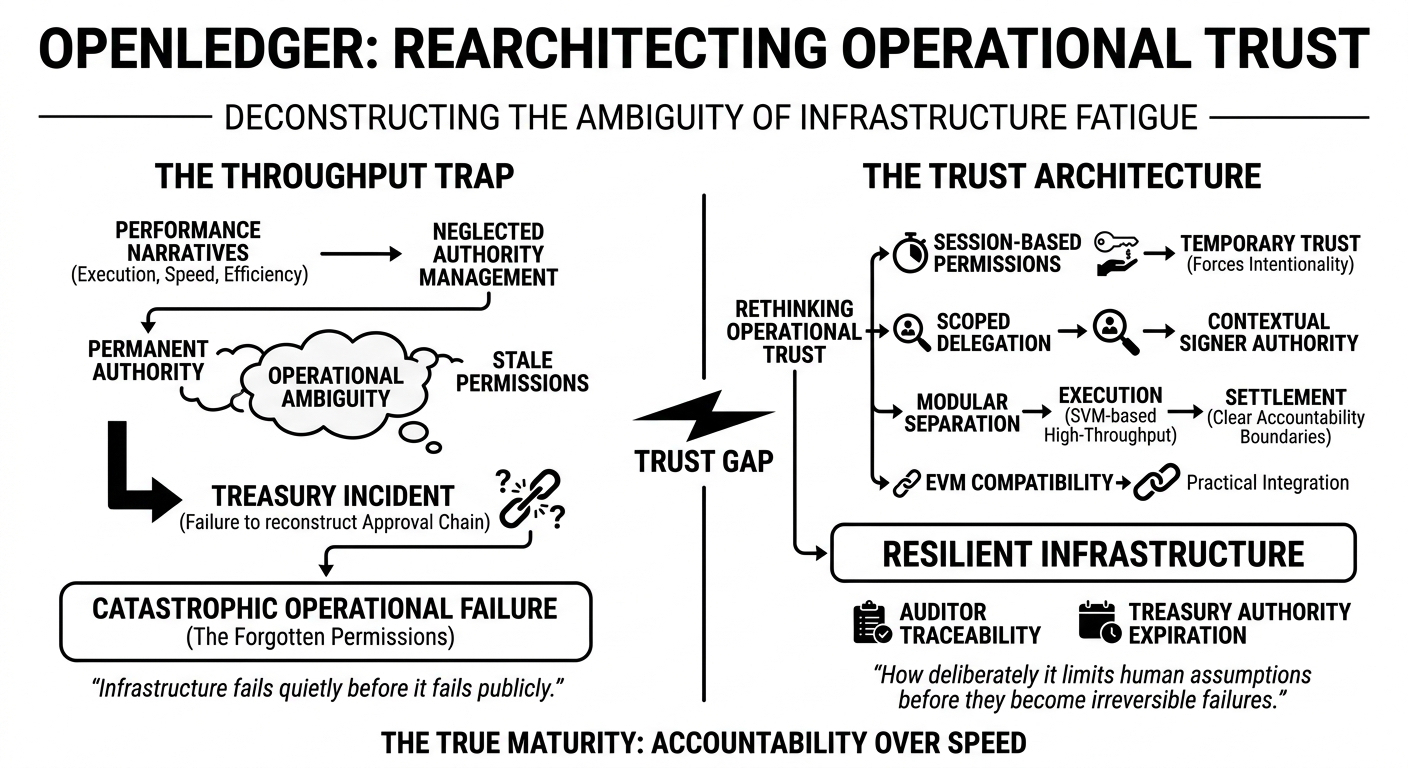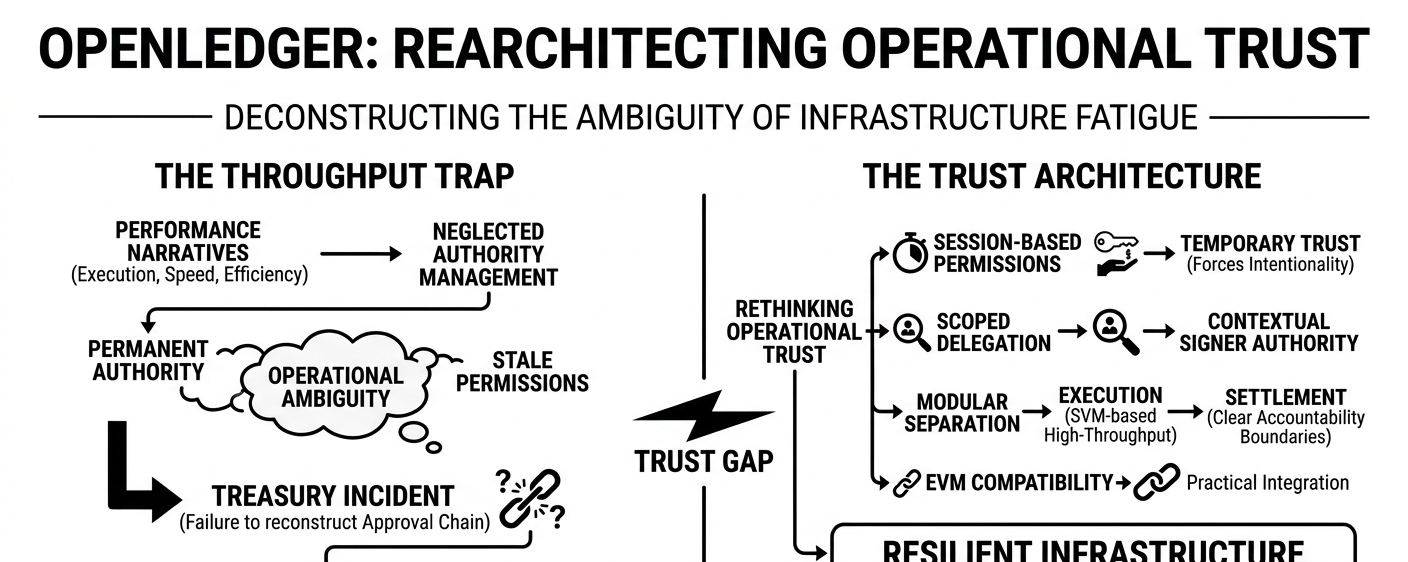
I remember a treasury incident where the technical details became almost irrelevant within the first thirty minutes. The alarms were real, but the greater problem was interpretive. An approval chain existed, yet nobody could fully reconstruct it under pressure. A signer believed their authority had been removed after a prior emergency operation. Governance participants assumed delegation had been narrowly scoped. Security teams discovered permissions that remained active not because anyone intentionally preserved them, but because operational convenience had quietly become infrastructure policy. The immediate concern was whether funds were exposed. The deeper concern was simpler: nobody could confidently explain where authority actually lived.
That kind of ambiguity tells you more about blockchain infrastructure than any throughput benchmark ever will.
The industry became deeply attached to performance narratives. Faster execution, smoother interfaces, better settlement efficiency, more composability, broader interoperability. Speed became synonymous with maturity. But after enough treasury failures, wallet exploits, governance freezes, and bridge-related security panics, a less flattering truth emerges: many systems optimized execution while neglecting authority management. Infrastructure fatigue did not come from computational limits. It came from trust architectures growing more complex than the institutions operating them.
“Infrastructure fails quietly before it fails publicly.”
That is what makes OpenLedger interesting—not as another performance system, but as an attempt to rethink operational trust itself.
Session-based permissions matter because permanent authority is fundamentally an institutional liability. Temporary trust forces intentionality. Scoped delegation matters because signer authority should be contextual, not ambient. Reducing signature overhead may improve efficiency, but fewer signatures mean nothing if the permissions underneath remain indefinite. Most catastrophic operational failures do not begin with sophisticated attacks. They begin with stale assumptions.
“The dangerous permissions are usually the forgotten ones.”
OpenLedger’s architectural decisions reflect this tension. SVM-based execution and high-throughput design address familiar scaling concerns, but the more meaningful choice is modular separation between execution and settlement. This creates clearer accountability boundaries, both technically and psychologically. Execution becomes more containable. Responsibility becomes easier to reason about. EVM compatibility feels less ideological than practical; institutional systems rarely have the luxury of architectural purity.
But none of this resolves the harder risks.
Interoperability remains structurally dangerous. Bridges are fragile trust layers masquerading as convenience. State verification across modular environments creates monitoring blind spots. Composability expands attack surfaces faster than governance frameworks mature. Validators inherit operational responsibility, not merely incentive flows.
“Trust rarely disappears gradually.”
Auditors care about traceability. Treasury teams care about authority expiration. Operators care about narrowing uncertainty.
The enduring lesson is that resilient infrastructure is not defined by how efficiently it moves assets. It is defined by how deliberately it limits human assumptions before those assumptions become irreversible failures.