
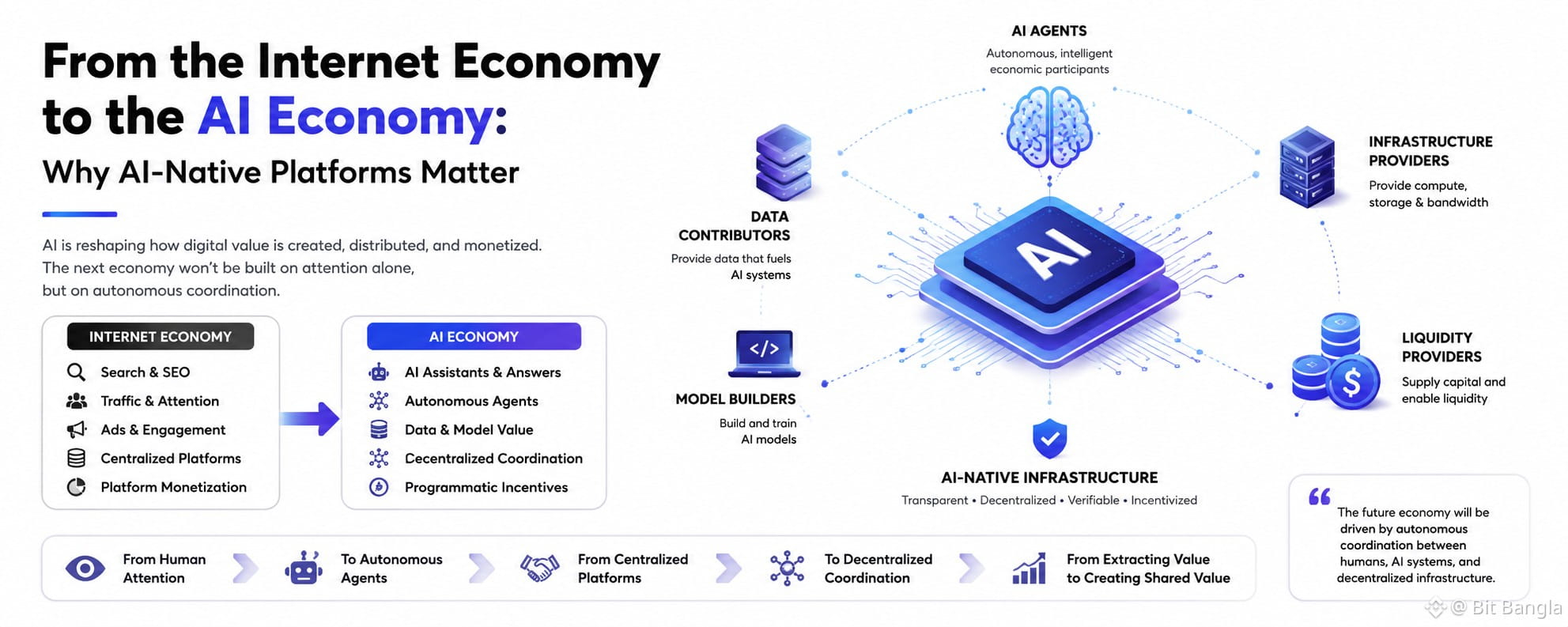
The internet economy was built around attention. Search traffic, ads, clicks, and centralized platforms controlled how digital value moved online. But AI is starting to change that entire system.
What feels different about this AI wave is that it’s not just improving productivity it’s reshaping the structure of the digital economy itself.
For years, websites competed for visibility through SEO and content distribution. Now AI assistants can summarize information instantly, reducing the need for users to visit multiple platforms. That changes how value is captured online. Traffic alone may no longer be the most important asset.
The creator economy is also entering a new phase. AI can now generate articles, graphics, marketing copy, code, and even videos within minutes. Productivity increases massively, but it also raises a difficult question:
Who should actually benefit from AI-generated value?
The model creators? The data contributors? The infrastructure providers? Or the platforms coordinating everything?
I think this is where AI-native infrastructure becomes important.
Traditional internet systems were designed mainly for human interaction. AI economies require something very different — systems that support autonomous agents, transparent attribution, machine-to-machine coordination, and programmable incentives.
That’s why projects like OpenLedger are interesting to watch. The goal is not only building AI tools, but creating an ecosystem where developers, data providers, liquidity participants, and AI agents can coordinate economically in a decentralized way.
The bigger shift may come when AI agents themselves become active economic participants — managing liquidity, executing transactions, optimizing strategies, and coordinating data autonomously.
If that happens, the internet will no longer revolve only around human attention.
It may evolve into an economy driven by autonomous coordination between humans, AI systems, and decentralized infrastructure.
We are probably still early in this transition, but it feels increasingly clear that the move from the Internet Economy to the AI Economy is already underway.