
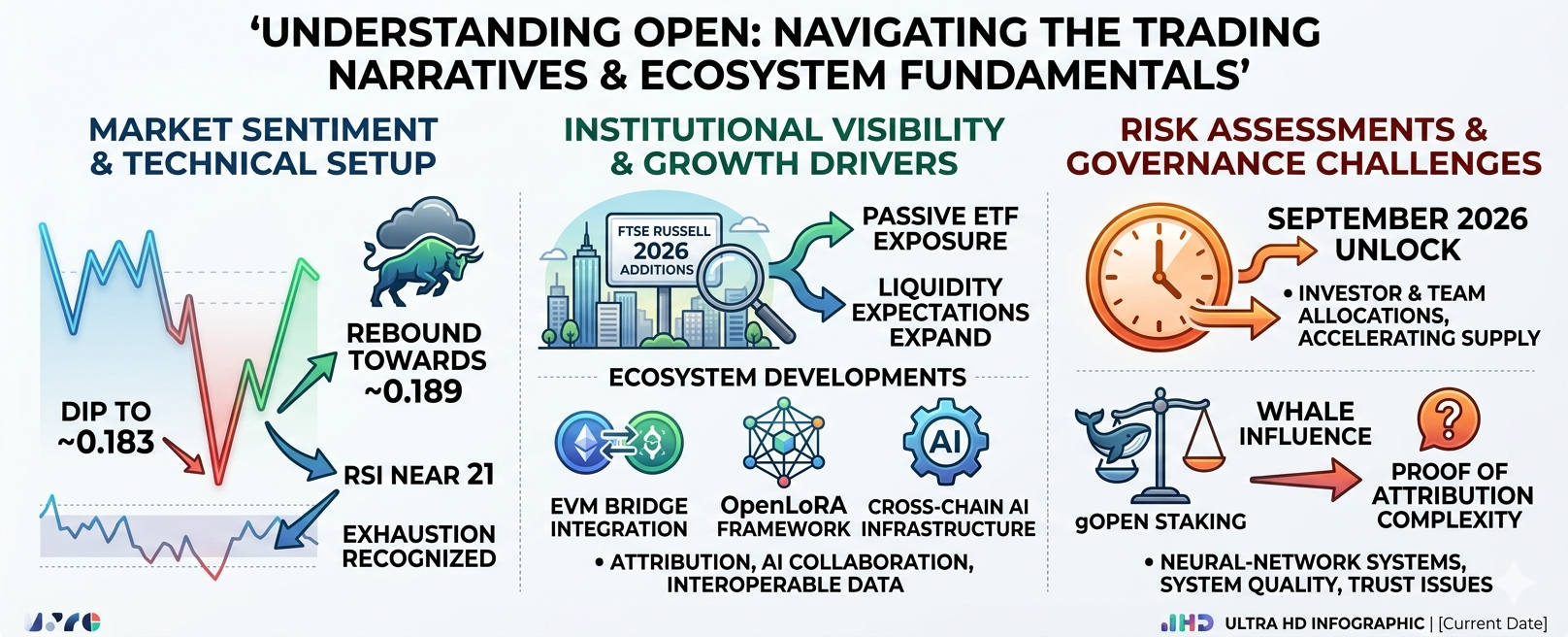
@OpenLedger I’have been watching OPEN very closely over the last 24 hours, and what stood out to me wasn’t just the price volatility it was how quickly market sentiment shifted once traders started connecting the technical setup with the broader institutional narrative around the ecosystem. After seeing OPEN drop into deeply oversold territory with RSI collapsing near 21, I honestly felt the market had pushed fear too far. The rebound from around $0.183 back toward $0.189 looked less like random speculation and more like traders aggressively repositioning after recognizing exhaustion on the sell side.
What’s making this move more interesting to me is the growing attention around OPEN potentially being tied to the preliminary 2026 FTSE Russell additions narrative. Whether people call it speculation or early positioning, institutional visibility changes the psychology of a market very quickly. I’have seen this happen before with smaller assets once traders start imagining passive ETF exposure and future index linked flows, liquidity expectations expand almost overnight. Even before actual inflows arrive, the perception alone can create momentum because participants start pricing in future demand ahead of time.
At the same time, I think the ecosystem side of OPEN is becoming harder to ignore. I’have been following the recent discussions around the EVM bridge integration and the ongoing OpenLoRA framework development, and it feels like the project is trying to build utility beyond simple token speculation. Cross-chain AI infrastructure is becoming one of the most competitive sectors right now, and OPEN positioning itself around attribution, AI collaboration, and interoperable data layers gives it a much broader narrative than most low cap ecosystems currently chasing attention. What I personally find interesting is how the community keeps focusing on ownership and contribution tracking inside AI systems instead of just repeating generic “AI blockchain” marketing.
Still, I don’t think the risks can be ignored here. The September 2026 unlock structure remains one of the biggest concerns in my view. Large investor and team allocations entering circulation can completely change supply dynamics if ecosystem adoption doesn’t accelerate fast enough before then. I’have watched many promising projects lose momentum when token inflation outpaced real usage growth, so this is something I’m paying serious attention to.
I’m also cautious about the governance structure. The OPEN staking model currently gives whales significant influence because quadratic voting protections aren’t implemented yet. In AI ecosystems especially, governance matters more than people realize because decisions around models, datasets, incentives, and attribution frameworks can shape the long term credibility of the entire network.
Another thing I keep thinking about is the technical complexity behind Proof of Attribution itself. The idea is ambitious, but proving contribution quality inside neural network driven systems is still one of the hardest unsolved problems in AI infrastructure. If low quality submissions or behavioral exploits start gaming the attribution layer, the system could face trust issues very quickly. That’s why I think the next phase for OPEN isn’t only about price action it’s about proving the architecture can survive real world scale and adversarial behavior.
Right now, I’m seeing OPEN transition from a niche speculative token into a project traders are starting to evaluate through both institutional and infrastructure lenses at the same time. That combination creates opportunity, but it also raises the standard dramatically. The market is no longer only asking whether OPEN can rally it’s asking whether the ecosystem can actually justify the narrative forming around it.
