

I have been watching the AI narrative collide with crypto for the past few years, and one thing has become increasingly clear: the real opportunity may not be another chatbot or another token. It may be the infrastructure that decides who owns intelligence and who gets paid for creating it.
That is the space OpenLedger is trying to enter.
Every major crypto cycle leaves behind a new foundation for digital economies. Bitcoin created a system for moving value without banks. Ethereum introduced programmable ownership and smart contracts. DeFi transformed idle assets into productive capital. Now, as artificial intelligence becomes a central part of modern technology, a new challenge is emerging around ownership, attribution, and monetization.
The problem is surprisingly simple.
AI systems depend on data, models, and increasingly autonomous agents. Yet the people who provide valuable datasets often receive little compensation. Developers building specialized models struggle to capture ongoing value. Meanwhile, most AI ecosystems remain concentrated inside a handful of large platforms that control distribution, infrastructure, and monetization.
OpenLedger believes there is another way.
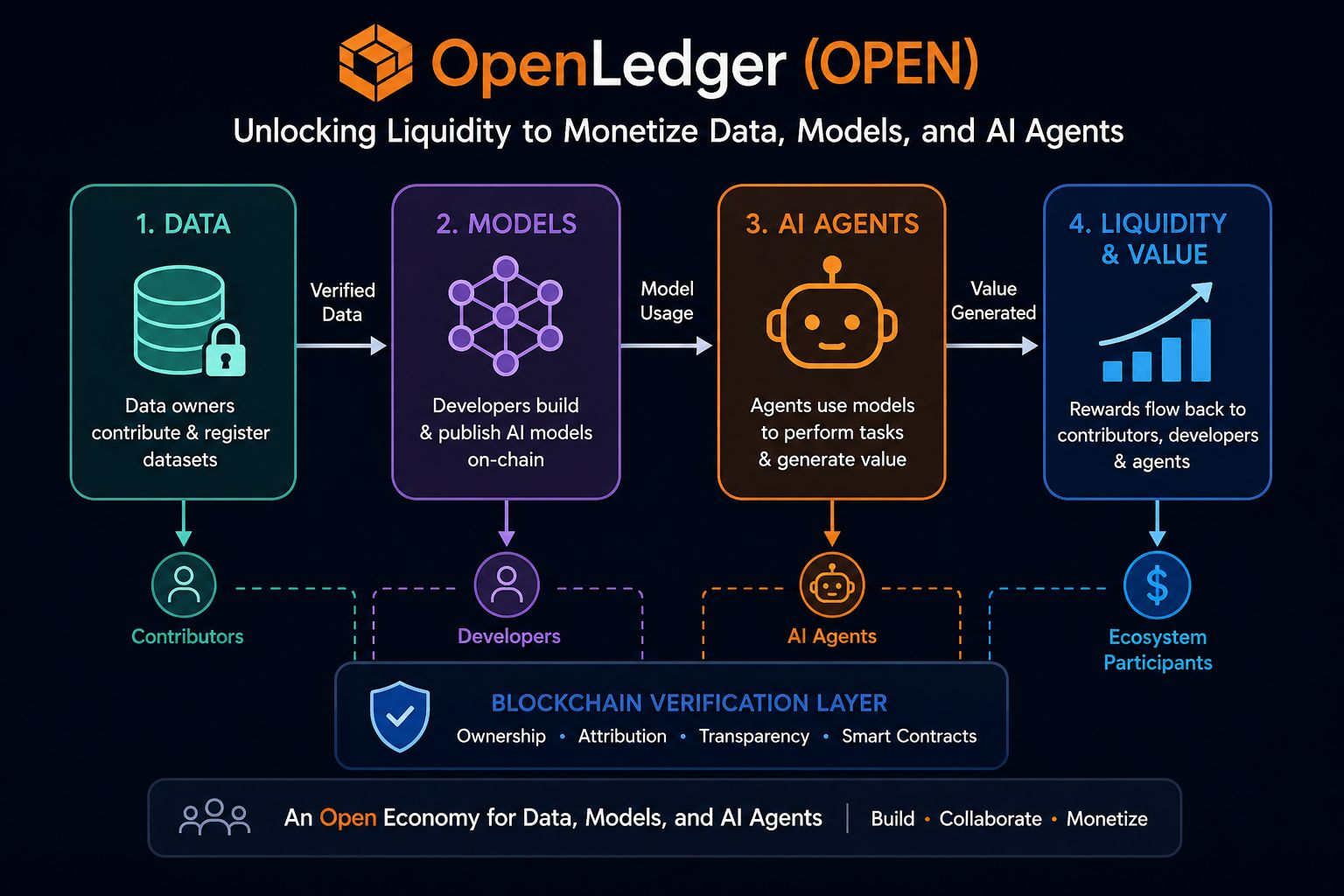
The project positions itself as an AI-focused blockchain network designed to unlock liquidity around data, machine learning models, and AI agents. Instead of treating intelligence as a closed product delivered by centralized companies, OpenLedger aims to make intelligence itself an economic asset that can be owned, verified, tracked, and monetized through blockchain infrastructure.
That idea sounds ambitious.
But it also reflects one of the most important debates taking shape across the technology industry. As AI becomes more powerful and more embedded in daily life, questions around ownership and value distribution become impossible to ignore. If data trains the model, who owns the value created? If an autonomous agent generates revenue, who benefits? If a specialized model solves real-world problems, how should that economic activity be shared?
OpenLedger attempts to build answers directly into the infrastructure.
The project emerged from a broader movement often described as decentralized AI. Over the past few years, blockchain developers have increasingly explored alternatives to centralized AI systems. Some networks focus on decentralized computing power. Others build data marketplaces or distributed training environments. A growing number concentrate on AI agents and machine-to-machine economies.
OpenLedger’s focus is slightly different.
Its core thesis is that data, models, and autonomous agents should function as productive assets within an open marketplace rather than isolated technological resources trapped inside proprietary ecosystems.
The concept begins with data.
Data remains the fuel powering modern artificial intelligence. Every recommendation engine, prediction model, and generative AI system improves through exposure to information. Yet most contributors have little visibility into how their data is used or how much value it creates. OpenLedger proposes a framework where datasets can be registered, verified, and linked to transparent ownership records.
The goal is straightforward.
If contributed data becomes valuable for training or improving AI systems, the original providers could potentially share in the economic benefits. Instead of a one-time transaction, data ownership becomes connected to ongoing value creation through blockchain-based attribution and reward mechanisms.
The same logic extends to AI models.
Developers spend significant resources building specialized models for industries ranging from healthcare and finance to legal services and scientific research. Traditional monetization often depends on subscriptions, licensing agreements, or API fees. OpenLedger introduces a different approach by treating models as identifiable on-chain assets with transparent ownership and usage tracking.
That changes the economics.
As applications interact with those models, revenue can theoretically be distributed automatically according to predefined rules. Rather than relying entirely on centralized intermediaries, creators gain access to a system where compensation is tied more directly to actual usage and contribution.
The most intriguing element may be autonomous agents.
AI agents are evolving beyond simple chat interfaces. They can gather information, analyze data, perform tasks, interact with applications, and make decisions within defined parameters. As these systems become more sophisticated, entirely new economic questions emerge. Who owns an agent? How can its actions be verified? How is revenue generated and distributed? How do autonomous systems establish trust with one another?
OpenLedger’s blockchain layer is designed to support those interactions.
By recording ownership, activity, and value flows on-chain, the network aims to create an environment where agents can operate within transparent economic frameworks. If machine-to-machine economies eventually become a meaningful part of digital commerce, infrastructure like this could play a critical role.
That possibility is attracting attention.
The broader significance of OpenLedger extends beyond artificial intelligence itself. Historically, economic systems evolved because societies needed better methods for allocating resources and rewarding productive activity. Financial markets, banks, and capital networks emerged to solve those problems. The AI economy now faces a similar challenge as data contributors, model creators, and autonomous systems generate value without efficient mechanisms for attribution and compensation.
OpenLedger is attempting to build that missing layer.
The potential benefits are substantial. Smaller developers could gain access to new monetization channels. Specialized datasets could become economically viable assets. Contributors might receive clearer attribution for their work. Autonomous agents could participate in transparent digital economies governed by programmable rules rather than centralized gatekeepers.
Yet none of this comes without risk.
The biggest obstacle may be adoption. Developers already have access to mature AI ecosystems supported by powerful infrastructure, extensive tooling, and enormous user bases. Decentralized alternatives must offer clear advantages to justify migration. Strong technology alone rarely guarantees network growth.
Data quality presents another challenge.
Not all information is valuable, and poor datasets can damage model performance. Any system designed around rewarding contributions must establish reliable methods for validating quality. Otherwise, incentives can quickly become distorted.
Scalability remains equally important.
AI systems generate enormous volumes of activity through training processes, inference requests, model interactions, and agent communications. Maintaining blockchain transparency while supporting large-scale AI operations will require significant technical efficiency.
Then there is regulation.
Governments around the world are still developing rules covering digital assets, artificial intelligence, data ownership, privacy, and intellectual property. Future regulatory decisions could significantly influence how decentralized AI ecosystems evolve and whether certain economic models become practical at scale.
Competition is another reality.
OpenLedger is entering an increasingly crowded sector filled with projects pursuing decentralized compute, data infrastructure, AI marketplaces, and agent ecosystems. Long-term success will depend on execution, developer adoption, ecosystem growth, and real-world utility rather than narrative momentum alone.
Still, the broader trend is difficult to ignore.
For years, blockchain innovation focused primarily on financial infrastructure. Lending markets, decentralized exchanges, derivatives, and yield-generation protocols dominated development. AI introduces an entirely new category of digital economic activity where intelligence itself becomes an asset capable of generating value.
That shift could prove transformative.
For retail investors, it offers exposure to one of the most important technology themes emerging today. For institutions, it creates alternative frameworks for collaboration, data sourcing, and model monetization. For developers, it opens new pathways to ownership and revenue generation. For DeFi, it introduces the possibility of machine-generated economic activity interacting directly with decentralized financial systems.
Whether OpenLedger ultimately becomes a dominant platform remains uncertain. What is becoming increasingly clear, however, is that the intersection of blockchain and artificial intelligence is moving beyond theory. The conversation is gradually shifting from speculation toward infrastructure.
And in technology, infrastructure often matters far more than hype. The systems that quietly establish ownership, attribution, coordination, and value exchange tend to outlast the narratives that first brought attention to them. OpenLedger is betting that data, models, and autonomous agents will eventually require exactly that kind of foundation—and if the future AI economy becomes more decentralized, that wager could become increasingly relevant.
