

A few months ago I used to look at AI and blockchain projects in a very simple way. If a project had a strong narrative a modern website and people talking about “the future of AI,” I automatically assumed value would follow. Yeah I believed creation itself was enough. If a system could build something impressive I thought adoption would naturally come after.
But over time that view started to feel incomplete.
One night around 2 AM, I was sitting with charts open on my laptop while discussing crypto projects with a friend on a video call. We were breaking down different AI ecosystems, questioning what actually survives after hype disappears. That conversation changed how I evaluate projects. Oh the biggest realization was simple: creating something is not the same as keeping it alive inside an economy.
That’s where OpenLedger started to look different to me.
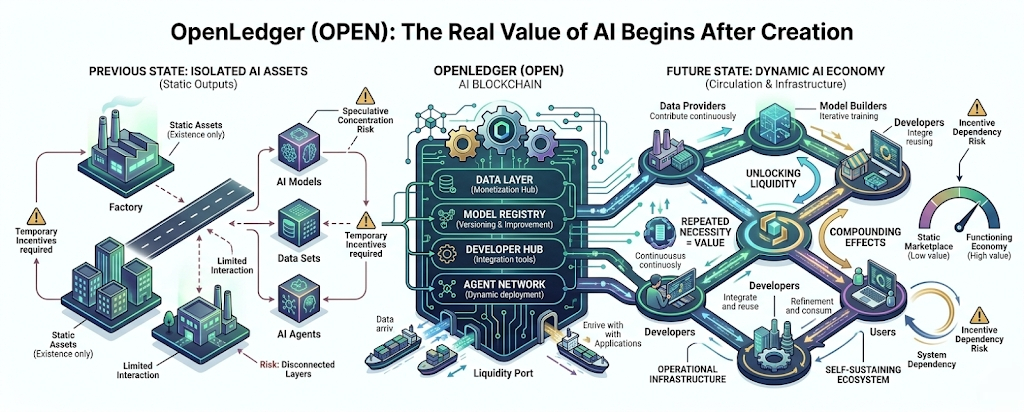
Most systems today focus heavily on creation. They help people generate models, agents, or data outputs. But I kept asking myself one thing: what happens after creation? Does the output continue moving through the system like goods moving through a real city economy, or does it just sit there unused like an empty building in the middle of a financial district?
That distinction matters more than people realize.
A factory that produces products nobody uses is not an economy. A road with no traffic has no economic value. In the same way, AI models without continuous interaction become static assets. They exist, but they do not participate.
OpenLedger seems to be trying to solve that exact gap between creation and circulation.
Instead of treating AI outputs as isolated products, the system attempts to structure them like economic assets that can move between participants. Data providers, model builders, developers, and users are not separated into disconnected layers. The network is designed so outputs can be referenced, reused, improved, and monetized continuously.
Okay, that changes the conversation.
Because now the focus is not just “Can AI be created?” The real question becomes: “Can AI outputs stay active inside a living system?”
That is where infrastructure begins.
I started looking deeper into how the system functions structurally rather than emotionally. The interesting part is not the branding around AI agents. It is how interaction happens between participants over time. One participant contributes data, another trains models, another integrates those models into applications, while others continue using or refining outputs. Every interaction creates another reference point inside the network.
That creates compounding effects.
It reminds me of how ports work in global trade. A port becomes valuable not because one ship arrives there once. Its value comes from repeated movement. Ships arrive, goods move, businesses depend on the routes, and over time the port becomes embedded into economic activity. Without movement, infrastructure loses meaning.
The same logic applies here.
If OpenLedger can create an environment where AI models, agents, and datasets continue circulating between users and developers, then the system starts behaving less like a standalone product and more like operational infrastructure.
But I also think the market is still trying to figure out where exactly OpenLedger belongs.
Positioning and maturity are two different things. A project can position itself as infrastructure long before adoption proves it. Right now, I see potential signals, but I also see early-stage uncertainty. Activity still feels partially event-driven. There is attention around AI narratives, partnerships, and ecosystem discussions, but the important question is whether usage continues quietly even when attention slows down.
That is where real evaluation starts.
I pay close attention to whether participation is expanding naturally or staying concentrated around a limited group of users and speculators. Real systems slowly disappear into daily operations. People stop talking about them constantly because they become part of normal workflows.
Oh, that is the level most projects never reach.
A lot of blockchain ecosystems survive temporarily because incentives force activity. Remove rewards, and movement disappears. That is the biggest risk for any AI-chain economy too. If participation depends mostly on short-term incentives, then usage becomes temporary instead of self-sustaining.
Continuous usage is the real test.
The strongest systems are not powered by excitement alone. They are powered by repeated necessity. Developers return because integration saves time. Businesses return because operations depend on it. Users return because the network continues producing useful interactions without needing constant stimulation.
That is what I am watching closely with OpenLedger.
My confidence would increase if I start seeing deeper integration across real workflows. Not just announcements, but actual dependency. More developers building reusable layers. More businesses connecting operational processes to the network. More evidence that outputs created inside the ecosystem continue circulating long after their initial creation.
At the same time, there are warning signs I cannot ignore.
If activity spikes only around incentives or narrative cycles, I become cautious. If participation stays concentrated among speculators instead of expanding toward actual builders and users, that weakens the long-term infrastructure argument. And if outputs are created but rarely reused or integrated into ongoing systems, then the network risks becoming another temporary AI marketplace instead of a functioning economy.
Yeah, that difference matters more than hype.
Because in the end systems that truly matter are not the ones that simply create something. They are the ones where that thing keeps moving, keeps interacting and keeps integrating into everyday activity without needing constant attention to survive.