

Every major shift in the digital world begins quietly, almost like a whisper carried through a crowded room. People do not notice it at first, but something inside them feels the change before they understand it. OpenLedger has started creating that same feeling again. Each update, each small improvement, and each new piece of data released by the team is slowly shaping a structure that seems simple on the surface but is actually redesigning how trust and digital ownership work. The rise of its token is not just a moment in the market; it is becoming a sign of a deeper movement that many people have not yet fully recognized.
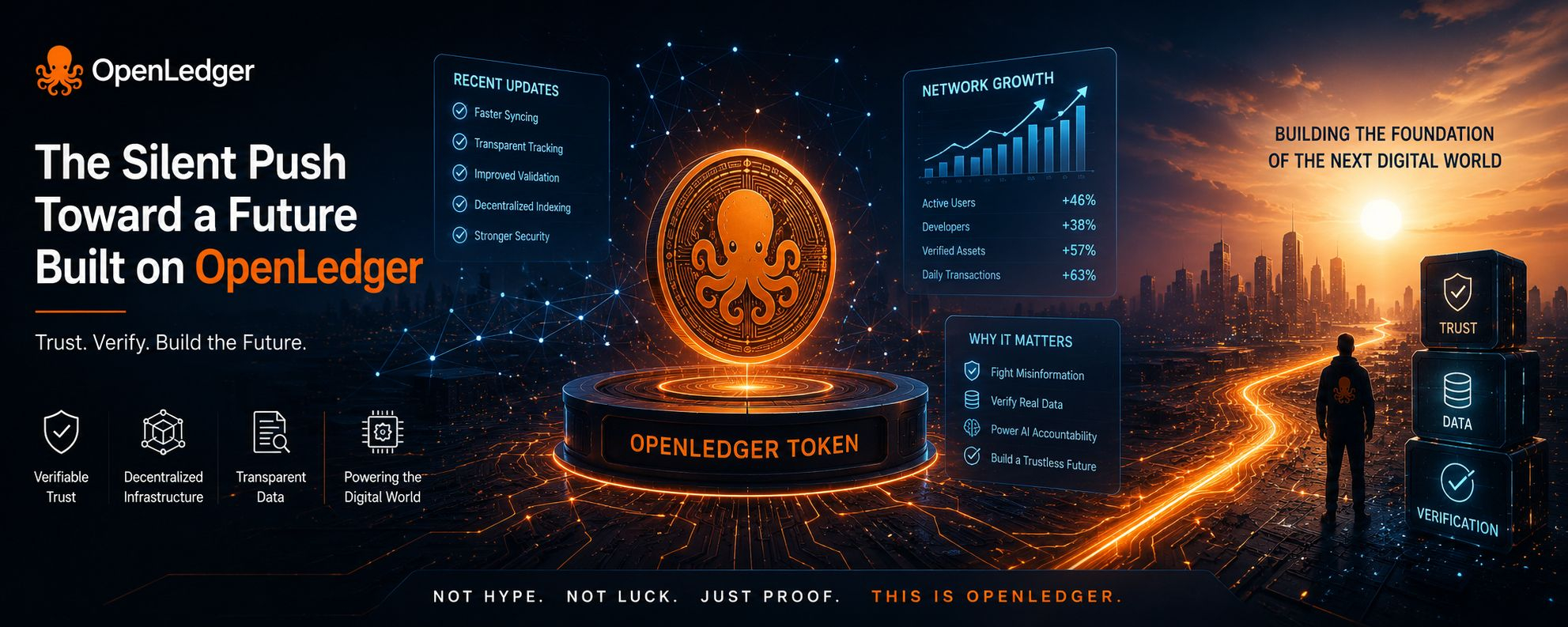
Most people misunderstand progress because they expect big announcements, loud celebrations, and dramatic jumps in price to confirm that something has value. But real progress is almost always the opposite. It grows quietly, through consistent updates and decisions that strengthen the foundation long before the world sees the results. This is exactly what OpenLedger has been doing. The recent updates shared by the team faster syncing times, more transparent asset tracking, improved validation layers, and the expansion of decentralized indexing show a project preparing itself for long-term stability instead of short-term excitement. When a project focuses this deeply on its core systems, it is usually because it already knows the future it wants to build.
Data is the one thing that never lies, and the latest OpenLedger numbers show a clear direction. More users are interacting with the protocol, more developers are integrating its frameworks, and more assets are being recorded through its verification layers. The daily activity of the token has increased, not in sudden spikes, but in a steady upward pattern that usually indicates real adoption rather than speculative behavior. Markets often pretend to tell the truth, but usage data exposes what people actually trust. And right now, that trust is rising.
Still, every new technology faces the same question: how do we know it will survive? Fear does not come from the technology itself but from the system it lives in. OpenLedger is entering a digital landscape full of doubt, regulations, competition, and fast-changing trends. But instead of depending on hype or promises, the project is putting its strength into something far more important verifiable proof. In a world where information spreads faster than logic, the need for accurate, tamper-free records has become almost as vital as currency itself. The token’s role in securing and powering this process is turning it into a necessary part of the system rather than just another digital asset.
People often wait for someone else to confirm that a project is meaningful before they take it seriously. They wait for influencers, exchanges, or institutions to tell them what has value. But the truth is simpler: value comes from the problems a system actually solves. OpenLedger is solving a problem that nearly every digital platform struggles with how to store, verify, and track data in a world filled with manipulation, misinformation, and artificial content. The timing could not be better. As AI continues to create endless amounts of synthetic information, the world is beginning to realize how important it is to know what is real and where it came from. The recent improvements to OpenLedger’s verification engine directly target this need, making the token’s role even more clear.
Even the movement of the token reflects this shift. Instead of wild, unpredictable swings, the price behavior has started showing patterns linked to real activity network use, validator expansion, and ecosystem updates. When a token stops behaving like a gamble and starts functioning like a tool, it reaches a different level of stability. The OpenLedger token is moving in that direction. And when utility begins to matter more than speculation, long-term growth becomes possible.
The more the project progresses, the more it highlights a deeper truth about the digital world: trust is no longer something we can leave to chance. It has to be earned, measured, and recorded. OpenLedger is quietly building an ecosystem where trust is not a belief it is a verifiable signature. The recent development updates, along with the increasing consistency in network data, show a system that is not trying to compete for attention but trying to outlast everything around it.
What makes this moment important is not the noise but the silence. The project is growing without asking for permission. The token is gaining strength without forcing itself into the spotlight. The updates are becoming more meaningful without being exaggerated. When technology grows in this kind of quiet, steady way, it often ends up defining the next era of innovation.
OpenLedger is not promising the future; it is preparing for it. This difference is exactly what separates temporary excitement from lasting progress. And as more data continues to confirm the direction of the project, it is becoming clearer that this system is on a path that others will eventually have to follow. The silent movement happening now might soon become the foundation the next digital world is built on.
