
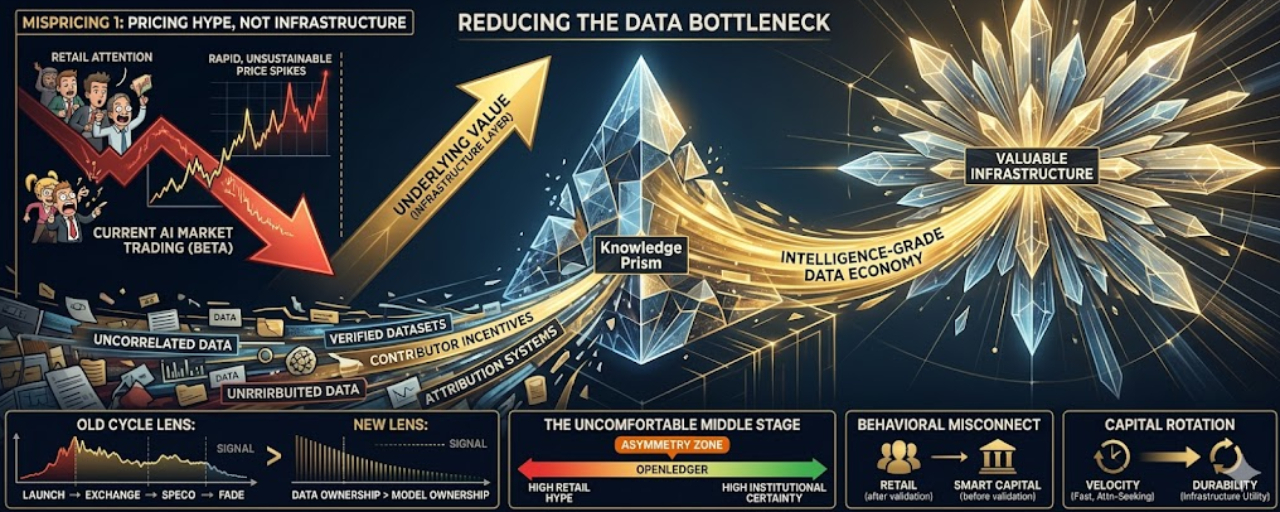

The market is treating OpenLedger like another AI beta trade. That’s the first mispricing.
Most participants still frame OPEN through the old cycle lens: launch hype, exchange listings, speculative momentum, then inevitable fade. But the more interesting question is whether the market is underestimating what happens when data ownership becomes more valuable than model ownership.
The Market Is Pricing AI Hype, Not AI Infrastructure
Retail attention flows toward visible AI products because narratives reward what people can immediately use.
But infrastructure layers historically outperform once speculation matures. We saw it in L1s, modular stacks, and GPU narratives. Attention starts at the surface, capital eventually migrates underneath.
OpenLedger sits in that uncomfortable middle stage:
Too infrastructure-heavy for retail excitement Too early for institutional certainty Too visible to stay ignored forever
That timing asymmetry matters more than current sentiment.
Most Traders Still Underestimate the Data Bottleneck
The industry talks endlessly about models. The harder problem is trustworthy data coordination.
AI output quality eventually converges. Distribution advantages compress. Open-source competition accelerates that pressure. What remains scarce is:
verified datasets attribution systems aligned contributor incentives
That shifts value toward networks capable of organizing data economically, not just processing it technically.
OPEN’s positioning becomes more interesting if the market rotates from “best AI model” toward “best AI coordination layer.” Those are completely different valuation frameworks.
The Real Opportunity Is Behavioral, Not Technical
Cycle veterans know this pattern well.
Retail usually enters narratives after social validation arrives. Smart capital enters when narratives still feel confusing, fragmented, or slightly premature.
OpenLedger currently lives in that zone.
You can see the disconnect clearly:
strong intellectual interest relatively weak speculative consensus low emotional attachment compared to meme-driven AI trades
Ironically, that often creates cleaner positioning conditions because expectations remain manageable.
Capital Rotation Hasn’t Fully Reached Utility Yet
Current AI capital flow still favors velocity over durability.
Fast-moving traders chase attention spikes, not infrastructure depth. But later-cycle rotations historically reward ecosystems that quietly built utility during speculative distractions.
That doesn’t guarantee OPEN wins.
It means the market may still be valuing it using the wrong phase assumptions.
If AI narratives evolve from entertainment toward economic coordination, networks solving contribution alignment suddenly become strategically important rather than conceptually interesting.
What Most Participants Are Actually Missing
The biggest misunderstanding is thinking OpenLedger is competing only against AI projects.
It may eventually compete against broken incentive systems across the broader data economy itself.
That expands the addressable narrative far beyond temporary AI speculation.
And markets consistently misprice transitions when a project changes categories before participants notice the shift.
The important question is no longer whether AI remains hot. The important question is which layers become indispensable after hype stops masking structural weaknesses. That’s where asymmetric positioning usually appears — before the market upgrades its mental model, not after.
