
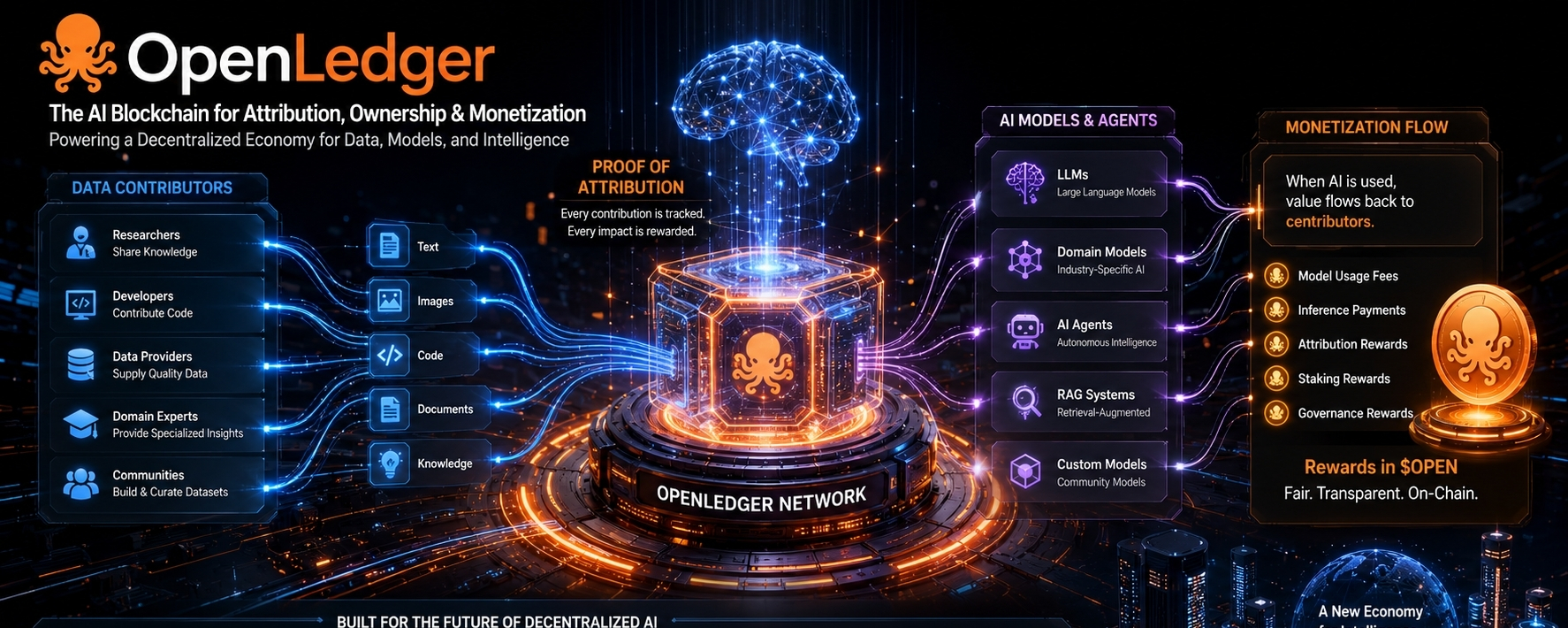
Artificial intelligence is rapidly becoming the foundation of the digital economy, but I think one of the biggest problems in the current AI industry is how unevenly the rewards are distributed. A small number of centralized companies control the majority of the infrastructure, datasets, model access, and profits, while the people who actually contribute valuable data, computational resources, or specialized knowledge rarely receive long-term compensation. This imbalance is exactly where OpenLedger tries to position itself differently. From my observation after reviewing its official documentation, ecosystem papers, tokenomics structure, and community discussions, OpenLedger is not simply trying to become another AI marketplace. It is attempting to redesign how AI value is created, tracked, and monetized.
What makes OpenLedger interesting is that it treats AI models as living economic assets rather than static software products. In traditional AI systems, a developer trains a model, deploys it through an API, and charges subscription or usage fees. The process is centralized, and most contributors behind the scenes are forgotten once the training phase is complete. OpenLedger introduces a very different idea. It creates an ecosystem where data providers, model developers, validators, infrastructure operators, and even inference contributors can continuously earn rewards whenever AI outputs are generated. I think this is one of the project’s strongest concepts because it recognizes that AI is not created by a single entity. It is built through layers of contributions from many participants.
The core infrastructure revolves around decentralized datasets called “Datanets.” Instead of relying entirely on massive centralized datasets collected by corporations, OpenLedger allows communities and individuals to contribute specialized data into decentralized repositories. These datasets can include industry-specific knowledge, curated text, labeled images, research information, or structured data for niche AI applications. What I find important here is the focus on specialization. Most large AI companies aim for generalized intelligence, but OpenLedger seems to believe that the future economic value of AI will come from domain-specific models trained on highly refined datasets.
This becomes even more valuable when combined with OpenLedger’s “Proof of Attribution” mechanism. From my perspective, this is the heart of the entire ecosystem. Modern AI systems have a major transparency issue because nobody truly knows which contributors influenced specific outputs. OpenLedger attempts to solve this by tracking how datasets contribute to model responses and distributing rewards accordingly. Whenever inference happens, contributors whose data influenced the result can receive token-based rewards. I think this creates something very close to digital royalties for AI contributions.
That idea may sound simple, but its implications are enormous. Right now, millions of creators unknowingly contribute to AI development without compensation. Writers, researchers, designers, educators, and communities generate the information that trains large models, yet the economic value flows almost entirely toward centralized AI firms. OpenLedger is trying to create an economy where contribution itself becomes monetizable. If the attribution system works efficiently at scale, it could fundamentally change how people think about data ownership and AI participation.
The OPEN token is designed to power this entire ecosystem. It functions as the payment layer for inference, governance, deployment fees, validator incentives, and contributor rewards. What I notice in the tokenomics design is the attempt to align incentives across every participant in the network. Developers earn when their models are used. Data contributors earn when their information influences outputs. Validators earn for securing and verifying the system. Infrastructure operators earn for supporting computational activity. This interconnected structure resembles decentralized finance systems, but instead of liquidity pools and swaps, the economic activity revolves around artificial intelligence.
I also think OpenLedger understands an important reality about AI monetization: infrastructure efficiency matters just as much as model quality. One of the largest costs in AI today is inference computation. Training advanced models is expensive, but serving millions of requests in real time is equally demanding. OpenLedger’s OpenLoRA framework appears designed to address this challenge by enabling multiple lightweight specialized models to operate efficiently on shared resources. From my observation, this strategy is smarter than trying to directly compete with centralized companies building trillion-parameter models. Instead, OpenLedger focuses on scalable specialization.
Another area where I think OpenLedger stands out is its positioning around decentralized AI ownership. Many blockchain projects mention decentralization as a marketing phrase, but OpenLedger attempts to integrate it directly into the economic architecture. Governance participation allows token holders to influence protocol development, ecosystem direction, and network parameters. More importantly, contributors are not separated from ownership. The people who provide value to the network can also participate in its long-term governance and growth.
Community discussions around OpenLedger often emphasize “data liquidity,” and I think that phrase captures the project’s broader ambition. Right now, enormous amounts of valuable data remain trapped inside private organizations, inaccessible ecosystems, or fragmented communities. OpenLedger wants to transform data into a productive digital asset that can generate continuous economic activity. In many ways, the project is treating datasets like decentralized capital markets treat liquidity pools. Data becomes an asset capable of generating yield through AI inference and attribution.
At the same time, I think it is important to recognize the technical challenges behind these ideas. Attribution inside large AI systems is incredibly difficult. Modern neural networks do not operate in simple linear relationships where you can easily identify exactly which dataset produced a specific output. OpenLedger’s vision depends heavily on its ability to create scalable and credible attribution systems. If attribution becomes inaccurate or manipulatable, the entire economic model could face trust issues. This is one of the biggest risks I see for the project.
Scalability is another challenge. Decentralized systems often struggle to match the speed and efficiency of centralized infrastructure. AI workloads require massive computational power, low latency, and stable execution environments. OpenLedger needs to prove that decentralized coordination can handle real-world AI demand without sacrificing performance. Competing against companies with enormous GPU infrastructure and billions in capital will not be easy.
Still, I think OpenLedger represents something larger than just another blockchain protocol. It reflects a growing shift in how people are starting to think about AI ownership. For years, the assumption was that only large corporations could build and monetize advanced AI systems. Projects like OpenLedger challenge that assumption by proposing decentralized alternatives where communities collectively create and profit from intelligence networks.
What makes this especially relevant now is the broader concern surrounding centralized AI dominance. As AI becomes integrated into finance, healthcare, education, research, and communication, questions about ownership and economic participation become more serious. If only a few companies control the infrastructure and data pipelines, then the future AI economy becomes highly concentrated. OpenLedger is trying to create a different model where participation is more open, rewards are more transparent, and contributors retain economic relevance over time.
From my perspective, the most valuable part of OpenLedger is not necessarily the blockchain itself. It is the attempt to create accountability and attribution inside AI economies. The project recognizes that intelligence is built collectively, and it tries to design financial systems around that reality. Whether OpenLedger achieves large-scale adoption or not, I think its ideas will influence future conversations about decentralized AI monetization.
In the long term, I believe AI economies will move toward systems that reward contribution more transparently. Developers, researchers, data providers, and infrastructure participants will increasingly demand ownership visibility and recurring economic participation instead of one-time payments. OpenLedger is positioning itself at the center of that transition by combining blockchain infrastructure with AI attribution mechanisms and decentralized economic incentives.