

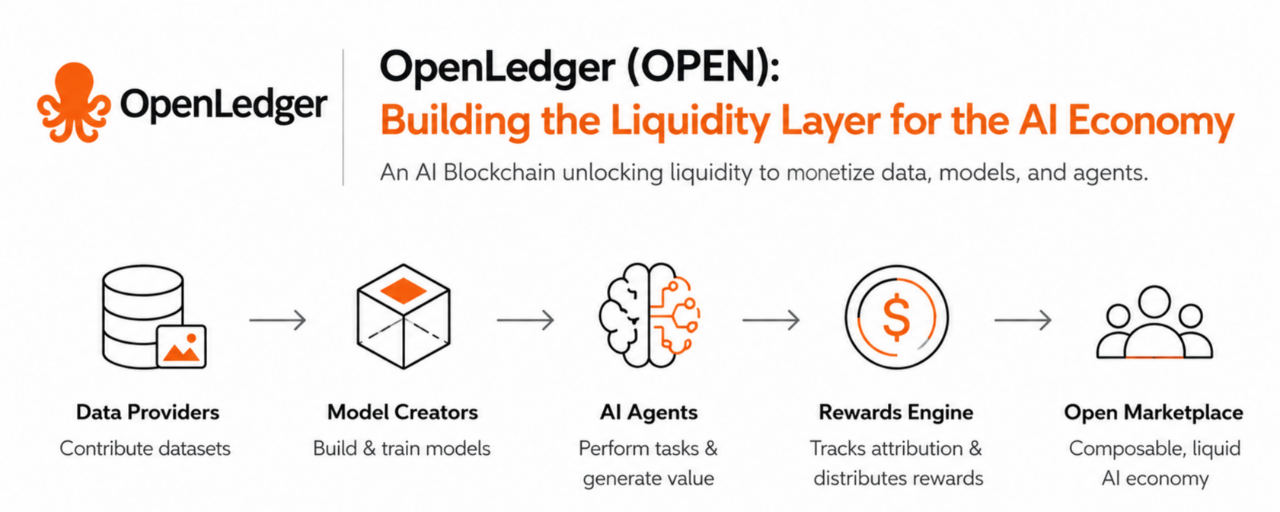
I still remember how often the market used to confuse *activity* with *durability*. In every cycle, there is a phase when anything with users, transactions, or a clean narrative is treated as if it has discovered the laws of gravity. Then the bid thins out, subsidies get exhausted, and one realizes the system was not earning demand so much as renting it.
That memory matters here.
OpenLedger presents itself in the familiar language of AI infrastructure: attribution, rewards, data contribution, model coordination, and on-chain settlement for machine-driven value creation. That framing is reasonable, even technically elegant. But the more interesting version is not just about accounting for AI outputs. It is about whether the system becomes a market structure for managing AI memory itself: what gets retained, what remains attributable, what can be proven later, and what should gradually be forgotten.
That is a much stranger and more economically serious problem.
Markets get excited about AI because intelligence sounds expansive. Infrastructure earns value, if it earns any at all, by doing the opposite: limiting ambiguity, reducing coordination cost, and making future disputes cheaper than they would otherwise be. OpenLedger’s hidden promise, if it has one, may not be intelligence. It may be persistence. Or more precisely, controlled persistence under economic rules.
## The first layer: the mainstream reading
The straightforward interpretation is simple enough. OpenLedger is building a blockchain layer for the AI economy. Data providers contribute datasets, model creators train systems, AI agents perform tasks, and a rewards engine distributes value according to usage and attribution. The platform’s purpose is to create an auditable marketplace where contributors can be compensated more fairly than in the usual black-box stack.
This is a coherent answer to a real problem. AI creation is increasingly modular. Datasets, fine-tunes, models, prompts, agents, and inference services all contribute to final output, but the economic claims around those contributions are messy. Who owns what? Who gets paid? What exactly was used, and for how long? The current AI economy often resolves those questions through platform power rather than transparent logic.
Blockchain enters as a proposal for legibility. Put the contribution record on-chain, attach rewards to verifiable usage, and you have a settlement layer for machine labor.
That is the pitch. It is not absurd.
But the market has learned to be wary of elegant pitches. Elegant pitches are usually strongest at the point where the real economic test begins.
## The more interesting version
The more interesting version is that OpenLedger may be trying to become a system for economically managing **AI memory**, not merely AI attribution.
That distinction is subtle but important.
In most current systems, memory is a technical feature. In a future AI economy, memory becomes an asset, a liability, and a source of governance conflict. If a model has been trained on something, how long does that influence last? If an agent learns from proprietary inputs, does the economic claim on that influence persist indefinitely? If a customer wants their contribution to stop mattering, can the network actually enforce forgetting? And if it can, what is the price of that forgetting?
Once you ask those questions, the project stops looking like a simple rewards layer and starts looking like a market for the lifecycle of machine memory.
That loop matters.
Because memory is not free. Retaining model influence creates storage, verification, compliance, and legal costs. It also creates future disputes. The more valuable AI systems become, the more people will care not just about who contributed, but how long that contribution should remain economically active. Provenance is not a static feature in that world. It is a living claim. Sometimes it must persist. Sometimes it must expire.
If OpenLedger can become the infrastructure through which memory is priced, attributed, licensed, renewed, or retired, then the token is not merely a medium for speculative participation. It becomes part of a recurring maintenance economy.
And maintenance economies are usually where infrastructure actually lives.
## Why memory may become a liability
The market likes to speak as if more memory is always better. In AI systems, that is not obviously true. Memory creates context, and context creates value. But memory also creates drag.
At scale, retained influence can become:
- a compliance problem,
- a provenance problem,
- a legal dispute,
- a model contamination issue,
- a reputational risk,
- a cost center.
A lot of the future AI economy may not be about adding more intelligence. It may be about deciding what influence remains active inside a model and what should be allowed to decay. In other words, controlled forgetting may become as economically important as learning.
That is where an infrastructure like OpenLedger could matter. If it can track contribution persistence, enforce time-based rights, or create a market for expiring influence, then it is addressing a very real class of operational pain. And operational pain is what creates durable demand.
The market often underestimates this because “memory management” sounds less exciting than “AI marketplace.” But boring things dominate the economics of infrastructure. The things that survive tend to be the ones that reduce future ambiguity.
## Economic cost of retaining model influence
There is an overlooked point here: retaining model influence may not be a one-time event. It may require ongoing maintenance.
If a dataset influences a model, and that model continues to generate revenue, then economically that influence may need to be accounted for repeatedly. If the rights to that influence expire, then the system needs to know when to stop paying. If the rights do not expire, then the liability compounds.
This is exactly where a token can become more than a speculative wrapper. It can become a settlement instrument for recurring economic obligations:
- renewals,
- access permissions,
- reputation locks,
- dispute resolution,
- verification costs,
- memory retention fees,
- forgetting or expiration payments.
That would be the desirable loop from a token perspective. Not just issuance for participation, but recurring sinks tied to the upkeep of the AI stack.
Markets get excited about adoption. But adoption is often front-loaded. Maintenance is slower, less glamorous, and much more monetizable if the system becomes indispensable.
## Attribution persistence and provenance disputes
Provenance is one of those words that sounds solved until money enters the room.
At the conceptual level, everyone likes attribution. At the commercial level, attribution becomes adversarial. If a model was partially trained on a dataset, what fraction of later value belongs to the contributor? If an AI agent uses a chain of models and prompts, who owns the final result? If a contribution is removed later, does past compensation get reversed, and if so, by what mechanism?
These are not just legal questions. They are market structure questions.
A credible attribution system must survive disputes, delayed claims, partial evidence, and bad-faith behavior. That means verification complexity is not a side issue; it is the core product. If attribution cannot be verified cheaply enough, it becomes too expensive to maintain. If it can be verified too easily, it becomes easy to farm.
And that is the tension.
A good system must be precise enough to be trusted and cheap enough to be used. Very few infrastructure tokens manage both. Most end up with either beautiful theory and weak usage, or strong usage under subsidy and no durable economics.
## What token demand actually looks like
This is where many market participants get lazy. They see a project with a token and assume the token is part of the value capture. That is not enough.
Token demand is only durable if it comes from recurring necessity. In OpenLedger’s case, that could emerge from several operational sources: staking for participation, fees for settlement, collateral for agents or model publishers, locks for attribution claims, or periodic payments for persistence and renewal.
That last piece is the most interesting. If memory or attribution rights need to be periodically renewed, then demand becomes continuous rather than episodic. That loop matters.
One-time participation is weak. Recurring retention is stronger. A marketplace that only charges at entry is easier to bypass than a system that sits inside the life cycle of the asset itself.
The token, then, would need to function less like a ticket and more like a maintenance instrument.
## Why maintenance economies matter more than intelligence narratives
Intelligence narratives attract attention because they sound like progress. Maintenance economies matter because they are where the bills are paid.
The AI stack will likely produce many layers of temporary excitement: model launches, agent launches, new copilots, new interfaces. But the durable layers are often the least glamorous ones: attribution tracking, provenance storage, dispute resolution, compliance, renewal logic, and settlement rails.
OpenLedger, if it works, may belong to that second category.
That matters because the second category is harder to substitute. Anyone can launch a theme. Fewer can build the infrastructure that makes the theme economically legible over time.
This is the difference between a platform and a toll system. A platform invites use. A toll system captures the repeated cost of use. The best infrastructure projects are often the ones that become invisible because they are embedded into repeated behavior.
## Risks: the familiar failure patterns
None of this should be mistaken for a clean bullish case. Infrastructure tokens fail in predictable ways.
The first failure is FDV pressure. The market can value the future far ahead of the present, and then the unlock schedule slowly reminds everyone that supply is real. If token emissions arrive faster than economic demand, the asset becomes a financing mechanism for early participants rather than a durable claims system.
The second failure is spoofed participation. Any token network built around rewards is exposed to farming, circular activity, and low-cost simulation of useful behavior. The more generous the incentives, the more aggressively the system gets optimized by actors who do not care about long-term integrity.
The third failure is enterprise friction. Large buyers dislike ambiguity. If attribution systems are too complex, too expensive to verify, or too hard to integrate into procurement and compliance workflows, adoption stalls. Enterprise users do not buy narratives. They buy reduced risk. If the operational burden exceeds the legal benefit, the system gets ignored.
The fourth failure is fragmentation. If memory rights, provenance claims, and settlement logic become too fragmented across participants, the network degenerates into coordination overhead. At that point the token may still trade, but the infrastructure value will be overestimated relative to actual economic necessity.
And the fifth failure is that the market confuses movement with retention. A project can have a strong launch, strong community energy, and strong speculative volume without creating a durable maintenance economy. Liquidity tells its own truth, but not always the truth the crowd wants to hear.
## Market behavior and reflexivity
The first market reaction to a system like OpenLedger will likely not be rational in a strict sense. It will be reflexive. Traders will price the possibility that AI needs memory infrastructure, that provenance disputes will grow, and that recurring settlement will become necessary. If the token begins to move, the move itself becomes a form of validation.
That is how these things work.
But reflexivity can only carry a project so far. At some point, the market asks whether the token is being used because the system is essential, or because the incentives are temporarily generous. That distinction becomes visible in retention, not headlines.
If participants stay after rewards normalize, the market may have found something real. If they leave, the project was likely subsidizing its own appearance of utility.
This is why institutional analysis of these systems should focus less on top-line user counts and more on operational dependency. Who needs the network every month? What does the token do that cannot be replicated cheaply off-chain? What recurring cost does it remove, and what recurring cost does it create?
Those questions matter because infrastructure value is usually a function of embedded friction. The network must solve a problem that comes back.
## Final unresolved question
OpenLedger may end up as a clean but ordinary AI attribution chain, useful mostly when incentives are strong and narratives are fresh. Or it may evolve into something more interesting: a market infrastructure for memory persistence, rights renewal, provenance disputes, and controlled forgetting in machine systems.
The second version is harder to build, harder to explain, and probably more economically durable.
But it is also easier to overestimate from a distance.
So the real question is not whether AI needs attribution. It does. The real question is whether the future AI economy will nee
d a persistent market for deciding what its models are allowed to remember, what they are required to forget, and who gets paid every time that memory is