
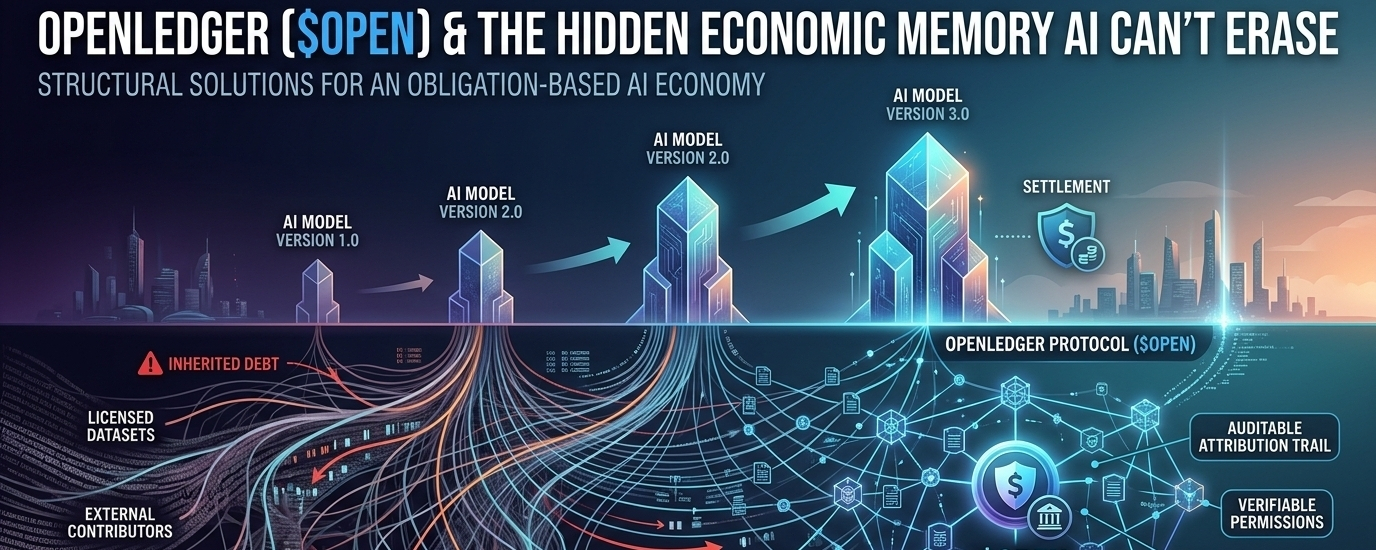
@OpenLedger Most people still analyze AI infrastructure as if it is only a technology race. The conversation usually circles around GPUs, inference costs, model accuracy, context size, speed, and distribution. Bigger models, faster systems, cheaper outputs. But the deeper AI moves into real business environments, the less convincing that framework starts to feel. Software upgrades are easy to imagine in theory because we assume new versions simply replace old ones and the system moves forward cleanly. Real commercial infrastructure rarely behaves like that. Old systems leave behind obligations, dependencies, licensing commitments, operational exposure, and legal baggage that continue existing long after the technology itself becomes outdated. That is the angle that makes OpenLedger ($OPEN) feel more important to me than most people currently realize, because the hidden challenge in AI may not ultimately be intelligence itself. It may be the economic memory attached to how that intelligence was built.
Imagine a future enterprise AI system that has been trained using multiple layers of licensed datasets, external contributors, specialized fine-tuning partners, retrieval systems, proprietary checkpoints, synthetic augmentation pipelines, and third-party integrations. Six months later a stronger version replaces it. On the surface, the old model appears obsolete. But economically, the situation may not be that simple anymore. Certain contributors could still retain usage-linked compensation rights. Some training agreements may continue applying even after a model upgrade if outputs still depend on earlier training lineage. Regulators are already becoming increasingly focused on provenance, which basically means proving where information originated and whether the underlying permissions were legitimate. Internal compliance teams care even more because unresolved attribution risk eventually becomes a financial problem. A newer model version does not necessarily erase the legal or economic fingerprints of the older one. In some cases, it may actually inherit them.
That starts looking less like ordinary software evolution and more like a system carrying embedded obligations forward over time. Not debt in the traditional balance-sheet sense, but something structurally similar. Financial markets understand this dynamic well. Obligations can survive long after the original asset changes form. Legacy systems continue costing money because replacing infrastructure rarely removes every dependency attached to it. Enterprises still maintain systems they no longer even like because operational continuity matters more than technical elegance. AI could evolve in a very similar direction. Every model upgrade may carry invisible layers of inherited permissions, contribution claims, licensing exposure, and accountability structures underneath the surface intelligence people interact with.
This is where OpenLedger becomes genuinely interesting to me, because its value may not come from simply helping people build AI. The deeper opportunity could be organizing and settling the economic relationships AI creates over time. The public narrative around OpenLedger is easier to digest because it focuses on attribution, contributor rewards, collaboration infrastructure, and specialized AI data systems. But historically, the most valuable infrastructure layers are often the ones that solve coordination problems nobody initially notices. The harder question is what happens once AI systems become dependent on continuous streams of external intelligence, licensed content, model refinements, agent interactions, and collaborative contributions spread across multiple generations of upgrades. At some point, businesses will need a reliable way to track who contributed what, under which conditions, and whether those permissions still remain valid after the system evolves. Once enterprise money, regulation, insurance exposure, and legal accountability enter the equation, that process stops being optional.
Manual reconciliation simply does not scale in that environment. Human teams cannot endlessly manage contribution histories through spreadsheets, fragmented contracts, and disconnected legal records once AI systems become deeply layered and autonomous. Think about a healthcare assistant model deployed across hospitals. One version may include proprietary medical research, another may rely on licensed healthcare datasets, another may absorb external specialist models, and another could integrate synthetic data refinement. The hospital using the system is not only concerned with output quality. Procurement teams will eventually ask whether deployment creates unresolved licensing risk. Compliance departments will demand traceability. Regulators may require explainability standards. Legal teams will want auditable proof that the model’s evolution did not violate historical agreements. The moment AI becomes commercially critical, inherited accountability becomes part of the product itself.
That is why OpenLedger potentially matters more as settlement infrastructure than as a standard AI utility project. If it can create machine-readable attribution systems where contribution history remains verifiable across evolving versions, then $OPEN may represent something closer to economic coordination infrastructure rather than just another speculative AI token. That distinction matters because pure usage narratives tend to weaken over time. Inference becomes cheaper. Open-source competition expands. Margins compress. Technical advantages decay faster than markets expect. But systems that reduce coordination costs often become more valuable as complexity grows. Financial infrastructure survives because trust, verification, clearing, and settlement remain difficult problems. AI could eventually create a very similar bottleneck around provenance and inherited rights.
The adoption path also feels more realistic when viewed from that angle. Startups may ignore these concerns initially because speed matters more than structure in early markets. Enterprises operate differently. Banks, insurers, healthcare operators, infrastructure providers, and regulated industries generally prefer systems that can be audited and defended later if something goes wrong. Not because they enjoy compliance, but because uncertainty eventually becomes expensive. That creates a real customer base for attribution infrastructure if the market matures in the direction many people expect. The difficult part is determining whether the token itself captures enough value from that infrastructure. A good business model does not automatically create strong token economics. $OPEN only becomes structurally important if staking, verification, settlement, or access coordination genuinely require the token layer. If enterprises move most processes off-chain or rely primarily on private legal agreements, token capture could weaken significantly.
Privacy creates another challenge. Large enterprises are unlikely to expose commercially sensitive training relationships or proprietary data dependencies publicly. Any serious attribution system therefore needs privacy-preserving verification rather than simple transparency. That is where concepts like zero-knowledge systems become relevant because they potentially allow organizations to prove rights or compliance without exposing the underlying data itself. But implementation complexity increases quickly, and complexity often slows adoption. Jurisdictional fragmentation complicates things further. AI regulation is evolving differently across Europe, the United States, and emerging markets. Infrastructure built around universal attribution assumptions may eventually discover that legal obligations are highly local and politically inconsistent.
The behavioral side may be the biggest uncertainty of all. Markets constantly assume that if a problem technically exists, businesses will immediately pay to solve it. History shows that is not always true. Companies often tolerate inefficient systems for years until a major failure forces structural change. Inherited AI obligation chains are logically plausible. Attribution infrastructure makes conceptual sense. Auditable settlement rails could eventually become essential. But timing matters enormously. Infrastructure can be directionally correct while still being commercially premature.
Still, the more I think about AI evolution, the harder it becomes to believe the future will function through clean replacement cycles where old models simply disappear. Complex systems rarely work that way. What tends to survive is not the old technology itself, but the obligations attached to the value it created. AI models may eventually operate the same way. Every training layer, every contribution, every licensed dataset, every external refinement could leave behind a trail of economic memory that continues existing long after the visible model changes. If that happens, then OpenLedger may not just be building another AI collaboration platform. It may quietly be building the settlement layer for the obligation economy AI creates as it scales.