I used to think bridges were mostly a technical detail. Move assets from one chain to another, connect liquidity, reduce friction, and everyone moves on.
But that view feels too simple now.
The more AI and crypto infrastructure overlap, the more I think bridges are not just about assets moving between networks. They are about whether users, builders, institutions, and even regulators can work with new systems without completely abandoning the habits and tools they already understand.
That is why the EVM Bridge angle around @OpenLedger caught my attention.
Not because bridges are exciting by themselves. They usually are not. But because they often decide whether good infrastructure remains isolated or becomes usable.
The real problem is fragmentation
Crypto already has too many separate environments. Users have assets on one chain, apps on another, liquidity somewhere else, and identity or reputation scattered across different systems.
AI infrastructure could easily make this worse.
If data, models, agents, ownership records, and settlement systems all live in separate environments, then the user experience becomes heavy. Builders have to integrate more tools. Institutions face more operational risk. Regulators see more unclear pathways. Costs rise because every connection needs custom work.
This is not just annoying. It slows adoption.
A builder may like the idea of monetizing data or deploying AI agents on OpenLedger, but if connecting existing EVM assets or workflows is painful, they may delay. A user may want access but avoid the process. An institution may reject the setup because the operational path looks unfamiliar.
So the bridge is not only a route between chains. It is a route between behavior people already have and infrastructure they may need next.
Why EVM compatibility matters
Ethereum and EVM-based ecosystems created a large base of wallets, contracts, tooling, liquidity, and developer habits. Whether someone likes that or not, it matters.
Builders already know how to deploy contracts, manage wallets, integrate dApps, and think in EVM terms. Users are familiar with common wallet flows. Institutions have spent years building internal procedures around custody, compliance, and transaction monitoring for EVM assets.
That existing base creates gravity.
For OpenLedger, which focuses on AI Blockchain infrastructure for monetizing data, models, and agents, an EVM Bridge could lower the psychological and technical distance between old workflows and new AI-native economic systems.
This matters because infrastructure adoption is rarely only about what is possible. It is about what feels manageable.
If OPEN mand the broader OpenLedger ecosystem can connect more smoothly with EVM environments, then builders may have fewer excuses not to experiment. Users may face less friction. Institutions may find it easier to evaluate the system using tools they already understand.
OpenLedger as AI infrastructure, not another isolated island
The important point is that @OpenLedger is not just trying to host another application layer. Its bigger idea is about unlocking liquidity around AI assets: data, models, agents, and the value they create.
That creates a settlement problem.
When AI systems use data, improve models, trigger agent actions, or generate economic output, someone needs to track contribution and distribute value. Without infrastructure, those flows often remain hidden inside private platforms.
A bridge does not solve all of that. But it can help connect the OpenLedger environment to broader crypto liquidity and existing user behavior.
That could matter for data owners who want compensation, builders who want access to capital and users, institutions that need clearer pathways, and regulators who care about traceable value movement.
In this sense, the EVM Bridge is not the headline. It is the doorway.
A practical example
Imagine a builder has an AI agent that helps e-commerce sellers analyze customer support tickets, product reviews, and inventory data. $POND
The agent uses several data sources, a specialized model, and a payment structure where contributors receive value based on usage. The builder wants to deploy the agent through OpenLedger because attribution and monetization matter.
But the builder already has users in an EVM ecosystem. Those users hold assets there, use familiar wallets, and do not want to learn a completely separate flow.
An EVM Bridge could make the transition easier. Users could access OpenLedger-related services without feeling like they are entering a disconnected environment. The builder could connect existing liquidity and user bases to AI asset monetization. Institutions watching the activity could have a clearer record of how value moves between systems.
The practical benefit is not glamour. It is reduced friction.
And reduced friction often decides whether real users show up.
The risk: bridges carry baggage
The cautious side is important.
Bridges have a long history of security issues, liquidity fragmentation, and confusing user experiences. Any bridge connected to AI infrastructure must earn trust carefully. If users feel unsafe moving assets, they will hesitate. If institutions see bridge risk as too high, they may avoid it. If regulators view cross-chain flows as opaque, compliance questions could increase instead of decrease.
There is also a product risk. A bridge can exist technically but still fail behaviorally. Users may not use it if the flow is complex. Builders may ignore it if documentation and incentives are weak. Liquidity may remain thin if there are not enough reasons to move.
So the EVM Bridge only matters if it becomes reliable, understandable, and useful in real workflows. $WLD
Grounded takeaway
The most likely users of OpenLedger’s EVM Bridge would be builders who already operate in EVM ecosystems, users who want simpler access to AI-related services, institutions testing AI asset infrastructure, and data or model owners looking for monetization paths without starting from zero.
It might work because people usually adopt new infrastructure faster when it connects to familiar tools, wallets, liquidity, and compliance habits.
It could fail or slow down if bridge security becomes a concern, if the user flow feels confusing, if liquidity stays shallow, or if builders do not see enough practical value.
That is why I see the EVM Bridge as more than a technical connector. It is a test of whether OpenLedger can meet the market where it already lives, instead of asking everyone to move all at once.
Not financial advice.
#OpenLedger $OPEN
Do you think AI blockchain ecosystems need EVM access to grow, or can they build strong adoption on their own?

Статия
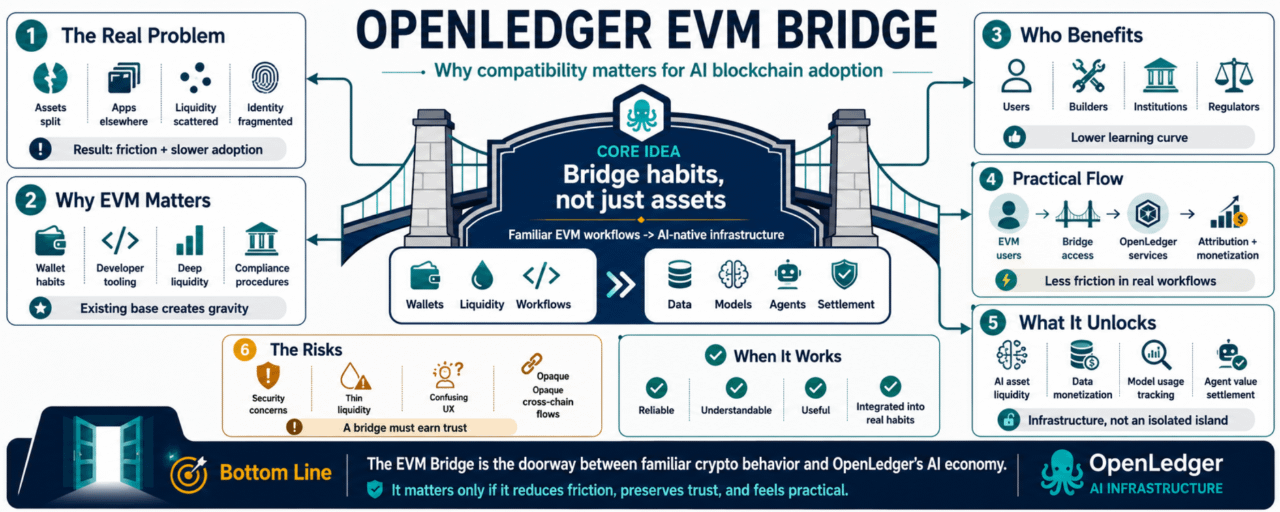
The EVM Bridge Question Is Really About Habits
Отказ от отговорност: Включва мнения на трети страни. Това не е финансов съвет. Може да включва спонсорирано съдържание. Вижте Правилата и условията.