
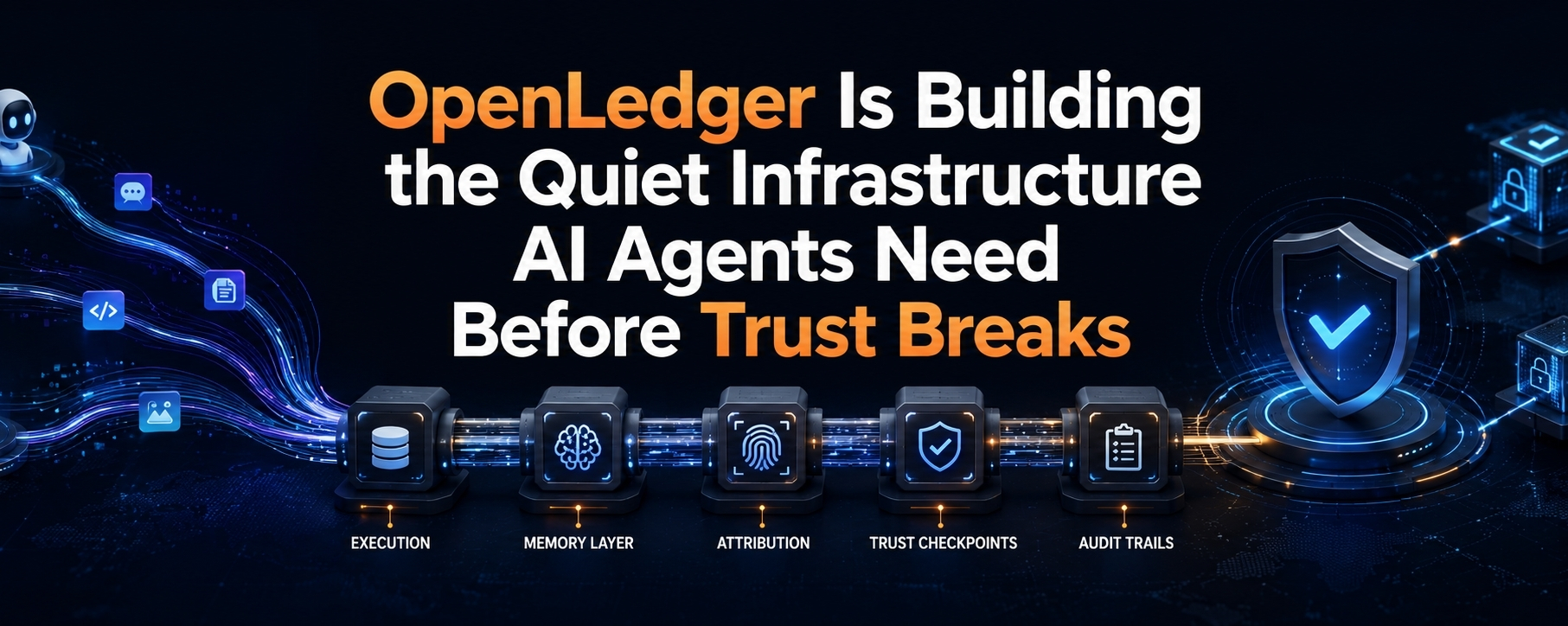

OpenLedger is one of those projects I do not want to judge too quickly, mostly because I have watched this market recycle the same shiny story a hundred different ways.
I’ve seen enough projects build around demos to know the difference. A demo is clean. A real system is ugly. Liquidity shifts. Users behave badly. Data gets stale. Models guess. Incentives bend. What looked smooth in a controlled environment starts grinding the moment it touches open markets.
That is where OpenLedger’s focus makes more sense.
The project is looking at AI agents less like chatbots and more like operators. That matters. An assistant can give you an answer and walk away. An operator has to act inside a system. It might read market data, use a model, call a workflow, trigger on-chain activity, or create value from someone else’s data. Once that happens, the agent is not just generating output anymore. It is participating in an economy.
And economies need rules.
Not pretty rules. Not marketing rules. Real ones.
Who gave the agent permission to act? What data did it use? Which model helped shape the result? Did the action actually happen? Who gets paid if the output creates value? Can anyone trace the path later, or is everything buried inside some private backend that only the team controls?
These are boring questions. That is exactly why they matter.
Crypto loves the loud layer. The chart. The narrative. The new meta. The promise that this time the machine is different. But the projects that survive usually end up dealing with dull, painful infrastructure problems. Settlement. Attribution. access. execution. incentives. The grind.
OpenLedger is trying to sit in that grind.
Its core idea is that intelligence should not be treated like some magical output floating in the air. AI output comes from somewhere. Data feeds it. Models shape it. Developers package it. Agents act on it. Users create demand around it. If value is created, the path should not disappear into fog.
That is the part I keep coming back to.
In most AI systems today, contributors vanish. Data gets absorbed. Models improve. Platforms grow. The people and sources that helped create the value become background material. OpenLedger is trying to push against that by making data, models, and agent activity more traceable and more economically connected.
Is that easy? No.
This is where I get skeptical. Attribution sounds good until you try to make it work at scale. Data is messy. Model usage is layered. Outputs are not always cleanly tied to one source. Agents may call multiple systems, reuse old memory, mix signals, and act under changing conditions. Anyone pretending this is simple is either selling something or has not looked closely enough.
But the problem is real.
AI agents without operational infrastructure are fragile. They can look impressive on the surface and still be weak underneath. They can summarize. They can suggest. They can automate a neat little task. Then you ask them to operate in a high-value environment and suddenly the soft spots show. Bad input. Weak memory. No audit trail. No clear permissioning. No fair reward path. No way to explain why an action happened except pointing at a black box and hoping nobody asks twice.
I do not think serious users will tolerate that forever.
Maybe casual users will. Casual users just want something fast. They want the shortcut. They do not care where the data came from until the answer fails them. They do not care about provenance until money is lost. They do not care about attribution until they are the ones being scraped, used, and cut out of the upside.
Power users are different. Builders are different. Funds are different. Protocols are different. Anyone letting an agent touch assets, workflows, or decision-making eventually starts asking for proof.
That is the market exhaustion talking, but it is also the truth. We have already seen what happens when systems hide too much. It works until it doesn’t. Then everyone suddenly wants transparency.
OpenLedger’s bet is that agents will need that transparency before they can scale into real utility. Not every agent action needs to be on-chain. That would be overkill, and crypto has a bad habit of putting things on-chain just to make a deck look better. But when an agent handles value, access, ownership, or execution, some kind of verifiable record starts to matter.
That is the useful part.
The project’s broader structure around data, models, agents, attribution, and operational rails is trying to create a loop. Better data supports better intelligence. Better intelligence creates more useful agents. Useful agents create demand. Demand rewards contributors. Rewards attract stronger inputs. In theory, the loop tightens.
In theory.
I always pause there because theory is where most crypto projects look best. The chart is clean. The docs sound confident. The roadmap has layers. The problem is traffic. Real usage. Real builders. Real demand that sticks when incentives cool down and the timeline gets boring.
That is what I’m watching with OpenLedger.
Not the slogan. Not the AI-agent label. Not the surface excitement around the category. I’m looking for the point where the system proves it can support agents that actually do something useful, repeatedly, under pressure, without collapsing into another rewards farm or narrative trade.
The agent economy idea is interesting, but it also needs to earn its weight. An agent paying another agent for a service sounds clean on paper. An agent using a specialized model and rewarding the data behind it sounds fair. An agent completing tasks and generating value through a traceable system sounds like the kind of infrastructure this space should want.
But I’ve seen plenty of elegant designs die from lack of demand.
So the real test is not whether OpenLedger can explain why AI agents need infrastructure. It can. The argument is solid enough. The real test is whether the project can make that infrastructure feel necessary rather than decorative.
That is a hard line to cross.
Because users do not wake up asking for operational infrastructure. They ask for results. Faster workflows. Cleaner execution. Less risk. Better data. More control. If OpenLedger can make those benefits visible without forcing everyone to think like infrastructure nerds, then it has a shot.
If not, it becomes another smart idea floating in a tired market.
I do think the timing is right. AI agents are getting more active. Crypto systems are already built around programmable value. The overlap is obvious, maybe too obvious. That is why there will be noise. There will be copycats. There will be projects that slap agent on everything and hope the market does not notice.
The market always notices eventually.
OpenLedger’s advantage, if it becomes one, is that it is focusing on the less glamorous part. The underneath layer. The part where data, models, permissions, execution, and rewards have to be wired together properly. Nobody claps for plumbing until the pipes burst.
That is why I’m not dismissing it.
Agents are powerful because they can act. That is also what makes them dangerous. Once an AI system can move through markets, workflows, and assets, vague trust starts to feel thin. You need structure. You need records. You need boundaries. You need attribution that does not vanish the moment value appears.
OpenLedger is trying to build around that reality.
Maybe it works. Maybe it gets buried under the same friction that has worn down so many ambitious crypto infrastructure plays. I’m not ready to call it either way.
But if AI agents really become economic actors, not just chat windows with better branding, then someone has to build the operating layer beneath them.
The question is whether OpenLedger can make the market care before the noise moves somewhere else.