
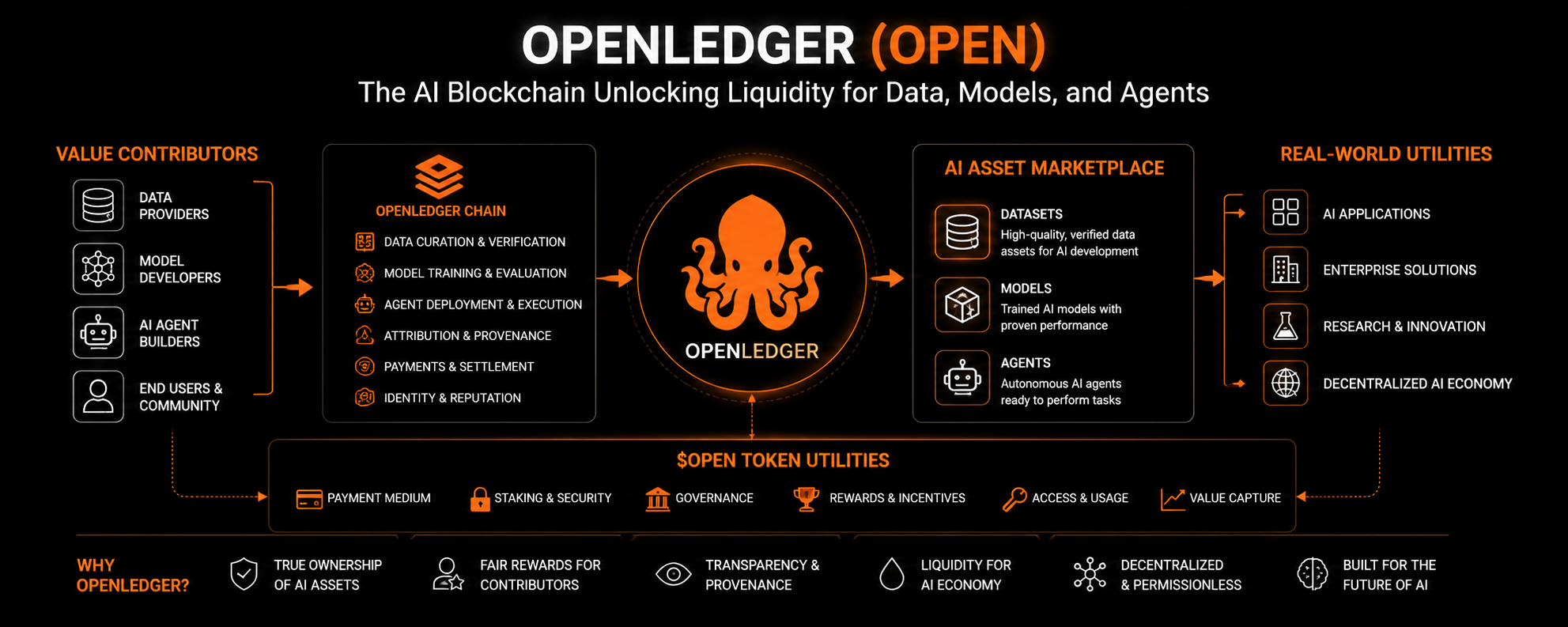
OpenLedger is the kind of project I end up thinking about too late at night, usually after reading too many whitepapers and watching the market recycle another narrative with a new coat of paint. I’ve seen DeFi promise a new financial world, GameFi promise ownership of play, modular chains promise cleaner infrastructure, AI tokens promise intelligence on-chain, and after enough cycles, I’ve learned not to get excited too quickly. So when I look at OpenLedger, I don’t want to just say “AI blockchain” and move on. That phrase is too easy now. What makes me pause is that OpenLedger is trying to touch something that actually feels unresolved: who owns the value behind data, models, and agents, and how that value moves when AI becomes more important than most people expected.
I’m curious, but I’m tired too. Tired of projects that sound correct in theory and then disappear when incentives dry up. Tired of dashboards that show activity but not real dependency. Tired of ecosystems where everyone is “building” until the rewards slow down and the Discord goes quiet. So with OpenLedger, I keep coming back to the same uncomfortable question: is this something people will actually need, or is it just another place where the market can park its AI excitement for a while?
The idea itself is not weak. That is the annoying part. It would be easier to dismiss if the thesis felt empty. AI does need better systems for attribution, data ownership, model monetization, and agent coordination. There is real value inside datasets, training inputs, domain knowledge, model behavior, and automated workflows. Most of that value is still messy, private, centralized, or invisible. OpenLedger seems to be trying to build a structure where these pieces can be tracked, monetized, and made liquid. On paper, that makes sense. Maybe too much sense, which is usually where I start getting suspicious.
Because crypto has always been good at turning difficult problems into clean language. “Unlock liquidity.” “Coordinate incentives.” “Monetize contribution.” These phrases sound elegant, but reality is uglier. Data is not automatically valuable just because it exists. A model is not automatically useful because it is linked to a token. An agent is not automatically important because it can perform some on-chain task. The value only becomes real when someone needs it badly enough to pay for it, use it repeatedly, and build around it without being bribed by emissions.
That is where I keep testing OpenLedger in my head. If someone contributes data, who wants it? If a model is created or improved, who depends on it? If an agent operates inside the network, what problem is it solving that was not already solved somewhere else? If OPEN is part of the system, is it actually needed for access, coordination, rewards, payments, or security, or is it mostly sitting beside the product as a market object? These are not small questions. They are the questions that separate infrastructure from narrative.
I don’t think OpenLedger should be judged too harshly just because it is early, but I also don’t think early-stage projects deserve automatic belief. Every cycle teaches that incentives can imitate usage for a while. People will upload, interact, stake, test, bridge, claim, and farm if they think there is something waiting at the end. That does not mean the network is alive in the deeper sense. A living network has users who come back because it helps them. It has builders who stay because the tools matter. It has economic activity that does not vanish the moment the reward pool shrinks.
And this is where OpenLedger gets interesting again, because if it can actually connect contributors, developers, AI models, and agents into one economic system, then it is not just chasing a trend. It is aiming at a real coordination problem. AI is becoming more centralized by the day. Large platforms control the data, the models, the distribution, and the monetization. Smaller contributors create value but rarely capture much of it. Developers need access to quality data and usable infrastructure. Users need trust. Agents, if they become meaningful, will need identity, permissions, payment rails, and reputation. There is a real gap there. I can see why OpenLedger wants to exist.
But wanting to exist and needing to exist are different things. That line matters. The market often ignores it during hype phases, but it always returns later. A project can have strong branding, good timing, and a believable thesis, and still fail to become necessary. OpenLedger has to prove that its infrastructure is not just conceptually elegant but practically useful. It has to show that data inside the network is valuable enough to attract demand. It has to show that models built around the system are not just technical showcases. It has to show that agents can create measurable activity. It has to show that OPEN is not only a speculative proxy for the AI narrative, but part of a working economic loop.
I keep thinking about trust too. AI already has a trust problem, and crypto does not magically fix that. Putting something on-chain does not make it high quality. Provenance is useful, but provenance of bad data is still bad data. Attribution is important, but attribution systems can be gamed. Rewards are powerful, but rewards can attract noise before they attract value. OpenLedger has to deal with all of that. It needs filters, reputation, verification, useful incentives, and some way to make quality matter more than volume. Otherwise, it risks becoming another marketplace where supply grows faster than demand.
Liquidity is probably the word that makes me slow down the most. Everyone in crypto loves liquidity because it sounds like life. But liquidity around what? Trading liquidity for OPEN is not the same as liquidity for data, models, and agents. Exchange volume can appear quickly if the story is strong enough. Real liquidity is harder. It means someone can bring a useful dataset into the system and find demand. It means a model can earn because people use it. It means an agent can perform tasks and create value. It means contributors are rewarded because their work matters, not just because the protocol needs activity charts.
That is the part I would watch carefully. Not the loudest announcements. Not the cleanest threads. Not the temporary excitement around AI. I would watch whether developers keep showing up after the first wave. I would watch whether real applications plug into the network. I would watch whether contributors earn from actual usage. I would watch whether the token has a role that feels unavoidable rather than decorative. I would watch whether OpenLedger becomes part of someone’s workflow, because that is when infrastructure starts becoming real.
There is also a bigger economic context here that should not be ignored. AI is not just another app category. It is becoming a layer of production, research, automation, finance, media, and decision-making. Governments are thinking about regulation. Institutions are thinking about data control. Companies are thinking about model access and ownership. Capital is flowing toward AI infrastructure because everyone can feel that something structural is happening. In that environment, a project like OpenLedger has a serious-sounding opportunity. But serious opportunity also brings serious standards. Institutions will not care about a token narrative if the infrastructure is unreliable. Developers will not stay if the tools are painful. Data providers will not stay if monetization is weak. Users will not care if the outputs are not useful.
So I’m left in this middle place with OpenLedger. I don’t want to hype it, but I also don’t want to ignore it. The thesis has weight. The timing makes sense. The problem is real. But the execution risk is huge, and I’ve seen enough cycles to know that “real problem” does not automatically mean “winning protocol.” DeFi had real problems to solve. GameFi had real user attention for a while. Modular chains had real technical reasons to exist. AI crypto has real energy right now. Still, only a small number of projects from any narrative become durable. Most become memories attached to old charts.
OPEN, to me, is still in the proving stage. It needs to prove that the network can generate usage beyond incentives. It needs to prove that AI assets inside the ecosystem can create demand. It needs to prove that contributors, developers, and users can form a real loop. It needs to prove that its token is not just a claim on future imagination but a working part of the system. Until then, I can respect the idea without surrendering to it.
Maybe that is the most honest way to look at OpenLedger right now. Not as a guaranteed winner, not as empty hype, but as a project sitting in a difficult and important part of the market. It is trying to answer a question that AI is making louder every day: who gets paid when intelligence is built from everyone’s data, models, and work? If OpenLedger can give that question a working economic answer, then it matters. If it cannot, then it becomes another well-written thesis that arrived during the right narrative and faded when the market asked for proof. Right now, I’m still watching. Not rushing. Not dismissing. Just trying to see whether there is real dependency forming underneath the story.
