

I remember looking at a project like this and thinking, okay, the tech sounds smart, but will people still care six months later? That’s usually the real test. OpenLedger is a good example. On paper, it’s trying to do something useful: turn data, model usage, and AI agents into something that can be tracked, attributed, and paid for onchain. Its official site says the chain is built to “unlock liquidity” across data, models, and agents, and its June 2025 paper says Proof of Attribution is the core mechanism behind that idea.
That part actually makes sense to me. A lot of AI projects talk big about decentralization but never solve the boring part: who contributed what, and who gets paid when the model uses it? OpenLedger tries to answer that with DataNets and attribution. In plain English, it wants data contributors to stay visible instead of disappearing into a black box. The pitch is simple enough. If the data matters, the people behind it should matter too. That’s not crazy. That’s just fair.
But here’s where the retention problem comes in, and I think this is the big one. A project like this doesn’t just need one-time curiosity. It needs people coming back again and again to contribute data, use the models, and keep the reward loop alive. If users show up once, test it, and leave, the whole system starts to look thinner than the narrative suggests. The retention problem is serious because the value engine is continuous usage, not a single transaction. No usage means no meaningful attribution events. No attribution events means fewer rewards flowing. And when that happens, the token starts losing one of its cleanest reasons to exist.
That’s why I pay attention to token stats here. As of May 27, 2026, CoinMarketCap lists OPEN around $0.185, with a market cap near $52.4 million, 24-hour volume around $18.6 million, and circulating supply at 290.8 million out of a 1 billion max supply. It also shows the token is still sitting way below its all-time high of about $1.83 in September 2025, which tells you the market has already cooled off a lot from the first wave of excitement.
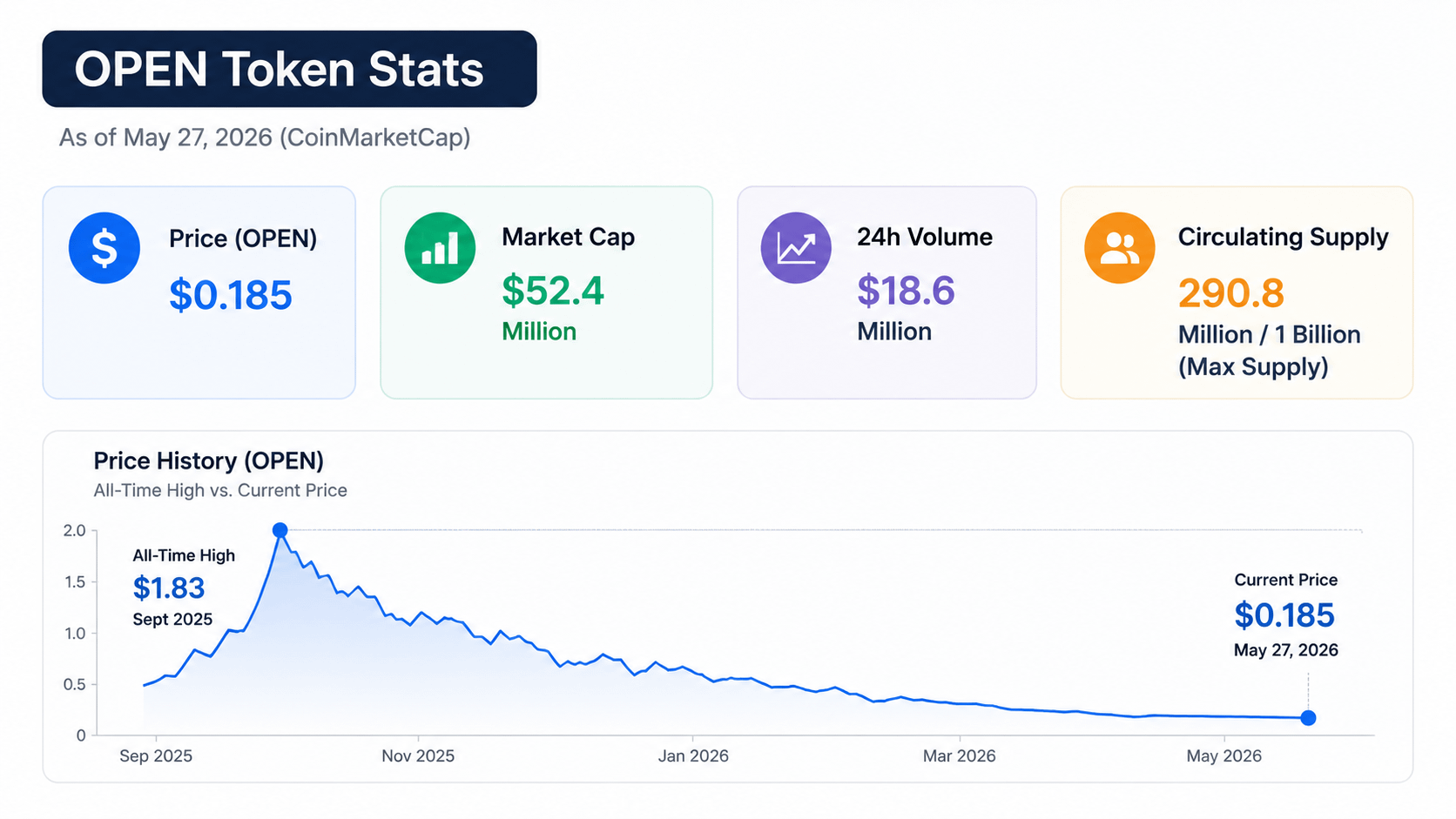
Now, numbers like that don’t prove failure. They just tell you the market is asking harder questions. A $52 million market cap is not tiny, but it’s also not the kind of size that forgives weak product use. If daily volume stays healthy while active users fade, that usually means traders are trading the story more than the product. And that’s a risk. A real one. Because when a token becomes mostly a narrative asset, any slowdown in attention hits harder than people expect.
I also think the middle of the story has a weakness that people should not brush off. OpenLedger’s model depends on very specific behavior: people have to care enough to contribute useful data, and then keep trusting that the reward system is worth the effort. That’s a lot to ask. Most users don’t wake up excited to manage attribution graphs or think about model provenance. They want something that works fast and feels obvious. If the product ever feels like extra work, retention gets ugly fast.
I’ve seen this movie before in crypto. A project gets a clean story, a decent launch, and a token that moves because traders like the theme. Then reality shows up. Usage has to survive the first wave, not just the first week. That’s why I don’t judge OpenLedger by whether the idea sounds clever. I judge it by whether the loop between data, rewards, and repeated use actually holds. If that loop breaks, the market notices fast. And if it holds, then the token has a real base, not just a headline. And that’s what keeps me cautious.
So is OpenLedger interesting? Yeah, I think so. The idea is real, the architecture is thoughtful, and the problem it’s chasing is not fake. But the retention issue is not a side note. It’s the whole game. If people keep using it, the token has a reason to matter. If they don’t, then all the attribution logic in the world won’t stop OPEN from drifting back into pure speculation. That’s the part I’d watch closely. Not the slogans. Not the hype. Just whether people come back tomorrow, and the day after that.