
OpenLedger with the kind of patience that feels necessary for any project trying to sit between AI, data, staking, and infrastructure. It is easy to look at its restaking mechanics and reduce them to yield, rewards, or another way for early users to position themselves before the network becomes larger. But that surface view feels incomplete. OpenLedger seems to be trying to build a system where people do not only participate because something is being distributed to them, but because their stake, their data, their attention, and their contribution all begin to matter inside the same network. That is a harder story to prove, and it is also the part that makes the project worth observing more carefully.
What stands out to me about OpenLedger is that it does not appear to treat AI infrastructure as something that can be built only through models or only through capital. It seems to understand that a useful AI network needs many quiet layers working together. It needs contributors who provide valuable data. It needs builders who can turn that data into usable applications. It needs infrastructure that can support activity without becoming fragile. It needs users who return after the first reward cycle. And it needs some form of economic alignment that gives people a reason to care about the system beyond one campaign or one announcement.
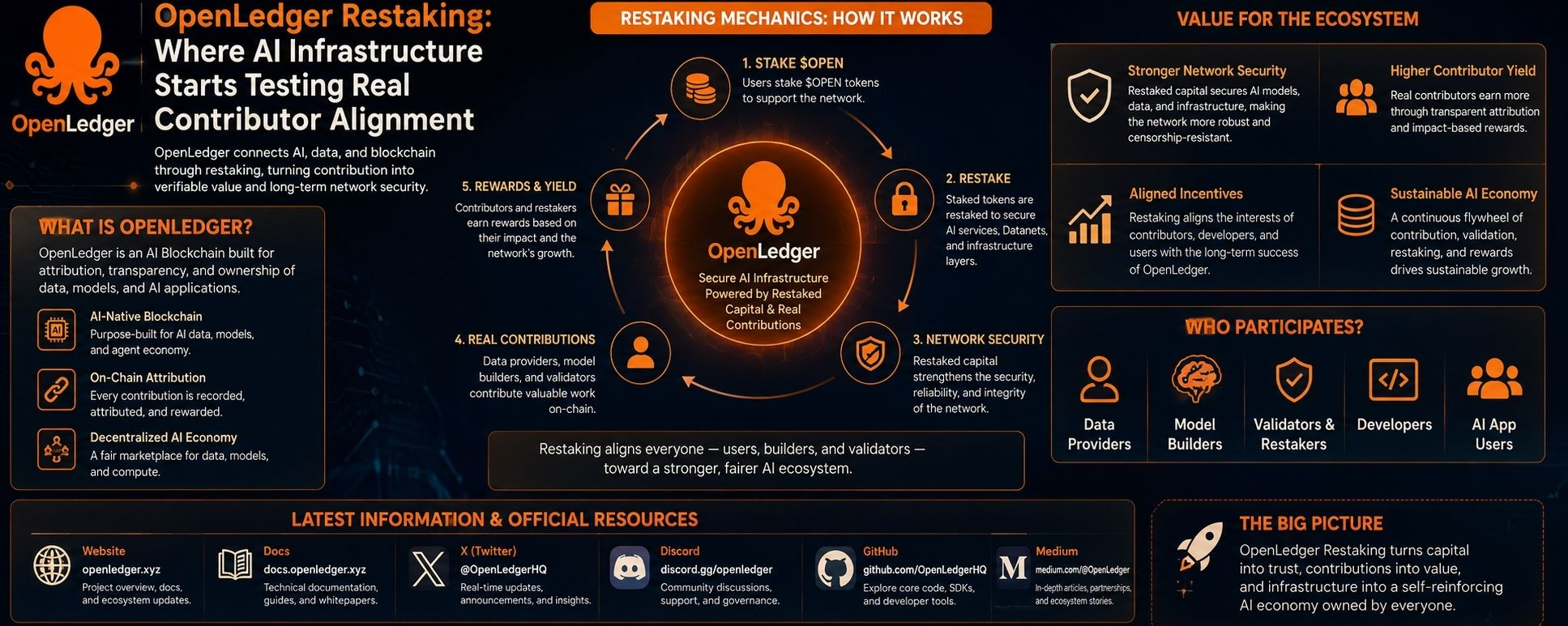
That is where restaking becomes important for OpenLedger. On the surface, restaking looks familiar. Users lock value, support the network, and expect some form of return. But underneath that, the mechanism appears to be part of a larger attempt to make participants more connected to the health of the project. When someone restakes, they are not only watching a reward number. They are also tying themselves, even slightly, to whether OpenLedger becomes secure enough, useful enough, and active enough to justify that commitment. The project is asking for more than attention. It is asking for a kind of patience that only makes sense if the network keeps developing in visible ways.
The interesting part is how this changes user behavior. A user who simply claims a reward may disappear quickly. A user who stakes may watch more closely. A user who restakes may begin to care about integrations, governance decisions, contributor activity, builder adoption, and whether the system is producing something real underneath the token mechanics. That does not mean every restaker becomes deeply aligned. Many will still arrive because yield is attractive. But OpenLedger’s design seems to suggest that even financially motivated users can become part of a broader security and coordination layer if the incentives are structured carefully enough.
What makes this difficult is that incentives can shape a community in both healthy and unhealthy ways. If OpenLedger rewards people only for being early, then the community may become dominated by people waiting for extraction. If it rewards only large capital holders, then smaller contributors may feel pushed to the edge. If it rewards activity without judging quality, then the network may appear busy while filling with weak signals. The project has to be careful because the same rewards that bring people in can also teach them how to game the system. A serious contribution economy needs more than participation. It needs useful participation.
OpenLedger’s focus on AI data and contributor value makes this especially important. In AI, not every contribution is equal. Some data is useful. Some data is noisy. Some feedback improves a model. Some activity only looks productive from the outside. A system like OpenLedger has to find ways to recognize the difference without becoming too complex for normal users to understand. That balance is not easy. If the rules are too loose, rewards lose meaning. If the rules are too strict, participation becomes inaccessible. The project appears to be moving through that middle area, where it has to encourage people to contribute while still protecting the quality of what is being built.
The deeper layer is that OpenLedger is trying to make AI contribution feel less invisible. Most people who interact with AI systems only see the final output. They do not see who provided the data, who improved the model, who evaluated the results, or who helped the infrastructure become more useful. OpenLedger seems to be working from the idea that these hidden contributions should have a clearer place in the economy. Restaking, in that sense, does not stand alone. It becomes part of the trust layer around a larger question: can a network make AI value more traceable, more secure, and more fairly distributed?
That question matters because trust in infrastructure forms slowly. OpenLedger cannot become believable only through announcements. It becomes believable when contributors keep returning, when builders find the tools useful, when integrations create actual activity, and when users can see that rewards are connected to something more durable than temporary hype. The healthier signal is not how loud the early community becomes. The healthier signal is whether the community begins to mature. Over time, the conversation needs to move from “what will I receive?” toward “what does this system actually help create?”
This is where OpenLedger’s community will likely reveal a lot about the project. Early on, people naturally focus on staking returns, reward eligibility, future token value, and how to position themselves. That is normal in Web3, and pretending otherwise would be unrealistic. But a project begins to change when the community starts asking deeper questions. Are the data networks useful? Are developers building with the infrastructure? Are AI applications finding a reason to connect with OpenLedger? Are governance decisions clear? Are contributors being rewarded in a way that feels fair? These questions are less exciting than reward speculation, but they are more important for long-term survival.
The architecture seems designed to pull different groups into one shared system. Stakers help secure the network. Contributors help improve the data layer. Builders create applications and tools. Users generate activity and feedback. Governance tries to keep the rules from drifting too far toward any single group. In a healthy version of OpenLedger, these roles reinforce each other. Better contribution improves the network. Better infrastructure attracts builders. Builder activity creates more demand. More demand gives staking and restaking more meaning. The loop becomes stronger because each participant type has a reason to care about the others.
But this is also where the risk sits. If one part of the loop becomes too dominant, the balance can weaken. If yield becomes the main attraction, OpenLedger may attract short-term capital without enough long-term contribution. If contributor rewards become too generous without quality control, the project may collect activity that does not improve the AI layer. If governance becomes too controlled by larger holders, smaller participants may stop feeling represented. If integrations are announced but not used, the infrastructure story may lose weight. The project’s challenge is not only growth. It is disciplined growth.
What stands out to me is that OpenLedger’s restaking mechanics seem to create pressure for the project to keep proving itself. Once people lock value into a system, they watch the system differently. They notice whether development continues. They notice whether partnerships lead to usage. They notice whether governance feels real or symbolic. They notice whether the project is building infrastructure or simply maintaining a narrative. That attention can be uncomfortable, but it can also be useful. A serious network should be able to withstand participants watching closely.
The more revealing thing is how OpenLedger handles the ordinary parts of infrastructure building. Big ideas are easier to announce than small systems are to maintain. AI data infrastructure requires clean contribution flows, reliable tooling, usable APIs, working wallets, developer support, and enough clarity for people to understand why they should build or contribute. Restaking can strengthen the security side, but the network still needs real activity worth securing. This is the part that cannot be rushed. Infrastructure becomes convincing when people use it repeatedly without needing to be constantly persuaded.
Over time, OpenLedger’s success may depend less on how attractive restaking looks at launch and more on whether restaking remains meaningful after the early excitement fades. If rewards are tied only to early momentum, the system may cool quickly. If rewards are tied to real network value, useful contribution, and security demand, then the mechanism becomes more grounded. That difference may not be obvious in the beginning. Many systems look active when incentives are fresh. The real test comes later, when users decide whether the project still deserves their time, stake, and effort.
The project appears to understand that AI infrastructure needs coordination as much as computation. Data has to come from somewhere. Models need to be improved. Applications need to be connected. Contributors need to be recognized. Security needs to be maintained. Governance needs to make tradeoffs without breaking trust. OpenLedger’s restaking mechanics seem to sit inside this wider coordination problem. They may help align participants around the network’s future, but they also increase the responsibility on the project to keep that future believable.
I also think OpenLedger is operating in a space where restraint matters. AI and Web3 both attract large claims, and when they are combined, the language can easily become too big too quickly. The stronger path is usually quieter. It is showing that contributors are useful. It is proving that builders can rely on the infrastructure. It is making integrations matter beyond the announcement. It is creating staking systems that support security without turning the entire community into yield hunters. OpenLedger’s long-term credibility will likely come from these slower signals rather than from the most dramatic parts of its narrative.
The deeper question is whether OpenLedger can keep its participants aligned as the ecosystem grows. Early communities often feel unified because everyone is moving toward the same expected upside. Later, the differences become clearer. Builders want reliable tools. Contributors want fair rewards. Stakers want security and return. Users want useful applications. Governance participants want influence. The project has to hold these groups together without letting one group extract too much from the others. That is not only a token design problem. It is a social and economic design problem.
This is why I see OpenLedger’s restaking mechanics as a test of maturity rather than just a feature. They can amplify network security, but they can also reveal whether the project has enough real activity to support deeper commitment. They can reward contributors, but only if the reward logic remains connected to quality and usefulness. They can attract early capital, but capital alone will not make the AI infrastructure valuable. What matters is whether restaking becomes part of a living system where security, contribution, and utility keep feeding back into each other.
For now, OpenLedger feels like a project still trying to prove the relationship between its ambition and its mechanics. The ambition is clear enough: build an AI-focused infrastructure layer where data, contributors, builders, staking, and governance are more connected than they usually are. The mechanics are where that ambition becomes testable. Restaking asks users to commit. Contribution systems ask users to provide value. Integrations ask builders to trust the rails. Governance asks the community to participate beyond speculation. Each layer adds weight to the project, but each layer also adds responsibility.
I’m still watching OpenLedger from that place of cautious interest. Not because restaking alone guarantees anything, and not because AI infrastructure becomes credible just by attaching rewards to it. I’m watching because the project seems to be working on the harder question of how people, capital, data, and trust can move through the same system without falling apart into short-term extraction. If OpenLedger can keep its incentives close to real contribution, its security close to real usage, and its community close to the work of building rather than only waiting, then its restaking mechanics may become more than a yield layer. They may become one of the quiet ways the network learns to hold itself together.