
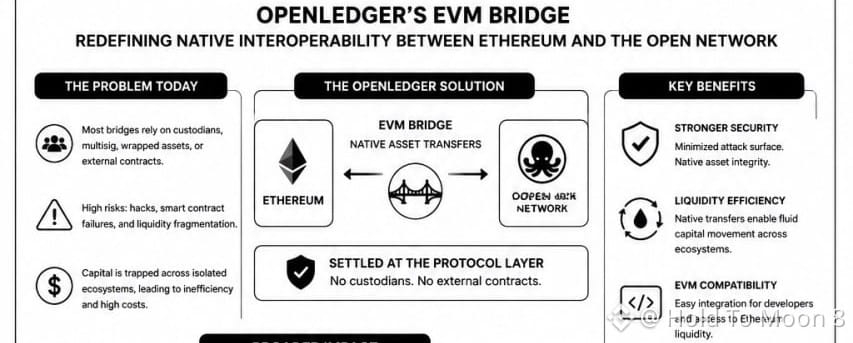
The launch of the OPEN Network EVM Bridge on Ethereum signals a deeper evolution in blockchain interoperability. In an industry where most bridges depend heavily on external validators, wrapped assets, or custodial mechanisms, OpenLedger introduces a fundamentally different approach: protocol-level settlement with native asset movement.
This distinction matters. Traditional cross-chain bridges have historically become one of the weakest points in decentralized finance, often exposing users to security vulnerabilities, fragmented liquidity, and operational complexity. OpenLedger’s EVM Bridge addresses these structural limitations by integrating interoperability directly into the network architecture itself. Assets are able to move between Ethereum and the OPEN Network without relying on centralized custodians or isolated external smart contracts.
By embedding settlement into the protocol layer, OpenLedger reduces unnecessary trust assumptions while improving transparency and execution reliability. The result is a bridge infrastructure designed not only for convenience, but for long-term scalability and security.
From a technical perspective, this creates several important advantages. First, native asset transfers minimize the dependency on synthetic representations and wrapped liquidity models that frequently introduce additional risks. Second, protocol-native settlement improves capital efficiency by reducing friction between ecosystems. Third, developers gain access to a more composable environment where Ethereum-based applications can interact with OPEN Network infrastructure more seamlessly.
For the broader DeFi ecosystem, this is a meaningful development. Liquidity fragmentation remains one of the largest inefficiencies in Web3. Users often face multiple interfaces, inconsistent execution layers, and complicated bridging experiences simply to move assets between chains. OpenLedger’s approach aims to simplify this process while preserving the core principles of decentralization.
The strategic significance extends beyond asset transfers alone. An efficient EVM Bridge creates the foundation for cross-chain applications, interoperable AI-driven finance, decentralized trading systems, and scalable on-chain automation. As ecosystems become increasingly modular, networks capable of enabling frictionless communication between chains will hold a major competitive advantage.
The OPEN Network is positioning itself not merely as another Layer-1 ecosystem, but as infrastructure focused on connectivity and programmable liquidity. The bridge is an early indication of that direction. By prioritizing native interoperability instead of relying on temporary middleware solutions, OpenLedger is building infrastructure intended for long-term adoption rather than short-term narrative cycles.
Importantly, the announcement also suggests that the network’s roadmap extends far beyond Ethereum integration alone. “The network does not stop here” implies a broader multi-chain vision where interoperability becomes a core operating principle instead of an additional feature. This opens the possibility for future integrations across multiple ecosystems, expanding liquidity access and developer reach over time.
In the rapidly evolving blockchain landscape, infrastructure that enables secure and efficient capital movement will become increasingly valuable. OpenLedger’s EVM Bridge represents more than a connection between two networks. It is a step toward a more unified decentralized economy where liquidity, applications, and users can move freely across ecosystems without sacrificing security, decentralization, or efficiency.
