
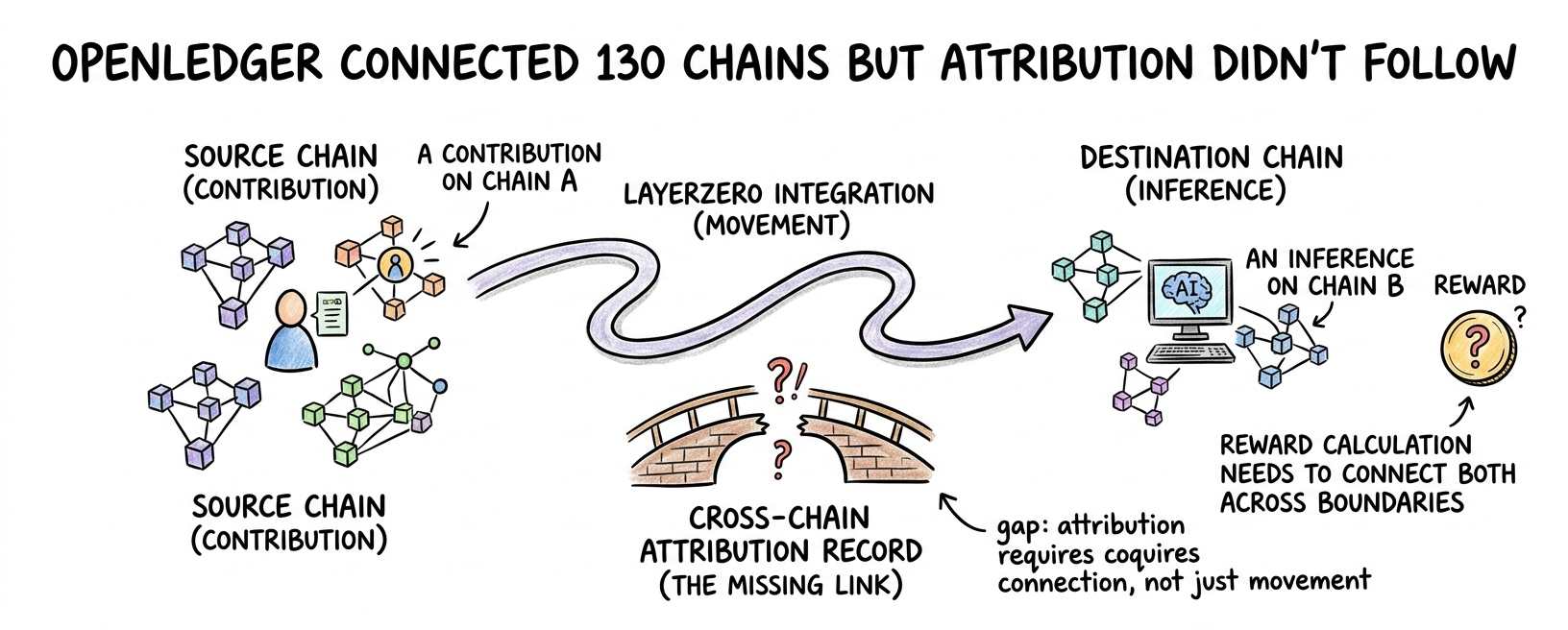
i went through the layerzero integration documentation a few days ago expecting a surface-level announcement. it wasn't actually. the technical depth surprised me. 130 chains connected. assets and data movement described with genuine specificity. for a protocol six months into mainnet this is more cross-chain infrastructure than most AI blockchain projects bother to build at all, let alone document carefully.
then i tried to trace what attribution looks like when a contribution and an inference happen on different chains.
the integration makes cross-chain data movement possible. a contributor on one chain can theoretically feed a datanet that trains a model deployed on another. that's the described capability and it's genuinely compelling it means openledger's contributor pool isn't siloed by chain, which is exactly the kind of network effect that makes a data marketplace valuable at scale. but the attribution system needs to connect those two events across chain boundaries to trigger a reward. the contributor event lives on chain A. the inference event lives on chain B. the attribution calculation needs to see both simultaneously to produce an accurate reward.
what i couldn't find in any public documentation was confirmation that the cross-chain attribution record actually exists in that form. 🔍
that gap matters in a specific way that the integration announcement obscures. layerzero enables the movement. attribution requires the connection. those are different infrastructure problems with different solutions, and solving one doesn't automatically solve the other. a protocol can have a fully functional cross-chain bridge and a fully functional single-chain attribution system while having an unresolved gap specifically at the intersection where an inference on chain B needs to credit a contribution that originated on chain A, and the attribution calculation has to bridge that gap without either record being on the same chain.
i watched something structurally similar happen with multichain defi protocols in 2020 and 2021. the bridges worked. assets moved. the yield calculations that were supposed to follow those assets across chains frequently didn't not because the bridge failed but because the accounting layer wasn't built to track cross-chain asset history. liquidity providers discovered this when they tried to claim rewards that the protocol's accounting had lost somewhere between the source chain and the destination. the infrastructure looked complete. the connection between two specific parts of that infrastructure was assumed rather than demonstrated.
openledger's layerzero integration may be at exactly that same point. the bridge is real. the attribution system is real. the cross-chain attribution calculation the specific mechanism that has to operate at the intersection of both is the part i can't find evidence of in any public form.
the genuinely strong element here is that layerzero itself is designed precisely for this kind of cross-chain state verification. omnichain messaging can carry attribution records alongside asset transfers, which means the technical infrastructure for cross-chain attribution exists within the integration openledger already built. the story protocol compliance partnership from january 2026 creates real incentive for enterprises routing legal AI workflows across chains to have verifiable attribution on both ends. those are reasons to believe the cross-chain attribution problem is being actively worked rather than ignored.
there is a version of this where i'm wrong. openledger could have implemented cross-chain attribution records as part of the layerzero integration in a way that isn't prominently surfaced in public documentation. the attribution engine update from january 2026 was specifically designed to maintain data-output links as models evolve which suggests the team was already thinking carefully about attribution persistence across state changes. if that engineering extended to cross-chain state changes, the gap i'm describing may already be closed and simply not announced.
what i'd want to see is not a technical description of how omnichain attribution could work. an actual on-chain record a contribution originating on one named chain, an inference on a different named chain, and an attribution reward that traces across both in a single verifiable sequence. that specific record, appearing from any cross-chain interaction since the layerzero integration launched in october 2025, would tell me the integration solved not just the movement problem but the attribution problem that movement creates. its absence doesn't mean the gap exists. but it means the most important question about what 130-chain connectivity actually delivers for contributors is currently unanswered and whether openledger's cross-chain reach is a feature or just a frontier depends entirely on which side of that question the answer lands on.
