
@OpenLedger I’ll be honest.
A lot of people still talk about AI as if it’s just another software product.
You open an app.
Type a prompt.
Get an output.
Simple.
But the deeper AI moves into real industries, the less accurate that view feels.
Because AI is no longer operating as a single isolated tool.
It’s becoming infrastructure.
And infrastructure changes the kinds of problems that matter.
At first, the challenge was building models powerful enough to generate useful outputs.
Now the challenge is becoming something bigger.
How do different datasets, models, agents, and contributors interact inside systems that are growing more complex every month?
That’s the layer where OpenLedger becomes interesting to me.

#OpenLedger isn’t only focused on making AI smarter.
It’s focused on organizing the economic and coordination systems forming around AI itself.
Because modern AI ecosystems are fragmented.
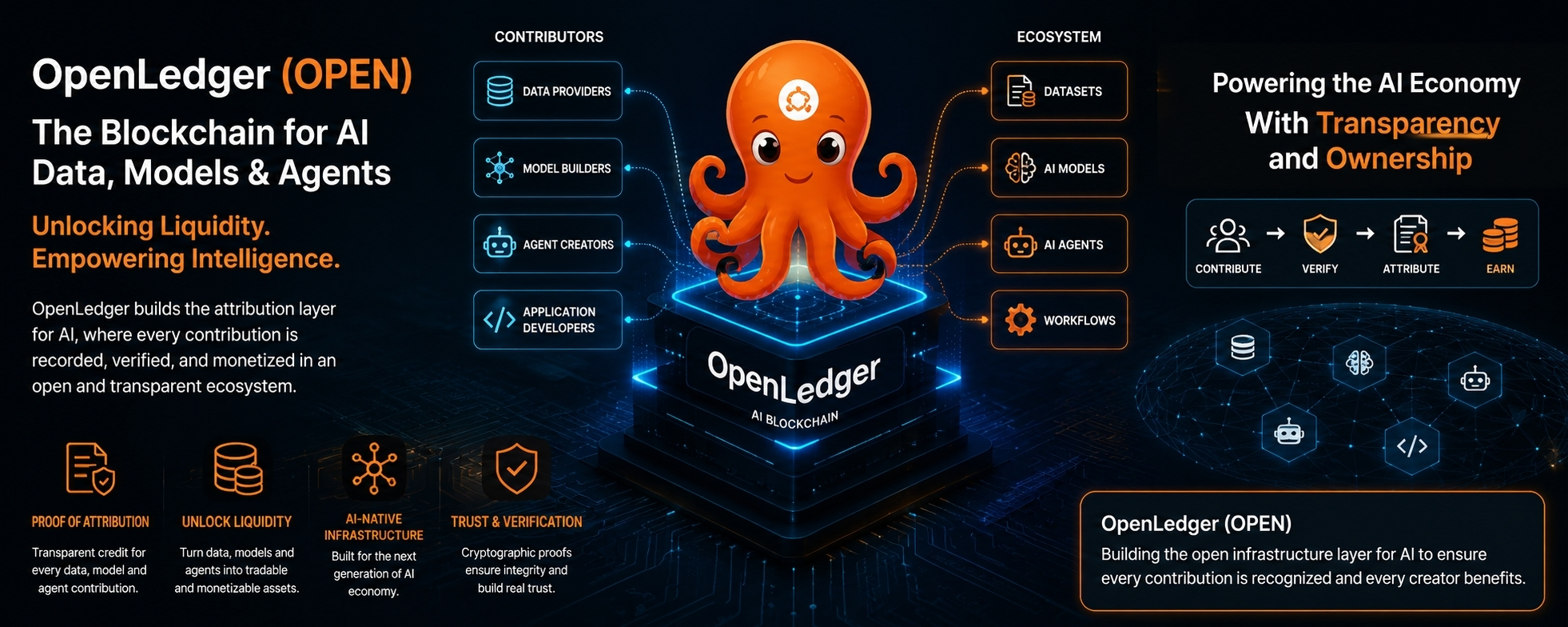
One group provides data.
Another fine-tunes models.
Another builds autonomous agents.
Another deploys applications on top of them.
Each layer creates value.
But most of that value moves through closed systems where attribution is difficult to track and contributors often disappear behind the final product.
As AI becomes more modular, that fragmentation only increases.
Specialized models are replacing one-size-fits-all systems.
Agents are beginning to interact across platforms.
Data itself is becoming a competitive asset.
Without coordination infrastructure, those ecosystems become difficult to manage.
That’s why OpenLedger’s approach feels more structural than speculative.
Instead of pushing every AI process onto blockchain infrastructure, the protocol focuses on anchoring important coordination layers.
Ownership records.
Dataset attribution.
Agent activity.
Model contributions.
Economic settlement.
Execution remains flexible.
Verification becomes shared.
That balance matters because AI systems require speed.
Inference, retrieval, and real-time interactions cannot depend entirely on network consensus.
OpenLedger’s architecture seems designed around that reality rather than ignoring it.
Another important part of the project is the idea of liquidity around AI assets.
Today, valuable data and specialized models often remain locked inside private ecosystems.
OpenLedger explores how those resources can become monetizable within an open network where contributors are visible instead of invisible.
In practice, that could reshape how AI economies function over time.
Because intelligence itself is becoming increasingly collaborative.
A single AI workflow may involve:
One dataset provider.
Another team building adapters.
Multiple retrieval systems.
Autonomous agents executing tasks.
Developers optimizing outputs for specific industries.
The final product may appear seamless.
But underneath it sits an entire network of contributions.
OpenLedger is essentially asking whether those contributions should remain hidden or become economically traceable.
The protocol also leans into agent-native infrastructure, which feels increasingly important.
Most digital systems today were designed assuming humans are the primary participants.
But AI agents behave differently.
They operate continuously.
They interact autonomously.
They move across systems without direct user commands.
Over time, they start functioning less like tools and more like economic actors inside digital environments.
Infrastructure built only for human participation may struggle to support that shift.
Of course, there are still difficult questions ahead.
Attribution in AI is complicated.
Governance systems remain imperfect.
And blockchain coordination itself is still evolving.
Not every contribution can be measured cleanly.
Sometimes the most valuable improvements come from tiny adjustments nobody notices at first.
But infrastructure does not become important because it is simple.
It becomes important because complexity eventually forces systems to organize themselves.
That’s probably why OpenLedger keeps staying in my head.
While most AI discussions focus on intelligence alone, OpenLedger is exploring the systems needed to coordinate the economies forming around that intelligence.
And if AI truly becomes foundational infrastructure across industries, the frameworks organizing trust, ownership, and value may matter just as much as the models themselves.
