
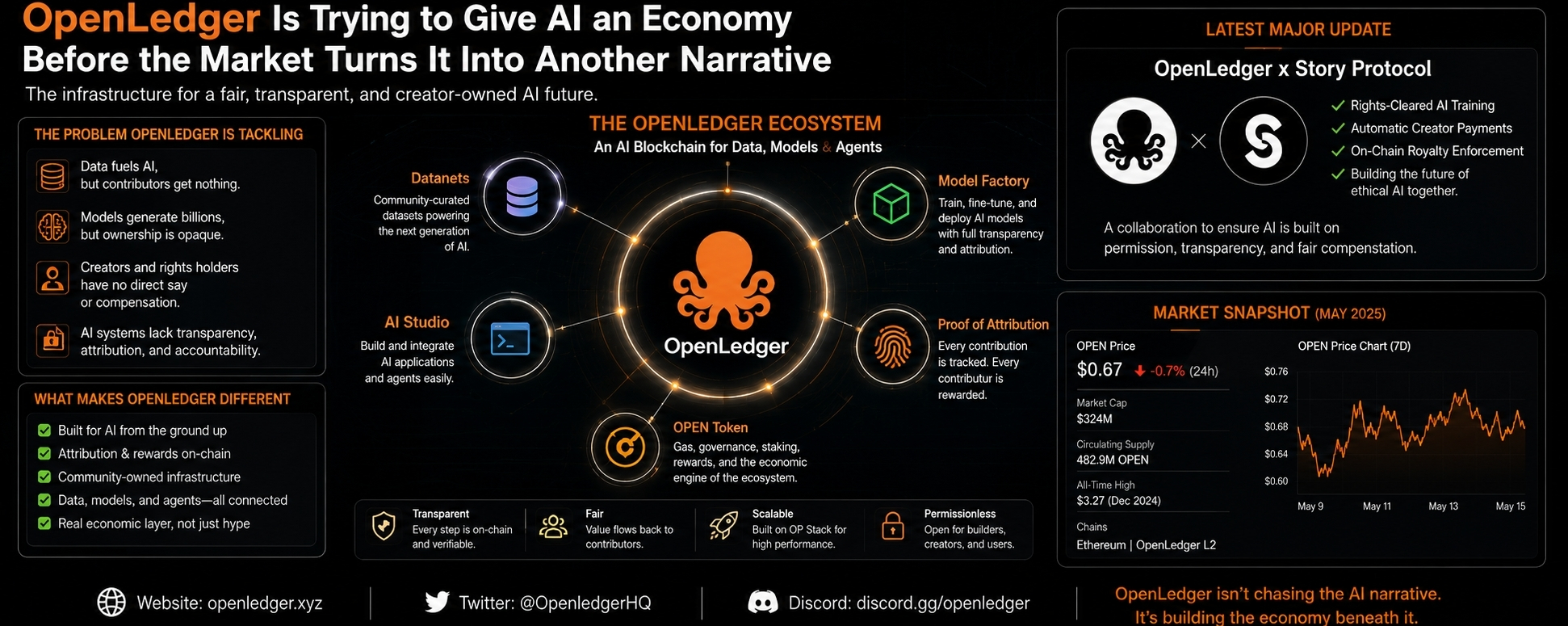
OpenLedger with mixed feelings, and that is probably the only honest way to look at an AI crypto project right now. I have seen too many projects wrap themselves in the language of intelligence while doing very little beyond chasing attention. So when OpenLedger says it wants to build around data, models, agents, and attribution, I do not immediately trust it. But I also do not ignore it. There is something more serious in the way it is trying to approach the problem, even if the market has not fully decided what to do with it yet.
OpenLedger is not interesting because it says AI is important. That part is easy. Everyone says that now. It is interesting because it is trying to deal with the part of AI most people avoid: where the value actually comes from. Models do not become useful from nowhere. They need data, structure, training, correction, testing, and constant improvement. A lot of that work disappears once the final product reaches the user. OpenLedger is trying to make that work visible and, more importantly, payable.
That is a difficult thing to build.
The project’s core idea sits around attribution. Not attribution as a nice word in a pitch deck, but attribution as an economic system. If someone contributes useful data, improves a model, or helps create intelligence that later gets used, OpenLedger wants that contribution to have a trail. The system is trying to remember who added value before the output existed.
That matters because AI has a quiet extraction problem. Data goes in, models improve, platforms grow, and the original contributors are usually left outside the economic loop. OpenLedger is trying to change that by building a network where data, models, and usage can connect through incentives. It is not a small idea. It is also not a clean one.
This is where I stay cautious.
Attribution sounds fair until it has to be measured. Who decides which dataset mattered? How much did one contribution improve a model compared to another? What happens when people upload low-quality data just to farm rewards? How does the system separate real usefulness from activity that only looks useful?
That is where things usually break.
OpenLedger’s Datanets are probably the most important part of the project to watch. The idea is that people can contribute specific datasets that help train or improve AI models in focused areas. This makes sense because AI does not only need more data. It needs better data. It needs cleaner, more useful, more specialized information. If OpenLedger can turn that into a working market, then the project becomes more than another AI token. It becomes a place where intelligence has a supply chain.
But supply chains only work when quality matters more than noise.
Crypto incentives can distort almost anything. A system that rewards contribution can attract serious contributors, but it can also attract people who are only there to extract rewards. That is not a small risk for OpenLedger. If the network fills with low-value data, fake activity, or short-term farming behavior, the idea weakens from the inside. The project does not just need users. It needs the right kind of users.
That is much harder.
The token, OPEN, also needs to be viewed carefully. It has roles inside the ecosystem, including gas, rewards, staking, governance, and settlement. On paper, that gives the token a reason to exist. But crypto has seen plenty of tokens with roles that never became real demand. A token can be deeply connected to a system and still struggle if the system itself is not being used in a meaningful way.
That is why OpenLedger cannot rely on the AI narrative alone.
The market has already become more tired than it was. Traders have heard enough about AI. Users have farmed enough points. Capital moves quickly now, and it does not wait around for long explanations. OpenLedger has to prove that people are using the network because it solves something, not just because there may be rewards attached to it.
This is where the project becomes interesting again. OpenLedger is not only trying to create another place to launch AI tools. It is trying to build the accounting layer behind them. If a model uses certain data, if an agent creates value, if an output comes from a chain of contributions, the project wants that value to be tracked and distributed. That is not glamorous, but it is important.
Most of the real economy is not glamorous.
I also think OpenLedger’s focus on rights-cleared AI and creator payments is worth paying attention to. AI will keep facing pressure around ownership, licensing, and compensation. People will keep asking who gave permission, who got paid, and who benefited. OpenLedger is trying to place itself inside that question before it becomes
unavoidable. That does not mean it will win. It means it is looking at the right pressure point.
Still, partnerships and frameworks are not enough. They can make a project look alive before real usage arrives. OpenLedger needs developers building on it, contributors returning to it, models improving through it, and payments moving through it in a way that feels real rather than staged.
Execution is where narratives go to die.
The project is ambitious, maybe too ambitious. Data contribution, attribution, AI model training, agent economies, governance, rewards, and creator payments are each difficult on their own. OpenLedger is trying to connect them. If it works, the system could become valuable because each part strengthens the other. If it does not, the same complexity could become the reason users leave.
That is the tension around OpenLedger.
I do not see it as something to blindly trust. I see it as a project asking a serious question in a market full of cheap answers. Can AI value be traced? Can contributors be rewarded without ruining quality? Can crypto make attribution useful instead of just making it tradable? Can OpenLedger build real economic activity beneath the AI narrative instead of becoming another token attached to it?
For now, I am watching the loop.
Useful data should lead to better models. Better models should lead to real usage. Real usage should create attribution payments. Those payments should attract better contributors. If OpenLedger can make that loop work, the project becomes much more interesting. If it cannot, the idea may stay intelligent while the market moves on.
That is the part I cannot settle yet.
OpenLedger feels like a project trying to build under the surface, where the harder problems are. But under the surface is also where weak systems disappear quietly. The question is whether OpenLedger can turn its theory into behavior before the market loses patience with another AI promise.