
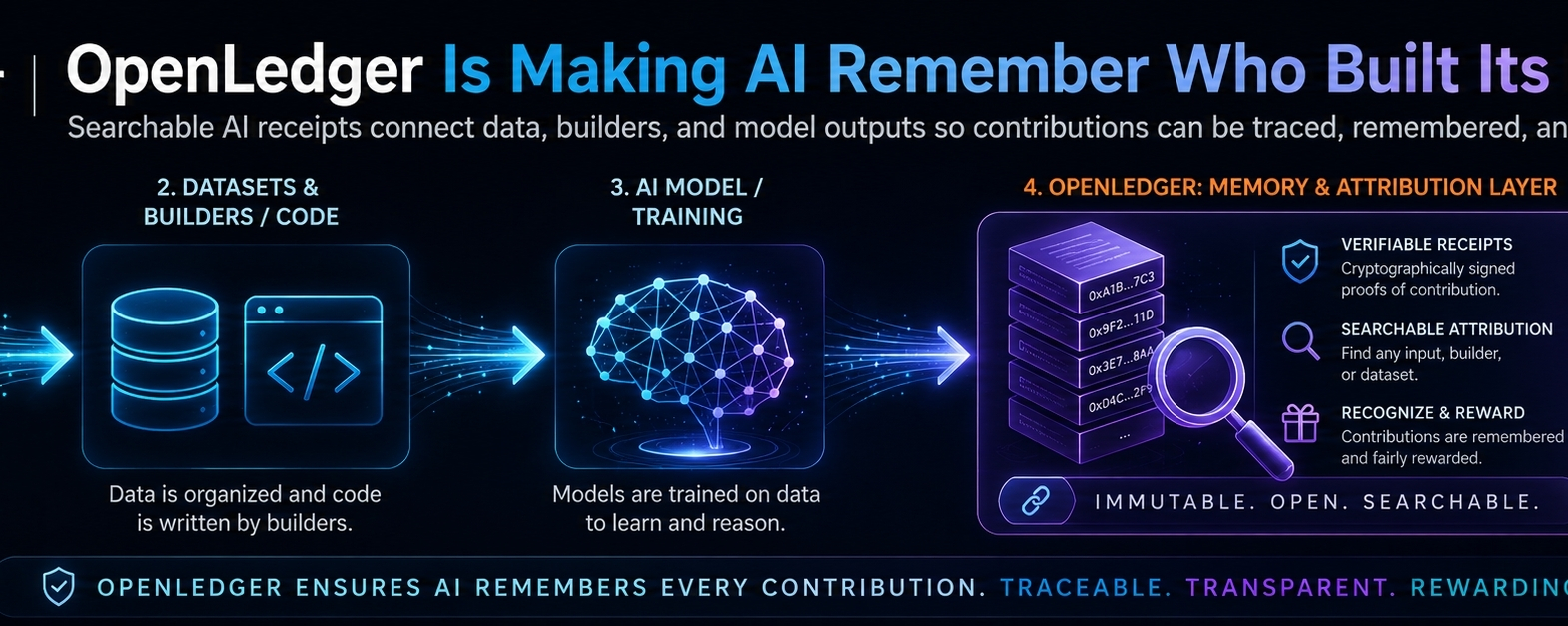
I’ve been noticing OpenLedger from the kind of angle that does not feel obvious at first. The project talks about AI receipts, searchable records, contribution tracking, and data infrastructure, but what keeps pulling my attention is not the language itself. It is the feeling underneath it. OpenLedger seems to be looking at one of the quiet problems inside AI: so much value is created by invisible inputs, but once the output appears, the trail behind it usually disappears. A model answers, an agent acts, a dataset improves something, a user contributes, a builder connects a tool, and most of that history gets flattened into a final result. OpenLedger appears to be trying to make that history harder to erase.
That is why the project feels more interesting when it is not treated as another AI infrastructure pitch. On the surface, OpenLedger is building around data, AI systems, attribution, and verifiable contribution. Underneath, it seems to be asking how an AI economy should remember the people and inputs that help it function. That difference matters. A receipt is easy to understand as proof that something happened. But inside OpenLedger, the idea feels bigger than that. It becomes a way to ask who contributed, what was used, what created value, and whether the system can carry that memory forward instead of leaving everything inside a black box.
What stands out to me about OpenLedger is that it starts from a very human discomfort. People are increasingly surrounded by AI systems that feel useful but difficult to inspect. They produce answers, recommendations, summaries, agents, workflows, and decisions, while the sources of that intelligence remain vague. In many cases, users do not know which data shaped the result. Contributors do not know whether their input mattered. Builders do not always know how value moves through the stack. OpenLedger seems to be trying to make those hidden paths more visible, not by making AI simpler, but by giving its activity a record that can be searched and understood.
The interesting part is that this changes the role of contributors. In a normal system, a person may provide data, feedback, domain knowledge, testing, or usage, and then disappear into the background. In OpenLedger’s model, contribution is meant to leave a trace. That trace may become part of how the network understands value. This is important because AI infrastructure does not only need more data. It needs better ways to know which data matters, who supplied it, how it was used, and whether it improved anything over time. OpenLedger’s focus on receipts seems to point toward that deeper coordination problem.
Underneath that, the project is dealing with incentives. Every ecosystem says it wants contributors, builders, users, and long-term believers, but the behavior it rewards is what truly shapes the community. If OpenLedger rewards only activity, people will chase activity. If it rewards useful contribution, people may begin to care more about quality. If it connects staking, governance, data, and builder participation carefully, then the system has a chance to attract people who are not only there for early speculation. This is where the project becomes more delicate. It has to make participation visible without turning visibility into a game.
That is not easy. Once people know that contribution can be tracked, some will try to optimize for being seen rather than being useful. This happens in almost every early Web3 ecosystem. Users farm tasks. Communities chase roles. Builders announce integrations before they are meaningful. Data contributors may focus on volume instead of quality. OpenLedger will likely have to deal with that same pressure. The healthier signal will be whether the project can separate real contribution from surface activity over time. A searchable receipt is only valuable if the system around it understands what the receipt actually means.
What makes OpenLedger worth watching is that its infrastructure seems aimed at a real gap between AI and ownership. AI keeps becoming more powerful, but the economic memory around it remains weak. Web3 has tools for ownership, verification, token incentives, wallets, staking, and governance, but it often struggles to connect those tools to actual utility. OpenLedger appears to be trying to bring those two unfinished worlds closer together. It is not only saying that AI should be on-chain. It seems to be saying that AI contribution should become traceable enough to support rewards, trust, and coordination.
The project’s focus on searchable AI receipts may sound technical, but the deeper issue is social. If people believe their work disappears into a machine, they eventually stop caring. If they believe the system can recognize useful input, they may stay longer, improve their contribution, and build around the network with more patience. That does not mean every contributor should be rewarded equally or instantly. It means OpenLedger is trying to create a structure where contribution is not automatically invisible. In an AI economy, that alone is a meaningful shift.
Over time, this could shape the kind of community OpenLedger attracts. Early on, it may bring in people who are curious about AI infrastructure, people who want to contribute data, builders looking for a new coordination layer, and users who are simply watching for potential rewards. That mix is normal. The real test is what happens after the early excitement becomes less fresh. Do the serious builders remain? Do data contributors improve quality? Do users find applications that feel useful beyond campaign tasks? Does governance become more thoughtful as more evidence appears? A project like OpenLedger becomes stronger only if the community matures with the system.
The more revealing thing is that infrastructure usually becomes believable slowly. It does not become real because of one announcement. It becomes real when builders can use the APIs without friction, when integrations produce repeated activity, when wallets and applications feel less confusing, when developers return because the tools solve a problem, and when users stop needing to understand every technical layer before they benefit from it. OpenLedger may be judged from the outside by visible milestones, but its deeper progress will likely show through quieter patterns of use.
That is why integrations matter so much for OpenLedger. Not every integration has the same weight. Some simply expand visibility. Others test whether the architecture can support real workflows. The meaningful ones are the integrations that make OpenLedger more useful inside AI applications, data systems, agent frameworks, or developer environments. If the project becomes something builders depend on rather than something they mention, then its infrastructure starts to feel more durable. The best sign is not noise around the integration. It is whether people keep using what was integrated after the announcement fades.
The architecture seems designed to make AI activity more accountable, but accountability also brings pressure. If receipts are searchable, the ecosystem can start asking better questions. Which contributions are actually improving models? Which datasets are being used? Which builders are creating tools that others rely on? Which applications are generating meaningful demand? Which parts of the network are active only because incentives are temporarily attractive? This kind of visibility can build trust, but it can also expose weak spots. That is part of what makes the idea honest.
OpenLedger’s challenge is that transparency alone does not create alignment. A record can show that something happened, but the system still needs judgment to decide whether it mattered. This is where governance and token design become important. Governance should not only be about voting on proposals. In a project like OpenLedger, governance may eventually become a way to define standards for useful contribution, data quality, model participation, staking responsibility, and ecosystem direction. Token systems can help hold long-term belief together, but only if they support behavior that strengthens the network instead of draining it.
This is where OpenLedger has to balance ambition with restraint. The ambition is clear: make AI contribution more visible, more traceable, and potentially more rewardable. The restraint is harder but just as important. The project cannot treat every record as equally valuable. It cannot assume that all activity is meaningful. It cannot let incentives move faster than the infrastructure can support. It has to build slowly enough that the system does not become just another points machine with AI language around it. The project appears strongest when it leans into this slower, more careful path.
What I find human about OpenLedger’s idea is that it deals with recognition. Behind all the technical language, people want to know whether their work counts. Builders want to know whether their tools matter. Data contributors want to know whether their input is being used. Users want to know whether the systems they interact with can be trusted. Communities want to know whether they are helping build something or simply creating momentum for someone else. OpenLedger does not fully answer all of that yet, but it seems to be building around the right question.
The risk, of course, is that the receipt layer becomes performative. If people treat receipts only as future reward tickets, the system may fill with shallow activity. If the market focuses only on token expectations, the infrastructure may get judged before it has time to mature. If governance becomes dominated by short-term participants, long-term builders may lose patience. These are not reasons to dismiss OpenLedger. They are the natural risks of building incentive infrastructure in public. The project’s ability to survive them will say more than any early narrative can.
Over time, the strongest signal will be whether OpenLedger can produce behavior that feels difficult to fake. Better data quality is difficult to fake for long. Builder retention is difficult to fake. Useful applications are difficult to fake. Repeated integrations that create real workflows are difficult to fake. A community that becomes more specific, more technical, and more thoughtful over time is difficult to fake. These are the signs I would watch more closely than surface excitement.
OpenLedger’s idea becomes more grounded when viewed as a system trying to help AI remember its own production history. That may sound abstract, but it touches something very practical. If AI keeps moving into finance, work, identity, research, commerce, and decision-making, people will want more than impressive outputs. They will want to understand where those outputs came from, who shaped them, and whether the system has a way to reward the inputs that made them possible. OpenLedger seems to be building toward that kind of infrastructure layer.
I do not see the project as a finished answer. It feels more like an experiment in making AI contribution visible enough to coordinate around. Some parts may work before others. Some incentives may need adjustment. Some participants may leave when the easy rewards are gone. Some builders may stay because the infrastructure helps them create something they could not build as easily elsewhere. That is usually how real ecosystems develop. They become clearer through friction.
For now, OpenLedger is interesting because it does not only ask people to trust AI. It seems to ask whether AI systems can earn trust by showing more of their own history. A searchable receipt does not solve the entire problem of attribution, ownership, or value distribution. But it may create a place to begin. And in a space where so much value disappears behind smooth outputs and confident interfaces, beginning with memory feels like a more serious step than it first appears.