
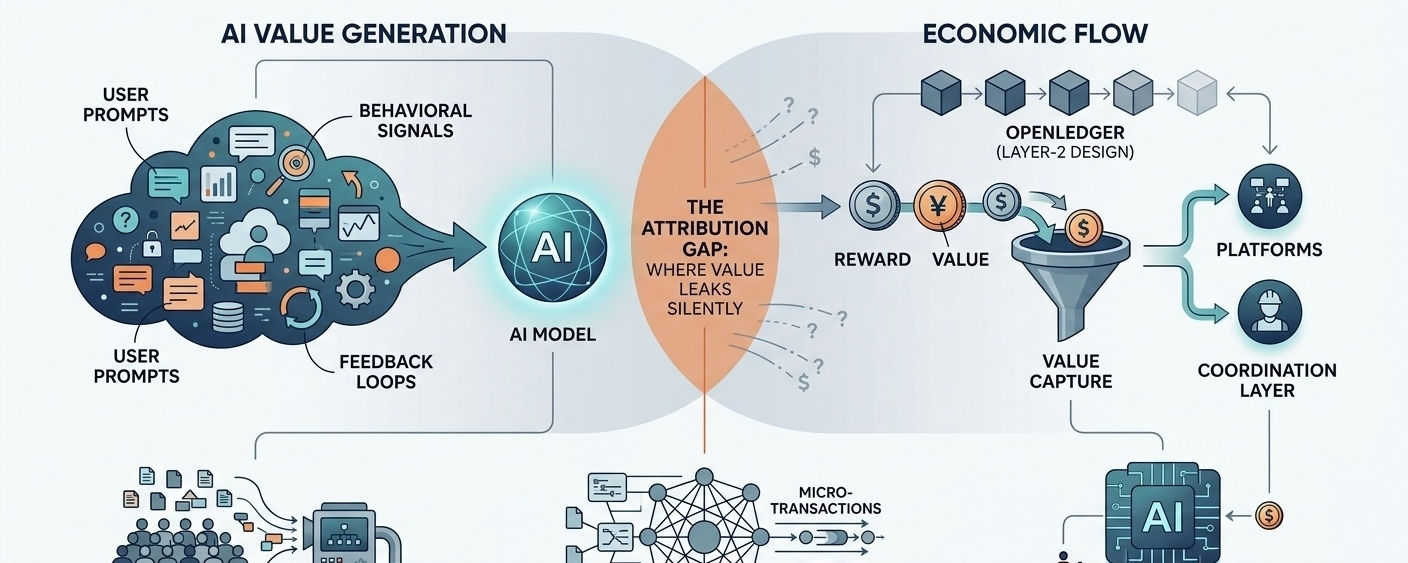
If AI is already creating value at scale, why does it still feel like nobody is actually being paid for the parts they contribute? The question stayed with me longer than expected while looking into OpenLedger and similar systems.
The more I look at this, the more it feels like two systems overlapping. AI generates outputs from collective behavior, while blockchain tries to record ownership and flow. But between them there is a gap where value leaks silently. It is not just a technical overlap, but an economic mismatch between how intelligence is produced and how it is priced.
The part most people miss is the attribution problem. Data, prompts, feedback loops… all of it builds intelligence, but ownership rarely traces back to contributors. That creates a strange tension in modern AI economies.
OpenLedger seems to be trying to sit inside that gap rather than just build another AI tool. A Layer-2 design with low-cost micro transactions might be an attempt to make attribution and rewards economically possible at scale, not just theoretical.
But then I keep asking who captures what. Users create signals, builders design models, platforms coordinate access… and value tends to concentrate at the coordination layer. Every layer takes a small cut, but the original contributor is often the most invisible in that chain. DeFi rails could redistribute that flow, or just add another abstraction on top.
I’m not fully convinced yet that systems like this scale cleanly. Micro-rewards sound elegant, but behavior rarely follows design. Costs, friction, and user attention might distort the model in unexpected ways.
Still, the direction feels important. If AI continues expanding, it may need financial infrastructure just to track contribution properly. Otherwise centralization becomes the default outcome again.
And maybe the real question isn’t whether this works today… but what kind of economy we are accidentally building underneath all this intelligence. I’m still thinking about what that means.
