
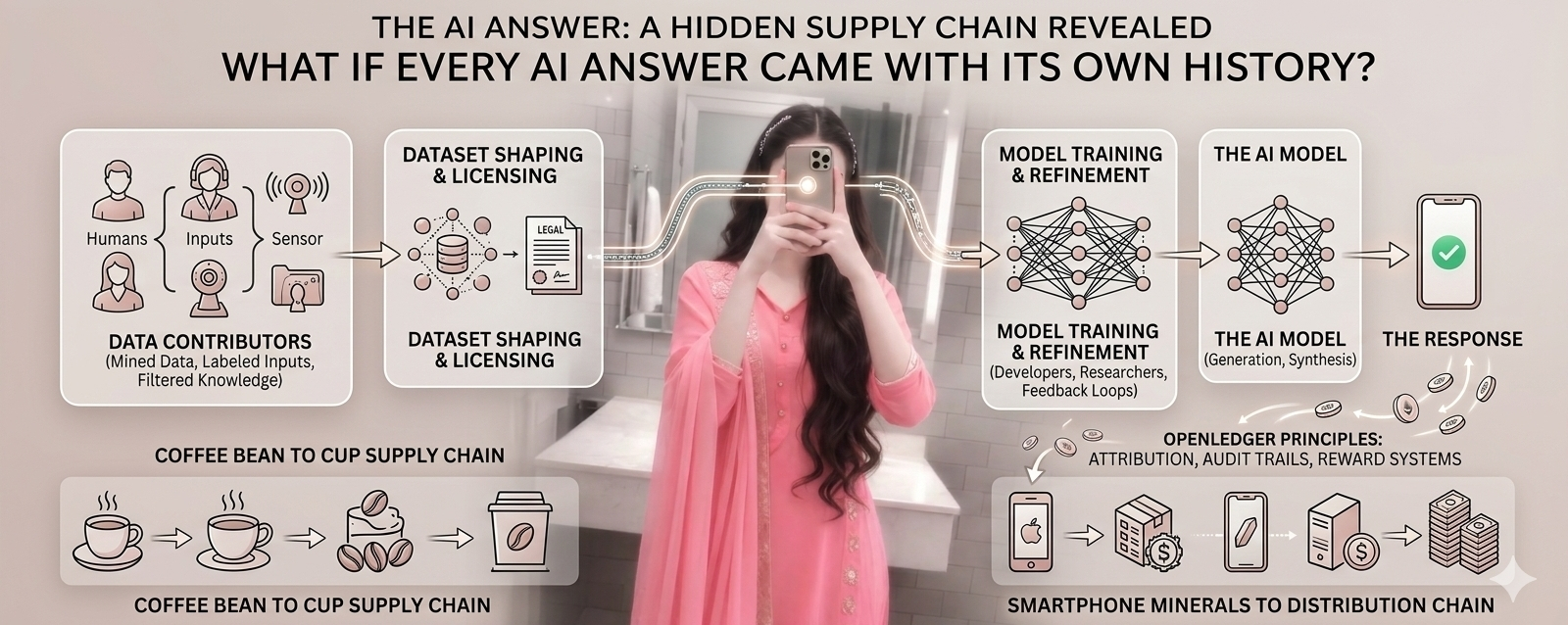
There is something about the current AI conversation that feels bigger and smaller at the same time. Bigger because the technology is moving into almost every corner of work, creativity, research, and daily life. Smaller because so much of the discussion still circles around the same few questions. Which model is faster? Which company released something new? Which benchmark went up? Which tool looks more impressive in a demo? These things are not meaningless, but after seeing the same arguments repeated again and again, they start to feel like surface-level noise. The part that feels more interesting to me is not just what AI can produce, but where that production actually comes from. Not the brand name on the interface, not the company behind the app, but the answer itself. The paragraph, the code, the image, the insight, the suggestion. Every AI response appears so cleanly on the screen that it almost feels like it arrived from nowhere, but of course it did not.
That is the strange thing about AI outputs. They are easy to consume as if they are simple commodities. You ask, the system answers, and the moment passes. Most people do not stop to think about the layers behind that answer because the whole experience is designed to hide those layers. The cleaner the interface becomes, the more invisible the process feels. Somewhere behind the response, there was data. Some of it may have been collected, organized, cleaned, labeled, filtered, licensed, contributed, or shaped by countless people and systems. There were models trained on top of that data, feedback loops that adjusted behavior, developers who built the tools, researchers who improved the methods, and users whose interactions helped refine the experience. Yet when the answer finally appears, all of that history collapses into one neat response. It feels instant. It feels complete. But it is actually the final point of a much longer chain.
In almost every other part of life, we understand that valuable things have origins. A phone is not just a phone. It carries a history of minerals, factories, chips, designers, transport networks, workers, packaging, software, and distribution. Coffee is not just coffee. It has soil, weather, farmers, exporters, roasters, baristas, and small decisions made across many stages before it reaches your cup. Even when we do not know every detail, we accept that a supply chain exists behind the product. With AI, that instinct is much weaker. The answer appears, and the chain behind it disappears. Maybe that is part of what makes AI feel magical, but it is also what makes it feel unfinished. The output is visible, but the path that created it is mostly hidden.
The more AI grows, the more this tension stands out. Intelligence is becoming cheaper, faster, and easier to access, but traceability is not moving at the same speed. In fact, the more advanced these systems become, the harder traceability can become. More datasets, more training methods, more fine-tuning, more models working together, more agents, more tools, more feedback, more invisible layers. Each new layer can make the final answer more useful, but also more difficult to explain. That may not matter much when someone asks for a simple caption or a quick summary, but it starts to matter when AI becomes part of legal work, financial decisions, research, education, healthcare, business strategy, and creative ownership. At that point, the answer alone may not be enough. People may start asking what the answer was built from.
This is why OpenLedger caught my attention. Not because decentralized AI is automatically a fresh idea. Every major technology wave eventually attracts a decentralized version, and many of those versions sound better in pitch decks than they do in the real world. What feels more interesting here is the attempt to treat AI output less like a random generated event and more like the last stage of a production process. In that view, the response is not just something produced by a model in isolation. It is connected to data contributors, datasets, model builders, networks, incentives, and ownership structures. The value does not only move forward to the user who receives the output. In theory, some of it can also move backward toward the people and resources that helped make the output possible.
The idea sounds simple when written in a straight line. Contributors provide data. Datasets help train or improve models. Models generate outputs. Outputs create value. Rewards flow back to the contributors. But systems involving real people rarely stay that clean. Contributors want fair compensation. Builders want flexibility. Users want speed and convenience. Governance participants want a say. Networks need to prevent low-quality data, spam, manipulation, and incentive games. Attribution needs to be detailed enough to matter, but not so complicated that nobody wants to use the system. This is where the real difficulty begins. The concept is easy to understand. The execution is where everything becomes messy. Still, that messiness is exactly what makes it worth paying attention to, because most important infrastructure ideas are not difficult because they are impossible to describe. They are difficult because they have to survive real-world behavior.
I keep imagining AI responses as a kind of receipt, but not a normal receipt that only shows payment. More like a historical receipt. A record attached to the answer that shows some version of the trail behind it. Which data helped shape this output? Which datasets were part of the model’s learning process? Which contributors added value along the way? Which model or system generated the final result? Who has a claim, a reward, or a role in that chain? Most users may not care to inspect this every time. Most people do not think about power plants when they switch on a light or banking rails when a transfer goes through successfully. But the existence of the trail can still matter, especially when something becomes important enough to require trust.
That is where the user behavior question becomes complicated. People often say they want transparency, but they usually choose convenience when transparency creates friction. This pattern shows up everywhere. Crypto, social media, privacy tools, finance apps, creator platforms, even normal consumer products. Users want the benefits of accountability, but they do not always want the extra steps that come with it. So maybe the real question is not whether every user will demand a visible AI supply chain. Maybe the real question is when the absence of one becomes too expensive. People may ignore the source of AI outputs until there is a dispute, a legal issue, a copyright problem, a failed decision, a hallucinated claim, or a question of ownership. Infrastructure often becomes visible only after it breaks.
If AI keeps moving deeper into the economy, that hidden trail may become harder to ignore. Businesses may need to know whether outputs are based on licensed or reliable data. Researchers may need stronger provenance before trusting AI-assisted conclusions. Creators may want compensation when their work helps train systems that produce value. Enterprises may demand audit trails before allowing AI into sensitive operations. Regulators may ask where a decision came from and who should be responsible when it causes harm. In those environments, usefulness alone may not be enough. A response may need context, origin, accountability, and a clearer connection to the chain that produced it.
That is why the OpenLedger direction feels interesting without needing to be surrounded by hype. It is not only trying to talk about intelligence as something that becomes faster or more powerful. It is looking at intelligence as something that may need accounting, attribution, and reward systems behind it. The performance side of AI will keep getting attention because demos are easy to understand. A better model is exciting. A faster agent is exciting. A new tool that generates something impressive is exciting. But the accounting layer underneath intelligence may become just as important over time. If AI creates value from many hidden contributors, then sooner or later someone has to ask how that value is tracked, recognized, and distributed.
I do not know whether every AI answer will eventually carry a visible supply chain. I do not know whether normal users will care enough to demand it. I do not know whether the added complexity will make sense for every type of output. Some answers probably do not need deep provenance. Some use cases may only need basic attribution. Others may require serious traceability because the stakes are higher. The market will probably not move in a clean, predictable line. It rarely does. But the question itself feels important because it points to something that is missing from the current conversation. We talk a lot about what AI can do. We talk much less about what AI is made of.
Maybe the future of AI is not only about better answers. Maybe it is also about making the history behind those answers less invisible. Not in a way that slows everything down or turns every interaction into a technical report, but in a way that gives contributors, builders, users, and institutions a clearer understanding of how value is created. A good answer may still be judged by usefulness first, but usefulness may not always be enough. In high-stakes environments, people may want to know the trail behind the output. They may want to know whether the system can be trusted, whether the data was legitimate, whether contributors were rewarded, and whether ownership was respected.
That is the reason the idea keeps staying in my mind. Not because it has a clean ending. Not because OpenLedger has already solved every problem. Not because users are suddenly going to wake up tomorrow demanding supply chains for every AI response. The interesting part is that the question feels early, uncomfortable, and probably more important than it looks. What happens when an AI response is no longer just an answer, but the visible end of a long chain of data, models, contributors, incentives, and ownership? I do not know the answer yet. But the fact that the question keeps coming back is enough to keep watching. Sometimes curiosity is a better signal than excitement.
