
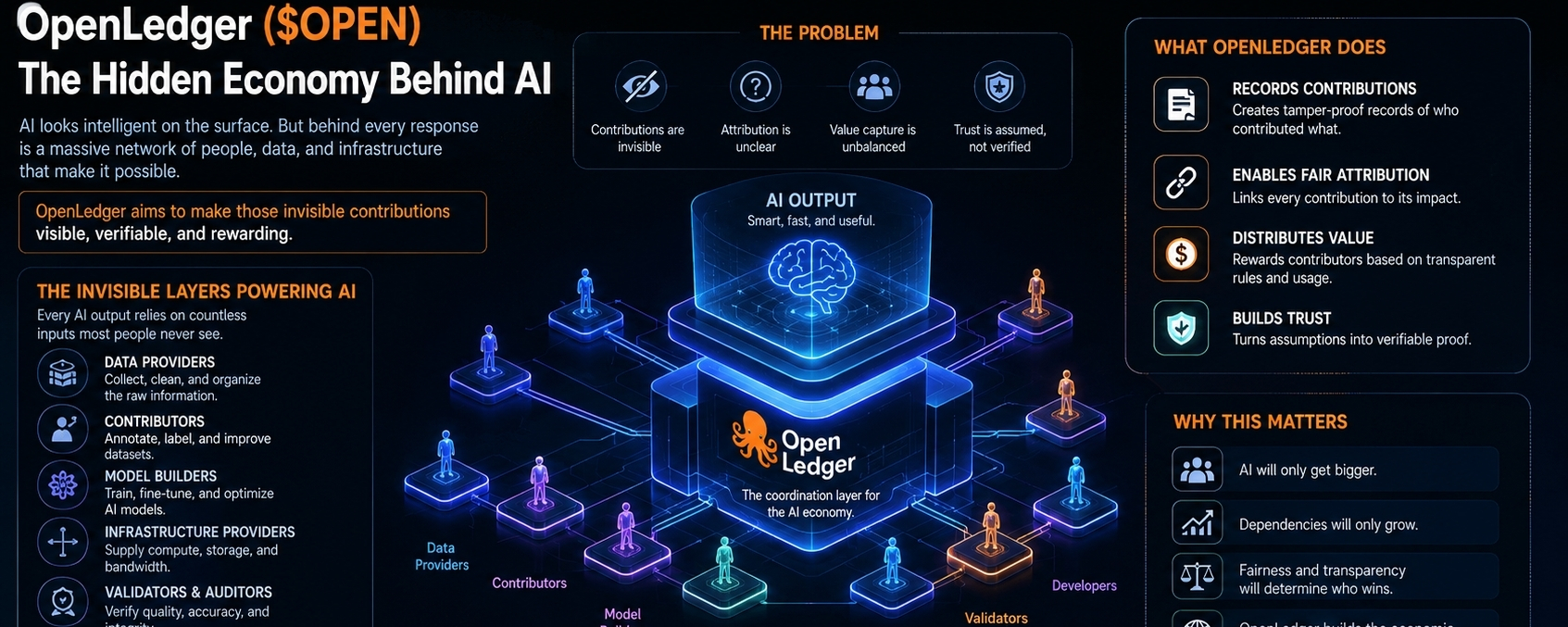
I've been in crypto long enough to know how easy it is to stop paying attention.
Not because nothing interesting is happening, but because after a while every new narrative starts arriving with the same energy. Bigger vision. Bigger market. Bigger opportunity. Eventually you develop a habit of filtering most of it out.
That's probably why OpenLedger caught my attention in such a strange way.
It wasn't immediate. If anything, I overlooked it at first.
From a distance, it looked like another project sitting somewhere between AI and crypto, two sectors that have become crowded with ambitious ideas and endless promises. There are so many projects trying to position themselves at that intersection that it becomes difficult to tell which ones are actually addressing a real problem and which ones are simply following a trend.
But every now and then something stays in your head longer than it should.
Not because of hype.
Not because everyone is talking about it.
Just because the question behind it feels more important than the answer being presented.
That's what happened with OpenLedger.
The more I looked at it, the less interested I became in the product itself and the more interested I became in the problem it seemed to be circling.
For all the excitement around AI, most conversations still focus on the finished result. People look at the model, the response, the application, the thing sitting in front of them. That's the visible part. That's what gets attention.
What gets less attention is everything underneath.
The data that trained the model.
The people who created that data.
The sources the system depends on.
The infrastructure that keeps everything running.
The countless inputs that make the final output possible.
The funny thing is that these invisible layers are often where the real value sits.
Not because they're glamorous.
Because they're necessary.
And necessity has a habit of becoming important whether people notice it or not.
The more I thought about OpenLedger, the more it felt like a project trying to look at those hidden layers instead of the surface.
That stood out to me because I've seen this pattern before, not just in crypto but everywhere.
The people creating value are not always the people capturing value.
The systems benefiting from contributions are not always the systems rewarding them.
And the larger a network becomes, the easier it becomes for those relationships to disappear from view.
AI feels like it's heading toward that same reality.
Everyone talks about intelligence.
Far fewer people talk about dependency.
Yet every AI system depends on something.
It depends on information.
It depends on contributors.
It depends on sources.
It depends on a constant flow of inputs that have to come from somewhere.
What happens when those dependencies become valuable?
What happens when they become scarce?
What happens when the people providing them start asking how that value should be distributed?
Those questions feel much bigger than any individual project.
They're older than AI.
They're older than crypto.
OpenLedger just happens to be operating close to where those questions are starting to matter.
Maybe that's why it keeps returning to my attention.
Not because I think it has everything figured out.
Honestly, I don't trust any project that sounds too certain about problems this large.
The relationship between contribution and compensation has never been simple.
The relationship between trust and incentives has never been simple either.
Crypto has spent years trying to solve those problems.
Sometimes successfully.
Sometimes not.
What interests me about OpenLedger is that it appears to understand that recording value and creating value are not the same thing.
That's an easy distinction to miss.
A system can track contributions perfectly and still fail to create meaningful incentives.
A system can reward activity without rewarding usefulness.
A system can generate numbers that look impressive while producing very little that actually matters.
We've seen that happen countless times.
That's why I find myself paying more attention to what a project is trying to align than what it's trying to advertise.
With OpenLedger, the alignment seems more interesting than the narrative.
It feels less focused on AI as a spectacle and more focused on AI as an economy.
An economy made up of contributors, data, incentives, ownership, and attribution.
An economy where the invisible participants may end up being more important than the visible ones.
Whether that works in practice remains to be seen.
Execution always matters.
Reality eventually catches up to every idea.
But I think that's exactly why the project feels worth watching.
Not because it promises a future nobody has seen.
Because it's looking at something that's already happening.
AI systems are growing more powerful.
They're consuming more data.
They're relying on more contributors.
They're creating more value.
The question of who owns that value and who deserves to participate in it isn't going away.
If anything, it becomes harder to ignore as these systems become larger.
Most people are focused on the outputs.
OpenLedger seems more interested in the inputs.
Most people are focused on intelligence.
OpenLedger appears focused on the network of dependencies that intelligence quietly relies on.
And the longer I spend thinking about it, the more I suspect that those dependencies may end up being one of the most important parts of the entire conversation.
Not because they're exciting.
Not because they're trendy.
Simply because every system eventually has to confront the same reality.
The things that matter most are often the things nobody notices while they're working.
Only later do people realize everything was resting on them the whole time.