
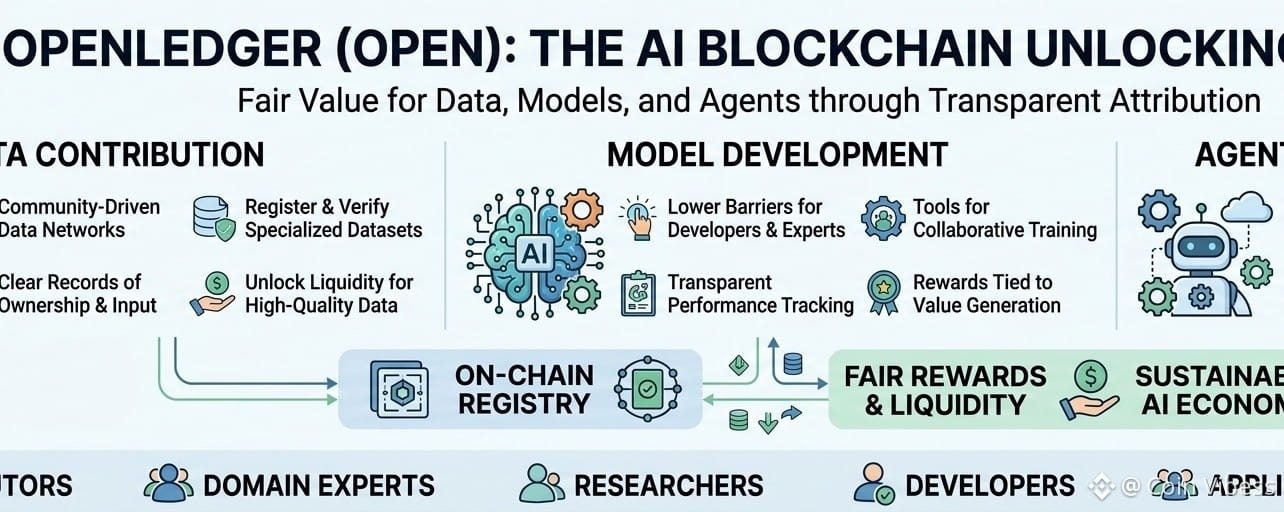
OpenLedger (OPEN) is built around a simple but increasingly important idea: the people who contribute to artificial intelligence should be able to benefit from the value it creates. As AI becomes more deeply integrated into everyday life, enormous amounts of data are being collected, processed, and transformed into models that power everything from chatbots to autonomous agents. Yet most contributors remain disconnected from the economic value generated by these systems. OpenLedger is attempting to change that by creating a blockchain-based infrastructure where data, models, and AI agents can be attributed, tracked, and monetized in a transparent way.
The rise of artificial intelligence has created a new digital economy, but it has also exposed a major imbalance. Data providers, domain experts, researchers, and developers often contribute to the creation of intelligent systems without receiving meaningful recognition or long-term rewards. Large organizations typically control the entire pipeline, from data collection to model deployment, capturing most of the value along the way. OpenLedger approaches this challenge from a different angle. Instead of treating AI assets as closed and isolated resources, it treats them as economic assets that can be registered, verified, and rewarded on-chain.
At the center of the project is the belief that AI should not function as a black box. When a model generates value, there should be a transparent way to understand what data influenced it, who contributed to its development, and how rewards can be distributed fairly among participants. This concept becomes increasingly important as AI systems grow more specialized and begin serving industries where expertise and high-quality data are essential.
One of the most interesting aspects of OpenLedger is its focus on creating a framework where data itself can become a productive asset. Traditionally, valuable datasets are collected and stored behind corporate walls, accessible only to the organizations that own them. OpenLedger introduces a different model by encouraging the creation of community-driven data networks. These networks allow contributors to participate in building specialized datasets that can later be used for training and improving AI models. Rather than simply donating information into an opaque system, contributors can become part of a transparent ecosystem where the value of their input is recognized.
This approach becomes particularly relevant when looking at industries that depend on highly specialized knowledge. A medical AI assistant requires accurate healthcare data. A financial AI system depends on market insights and historical information. Legal applications need access to structured legal knowledge. In each of these cases, the quality of the underlying data directly influences the effectiveness of the model. OpenLedger seeks to create an environment where such datasets can be developed collaboratively while maintaining clear records of ownership and contribution.
Another important part of the ecosystem revolves around model creation and deployment. Building useful AI models is often expensive, technically demanding, and heavily centralized. OpenLedger attempts to lower these barriers by providing tools that help developers and domain experts participate in model development more easily. This creates opportunities for individuals and smaller organizations to contribute their expertise without needing access to massive infrastructure or resources.
The project also recognizes that the future of artificial intelligence will likely be shaped by specialized systems rather than a small number of general-purpose models. Businesses increasingly need solutions tailored to specific industries, workflows, and user needs. A customer support assistant requires different capabilities than a financial analysis tool. A healthcare application has different requirements from an educational platform. OpenLedger's infrastructure is designed to support this growing ecosystem of specialized intelligence, making it easier to build and deploy targeted solutions.
AI agents represent another major area of focus. These systems go beyond simple chat interactions and can perform tasks, automate workflows, analyze information, and interact with digital environments. As agents become more capable, questions surrounding ownership, accountability, and monetization become more significant. OpenLedger envisions an ecosystem where AI agents can operate within a transparent framework that records their activity, tracks their performance, and connects their economic value back to the data and models that enable them to function.
What makes this vision particularly compelling is the way it connects different participants within the AI economy. Data contributors, model developers, application builders, and end users all become part of the same ecosystem. Instead of value flowing only to the final product owner, rewards can potentially be distributed across multiple layers of contribution. This creates a more collaborative environment where incentives are aligned around improving the overall quality and usefulness of AI systems.
The blockchain component of OpenLedger is not simply added for marketing purposes. Rather, it serves as the mechanism that enables transparency, attribution, and economic coordination. Blockchain technology provides an immutable record of contributions and interactions, making it possible to create trust among participants who may not know each other. In the context of AI, this becomes especially valuable because it introduces accountability into processes that are often difficult to audit or verify.
As artificial intelligence continues to evolve, questions surrounding ownership and value distribution are becoming impossible to ignore. The current landscape often concentrates benefits among a relatively small number of organizations, even though the creation of intelligent systems depends on contributions from many different sources. OpenLedger is positioning itself as an infrastructure layer that addresses this imbalance by making AI assets more transparent, accessible, and economically productive.
Of course, the project's ambitions come with challenges. Measuring contribution within complex AI systems is not straightforward. Ensuring data quality, maintaining fairness, encouraging adoption, and scaling the ecosystem will all require significant effort. The success of the platform will ultimately depend on its ability to demonstrate that attribution and reward mechanisms can function effectively in real-world environments. Nevertheless, the problem it aims to solve is both genuine and increasingly relevant.
What stands out about OpenLedger is that it focuses on the foundations of the AI economy rather than simply building another AI application. While many projects compete to create the next popular chatbot or automation tool, OpenLedger is attempting to build the infrastructure that supports how value is created and distributed throughout the entire lifecycle of artificial intelligence. It is less concerned with a single application and more focused on the broader ecosystem that enables AI innovation.
As the relationship between artificial intelligence and digital ownership continues to evolve, projects that address transparency, attribution, and monetization are likely to play an increasingly important role. OpenLedger's vision is rooted in the idea that data, models, and agents should not exist as isolated resources controlled by a handful of entities. Instead, they should form part of an open and collaborative economy where contributors are recognized and rewarded for the value they help create.
Whether this vision ultimately succeeds will depend on execution and adoption, but the direction is clear. OpenLedger is not simply trying to participate in the AI revolution; it is attempting to redefine how value moves through it. In a world where artificial intelligence is becoming one of the most powerful technologies of our time, creating fair and transparent systems around contribution may prove just as important as the intelligence itself.
