The part of OpenLedger that I keep returning to is not the model layer, the infrastructure layer, or even the reward layer by itself. It is the admission boundary that quietly forms between contributors and the network once attribution becomes economically meaningful. Most discussions focus on how OpenLoRA makes model adaptation efficient or how Datanets organize specialized datasets. What feels more interesting in practice is what happens when the system must decide whose contribution deserves to be remembered and whose does not.
Inside OpenLedger, this question appears constantly. Every dataset, adapter, validation step, and attribution pathway creates a filtering process. The network cannot simply accept everything. If it did, rewards would become noise, models would inherit lower quality inputs, and attribution would lose credibility. The friction emerges precisely where openness meets accountability.
That sounds reasonable until you spend time thinking about the operational consequences.
A contributor uploads a dataset into a Datanet expecting it to participate in future model improvements. The upload succeeds. The data exists. Yet existence and usefulness are not the same thing. The system still has to determine whether that contribution actually helped downstream performance or whether it merely increased storage, validation work, and evaluation costs.
This is where admission stops feeling abstract.
One dataset might contain 50,000 records collected from a specialized domain. Another might contain 500 carefully curated examples produced by people who understand edge cases. Traditional contribution systems often reward volume because volume is easy to measure. Attribution systems create pressure to reward impact instead. The difference sounds small until rewards become attached.
A useful test is simple.
Imagine two contributors entering the same Datanet. One contributes ten times more data. The other contributes data that improves model behavior in a narrow but critical failure scenario. Which contribution should generate greater future rewards?
Most people answer the second one immediately.
The difficult part is proving it.
The moment proof becomes necessary, new layers appear. Validation becomes heavier. Evaluation becomes more frequent. Disagreement becomes more expensive. The network gains accountability but loses some simplicity.
That tradeoff feels unavoidable.
I have noticed that many AI systems tolerate uncertainty because uncertainty is cheap. OpenLedger seems to move in the opposite direction. Attribution rewards require stronger evidence chains. OpenLoRA adapters can be tracked through model development paths, Datanets can organize contribution histories, and validation mechanisms can connect outcomes back to sources. The result is a cleaner relationship between creation and reward.
The cost is that somebody has to pay for verification.
Not necessarily with money at first. Often with time.
Consider a mechanical example. A LoRA adapter trained on a specialized medical transcription dataset shows improved performance during initial testing. Without attribution tracking, the adapter could simply be merged into a workflow and its origins gradually become irrelevant. With attribution active, the system now has reason to preserve provenance. Future improvements need to understand whether gains came from the adapter itself, the underlying dataset, or a combination of both.
The reward system benefits from that information.
The workflow becomes slower because that information must be maintained.
Neither outcome is accidental.
Another example appears when multiple Datanets contribute overlapping information. Suppose three datasets improve a model's accuracy on a task. The improvement is measurable, but the contribution split is unclear. One dataset may have provided foundational examples. Another may have corrected rare edge cases. A third may have increased coverage without changing overall performance dramatically.
Attribution sounds straightforward until contributions become entangled.
The network now faces a question that many organizations quietly avoid. How much credit belongs to each source?
The interesting part is not the answer. The interesting part is what happens while searching for the answer.
More validation work appears.
More scoring work appears.
More dispute potential appears.
A layer that once absorbed ambiguity now has to absorb accountability.
That is where I occasionally wonder whether attribution systems create their own form of hidden gatekeeping.
Not intentional gatekeeping. Structural gatekeeping.
When contribution quality becomes economically important, contributors who understand evaluation methods gain an advantage. People who know how attribution is measured often position their work differently than people who simply produce useful work. Over time, a network can drift toward optimizing measurable contribution rather than meaningful contribution.
I am not convinced OpenLedger escapes that entirely.
Maybe no attribution system can.
Another useful test is this: if contributors understand the reward formula perfectly, do they become better contributors or better optimizers of the formula?
The answer matters more than most technical discussions acknowledge.
This is where OpenLoRA becomes particularly interesting. LoRA adapters make specialization more efficient because models do not need to be retrained from scratch. That lowers development costs and increases experimentation speed. Yet attribution rewards introduce a counterforce. The network wants experimentation, but it also wants traceability. Every shortcut in model development eventually encounters a bookkeeping requirement.
The system scales.
The accounting scales with it.
That framing keeps sticking with me.
AI scaling is increasingly becoming an attribution problem disguised as an infrastructure problem.
The storage layer can scale. The model layer can scale. The adapter layer can scale. The difficult question is whether trust can scale at the same rate.
OpenLedger appears to be betting that attribution creates enough trust to justify the added complexity. I understand the logic. If contributors know their work remains visible through future model generations, participation becomes easier to justify. Effort has a memory. Value has a trail.
Eventually that is where the token enters the picture.
Not as a speculative asset, but as the accounting mechanism that makes attribution consequential. Without rewards attached, attribution is mostly record keeping. With rewards attached, attribution becomes governance. Decisions about validation, contribution quality, and provenance suddenly influence resource distribution across the network.
The token does not create the problem.
It simply makes the problem impossible to ignore.
What I find myself watching is not whether OpenLedger can scale AI development. Many systems can scale development if enough resources are available. The harder question is whether attribution can remain trustworthy as contribution graphs become denser, adapters become more specialized, and Datanets become harder to evaluate individually.
At small scale, remembering who created value feels manageable.
At larger scale, remembering becomes the system.
And when remembering becomes the system, every admission decision starts carrying more weight than it first appears.
I suspect most contributors will not notice that friction immediately. They will notice faster model iteration, clearer ownership paths, and reward distribution. The deeper tension sits underneath. The network is constantly deciding what deserves attribution and what fades into statistical background noise.
That decision gets harder as the system succeeds.
I am not sure there is a clean solution waiting at the end of that path. The more I look at attribution rewards, the more they seem less like an incentive mechanism and more like an ongoing argument about memory itself. Open systems rarely struggle with accepting contributions.
They struggle withI wrote the article as a reusable draft.
Writing
Scaling AI with OpenLoRA, Datanets, and Attribution Rewards
The part of OpenLedger that I keep returning to is not the model layer, the infrastructure layer, or even the reward layer by itself. It is the admission boundary that quietly forms between contributors and the network once attribution becomes economically meaningful. Most discussions focus on how OpenLoRA makes model adaptation efficient or how Datanets organize specialized datasets. What feels more interesting in practice is what happens when the system must decide whose contribution deserves to be remembered and whose does not.
Inside OpenLedger, this question appears constantly. Every dataset, adapter, validation step, and attribution pathway creates a filtering process. The network cannot simply accept everything. If it did, rewards would become noise, models would inherit lower quality inputs, and attribution would lose credibility. The friction emerges precisely where openness meets accountability.
That sounds reasonable until you spend time thinking about the operational consequences.
A contributor uploads a dataset into a Datanet expecting it to participate in future model improvements. The upload succeeds. The data exists. Yet existence and usefulness are not the same thing. The system still has to determine whether that contribution actually helped downstream performance or whether it merely increased storage, validation work, and evaluation costs.
This is where admission stops feeling abstract.
One dataset might contain 50,000 records collected from a specialized domain. Another might contain 500 carefully curated examples produced by people who understand edge cases. Traditional contribution systems often reward volume because volume is easy to measure. Attribution systems create pressure to reward impact instead. The difference sounds small until rewards become attached.
A useful test is simple.
Imagine two contributors entering the same Datanet. One contributes ten times more data. The other contributes data that improves model behavior in a narrow but critical failure scenario. Which contribution should generate greater future rewards?
Most people answer the second one immediately.
The difficult part is proving it.
The moment proof becomes necessary, new layers appear. Validation becomes heavier. Evaluation becomes more frequent. Disagreement becomes more expensive. The network gains accountability but loses some simplicity.
That tradeoff feels unavoidable.
I have noticed that many AI systems tolerate uncertainty because uncertainty is cheap. OpenLedger seems to move in the opposite direction. Attribution rewards require stronger evidence chains. OpenLoRA adapters can be tracked through model development paths, Datanets can organize contribution histories, and validation mechanisms can connect outcomes back to sources. The result is a cleaner relationship between creation and reward.
The cost is that somebody has to pay for verification.
Not necessarily with money at first. Often with time.
Consider a mechanical example. A LoRA adapter trained on a specialized medical transcription dataset shows improved performance during initial testing. Without attribution tracking, the adapter could simply be merged into a workflow and its origins gradually become irrelevant. With attribution active, the system now has reason to preserve provenance. Future improvements need to understand whether gains came from the adapter itself, the underlying dataset, or a combination of both.
The reward system benefits from that information.
The workflow becomes slower because that information must be maintained.
Neither outcome is accidental.
Another example appears when multiple Datanets contribute overlapping information. Suppose three datasets improve a model's accuracy on a task. The improvement is measurable, but the contribution split is unclear. One dataset may have provided foundational examples. Another may have corrected rare edge cases. A third may have increased coverage without changing overall performance dramatically.
Attribution sounds straightforward until contributions become entangled.
The network now faces a question that many organizations quietly avoid. How much credit belongs to each source?
The interesting part is not the answer. The interesting part is what happens while searching for the answer.
More validation work appears.
More scoring work appears.
More dispute potential appears.
A layer that once absorbed ambiguity now has to absorb accountability.
That is where I occasionally wonder whether attribution systems create their own form of hidden gatekeeping.
Not intentional gatekeeping. Structural gatekeeping.
When contribution quality becomes economically important, contributors who understand evaluation methods gain an advantage. People who know how attribution is measured often position their work differently than people who simply produce useful work. Over time, a network can drift toward optimizing measurable contribution rather than meaningful contribution.
I am not convinced OpenLedger escapes that entirely.
Maybe no attribution system can.
Another useful test is this: if contributors understand the reward formula perfectly, do they become better contributors or better optimizers of the formula?
The answer matters more than most technical discussions acknowledge.
This is where OpenLoRA becomes particularly interesting. LoRA adapters make specialization more efficient because models do not need to be retrained from scratch. That lowers development costs and increases experimentation speed. Yet attribution rewards introduce a counterforce. The network wants experimentation, but it also wants traceability. Every shortcut in model development eventually encounters a bookkeeping requirement.
The system scales.
The accounting scales with it.
That framing keeps sticking with me.
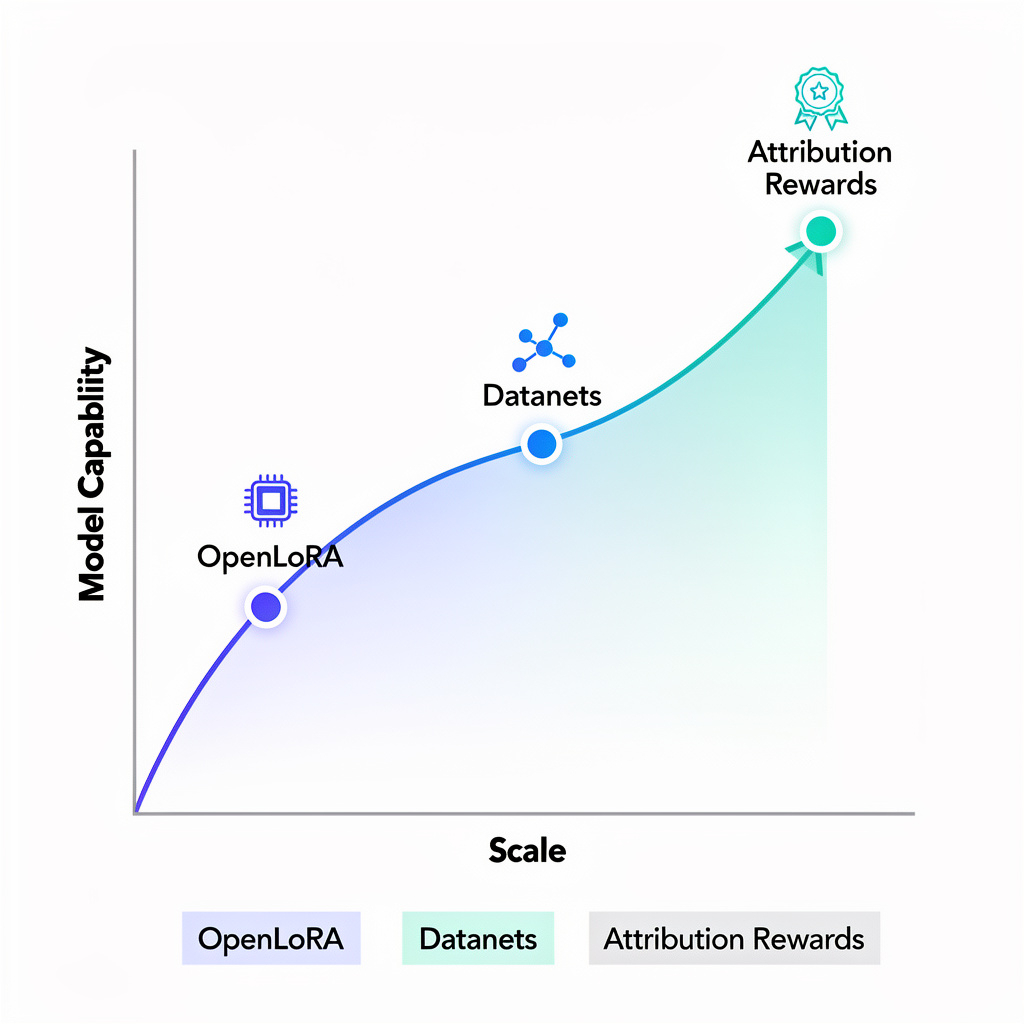
AI scaling is increasingly becoming an attribution problem disguised as an infrastructure problem.
The storage layer can scale. The model layer can scale. The adapter layer can scale. The difficult question is whether trust can scale at the same rate.
OpenLedger appears to be betting that attribution creates enough trust to justify the added complexity. I understand the logic. If contributors know their work remains visible through future model generations, participation becomes easier to justify. Effort has a memory. Value has a trail.
Eventually that is where the token enters the picture.
Not as a speculative asset, but as the accounting mechanism that makes attribution consequential. Without rewards attached, attribution is mostly record keeping. With rewards attached, attribution becomes governance. Decisions about validation, contribution quality, and provenance suddenly influence resource distribution across the network.
The token does not create the problem.
It simply makes the problem impossible to ignore.
What I find myself watching is not whether OpenLedger can scale AI development. Many systems can scale development if enough resources are available. The harder question is whether attribution can remain trustworthy as contribution graphs become denser, adapters become more specialized, and Datanets become harder to evaluate individually.
At small scale, remembering who created value feels manageable.
At larger scale, remembering becomes the system.
And when remembering becomes the system, every admission decision starts carrying more weight than it first appears.
I suspect most contributors will not notice that friction immediately. They will notice faster model iteration, clearer ownership paths, and reward distribution. The deeper tension sits underneath. The network is constantly deciding what deserves attribution and what fades into statistical background noise.
That decision gets harder as the system succeeds.
I am not sure there is a clean solution waiting at the end of that path. The more I look at attribution rewards, the more they seem less like an incentive mechanism and more like an ongoing argument about memory itself. Open systems rarely struggle with accepting contributions.
They struggle with deciding which contributions deserve to be remembered. deciding which contributions deserve to be remembered.