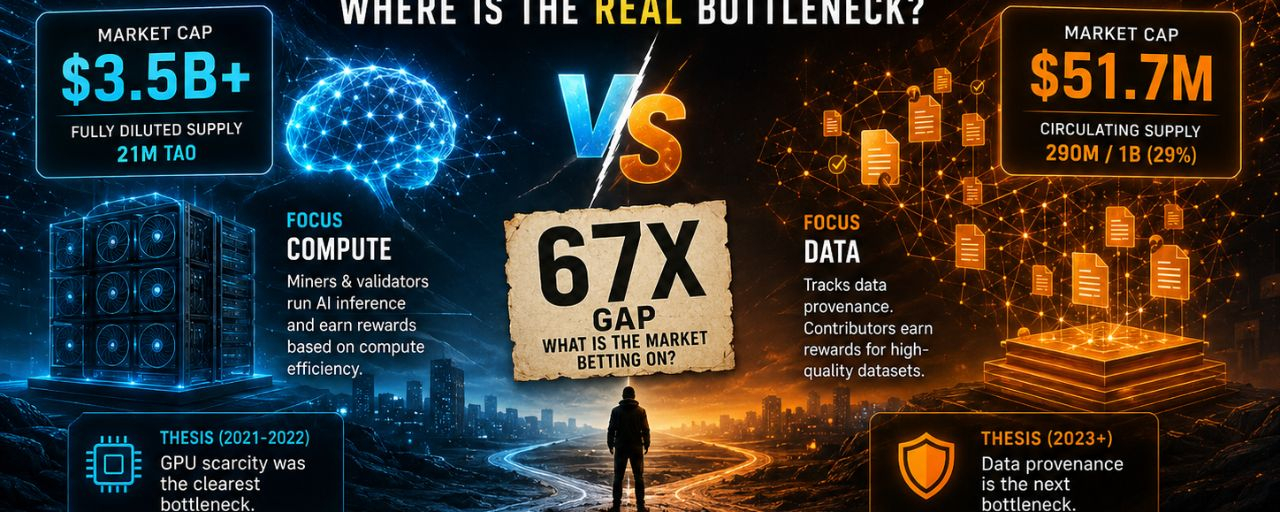
Honestly, I wasn’t expecting to find anything particularly special when I started reading about OpenLedger. Just another “AI on-chain” project, newly listed token, small market cap, nothing that sounded unfamiliar. But then one number made me stop.
Bittensor is valued at more than $3.5 billion, while OpenLedger is only at $51.7 million. A 67x gap between two projects that both claim to be solving “AI on-chain.” This is not a story about the market liking one more than the other. It is the market betting that it already knows where the AI bottleneck is.
Not capital. Not roadmap. Something closer to a fundamental question the entire AI industry has been quietly debating since 2023, in the next three years, what is really the bottleneck for AI, compute or data?
Bittensor answers with compute. TAO’s architecture is built around a subnet model, where miners and validators run AI inference and are rewarded according to computational efficiency. That thesis made perfect sense in 2021–2022, when GPU scarcity was the clearest bottleneck. Since then, TAO has accumulated a $3.5 billion market cap with a fully diluted supply of just 21M tokens, a Bitcoin-like scarcity narrative that the market absorbs very easily.
OpenLedger is betting the other way. Their PoA does not track compute, it tracks data provenance. Contributors provide datasets and are automatically rewarded, and the whole system is designed to function as an AI-native L2 rather than a general-purpose blockchain. The two projects are solving completely different layers.
I think the most interesting asymmetry is here. Compute is increasingly being commoditized, and faster than many people expected. Cloud providers are racing to offer cheaper and faster GPUs. Synthetic data is also improving significantly, but not for every use case. Domain-specific data with clear provenance is still something you cannot simply synthesize at will. If compute becomes a commodity, then what remains as the real moat may be data. And that is exactly where OpenLedger is placing its bet.
The second asymmetry is tokenomics. TAO, with a 21M fully diluted supply, no longer faces dilution pressure. Most of the price discovery has already happened. OPEN, with 290M circulating out of 1B total supply, about 29%, means 71% of the supply has not yet entered the market. OPEN’s ATH reached $1.82 in September 2025, with FDV at $175M. These numbers are not inherently good or bad. They are simply the reality of the supply schedule, and anyone doing serious token analysis has to put that into the model before concluding anything.
The structural consequence, if OpenLedger is right about the bottleneck, may go much deeper than a normal token move. Datanets, OPEN’s contributor network, is designed around cumulative network effects. Contributors build reputation inside the ecosystem, datasets get verified through PoA, and value accumulates through data depth rather than just volume. If this works as designed, it is a moat that is harder to copy than a compute network for one simple reason, a miner can switch to another subnet at any time, but a data contributor who has built reputation in one ecosystem usually does not leave easily. Still, that is a big “if.” Network effects only matter once they are large enough, and OpenLedger is still very early in that process.
To be honest, Bittensor has already done the hardest thing in crypto. It has earned real mindshare in AI blockchain. A $3.5 billion market cap is not just expectation, it is consensus from an investor community that has chosen to back the compute layer. Even if the compute-as-bottleneck thesis turns out to be wrong, TAO still has enough of a first-mover advantage that it will not be easily displaced by simply having a better architecture. And synthetic data is improving at a pace that is hard to predict, if it becomes good enough for most use cases over the next 2–3 years, OpenLedger’s advantage becomes much thinner.
Or maybe the real question is not who wins. Maybe the real question is whether that 67x gap is telling us that the market has been betting on a specific bottleneck from very early on, and if AI development over the next three years proves that data provenance on-chain is the more important layer to solve, then what exactly does the current consensus about where value accumulates actually mean?
$OPEN #OpenLedger #bittensor #AIBlockchain @OpenLedger