
The more time I spend learning about AI, the more I notice that most conversations revolve around the same things.
Better models.
Better outputs.
More intelligence.
More automation.
And don’t get me wrong, those things matter.
But lately I’ve found myself thinking about a different question.
What happens to the people who help make all of this possible?
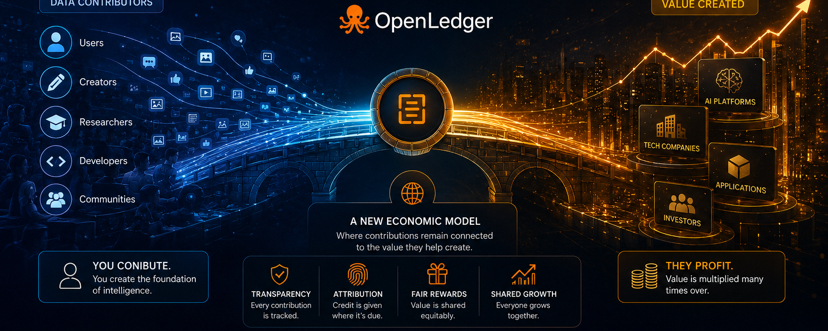
Every AI system learns from something. Behind every model are countless contributions from people. Data, feedback, corrections, expertise, conversations, and knowledge collected over time.
Yet once that contribution enters the system, the story usually ends there.
The model gets better.
The product improves.
The company grows.
Value gets created.
But the people whose contributions helped make that happen often have no connection to that value anymore.
We’ve seen this for so long that most people don’t even question it.
It’s just how things work.
But the more I think about it, the stranger it feels.
If someone’s contribution is still helping create value years later, why does the relationship end the moment the data is collected?
That’s one of the reasons OpenLedger caught my attention.
Not because it’s promising some magical AI breakthrough.
Not because it’s trying to build the biggest model in the industry.
What interests me is the question it’s asking.
What if contributors didn’t disappear from the picture?
What if data wasn’t treated like a resource that’s used once and forgotten?
What if people who help create intelligence could stay connected to the value that intelligence generates?
I think that’s a much bigger conversation than most people realize.
Because at the end of the day, incentives matter.
They shape behavior far more than promises ever will.
If people know their contributions matter beyond the moment they’re submitted, they’re more likely to care about quality.
Developers are more likely to seek better data.
Specialized knowledge becomes more valuable.
The whole system starts rewarding usefulness instead of simply collecting as much information as possible.
Of course, none of this is easy.
It’s one thing to track contributions.
It’s another thing entirely to make those contributions economically meaningful.
And that’s where the real challenge begins.
OpenLedger doesn’t just need attribution.
It needs demand.
It needs an ecosystem where transparency actually matters.
It needs a future where people care not only about what AI produces, but also where that intelligence came from.
That’s a much harder problem to solve.
Because technology can move fast.
People usually don’t.
Still, I think this is a conversation worth having.
AI is creating more value every year.
Yet the connection between contributors and outcomes remains surprisingly weak.
Most of the people helping build intelligence never participate in the upside created by it.
OpenLedger is essentially asking whether that model can be improved.
Whether the relationship between contribution and value can become more visible.
More transparent.
More connected.
And honestly, that’s the part that keeps me interested.
Not the technology itself.
The economics behind it.
Because if AI becomes one of the defining technologies of the next decade, then understanding who contributes to it and who benefits from it might end up being one of the most important questions we ask.
