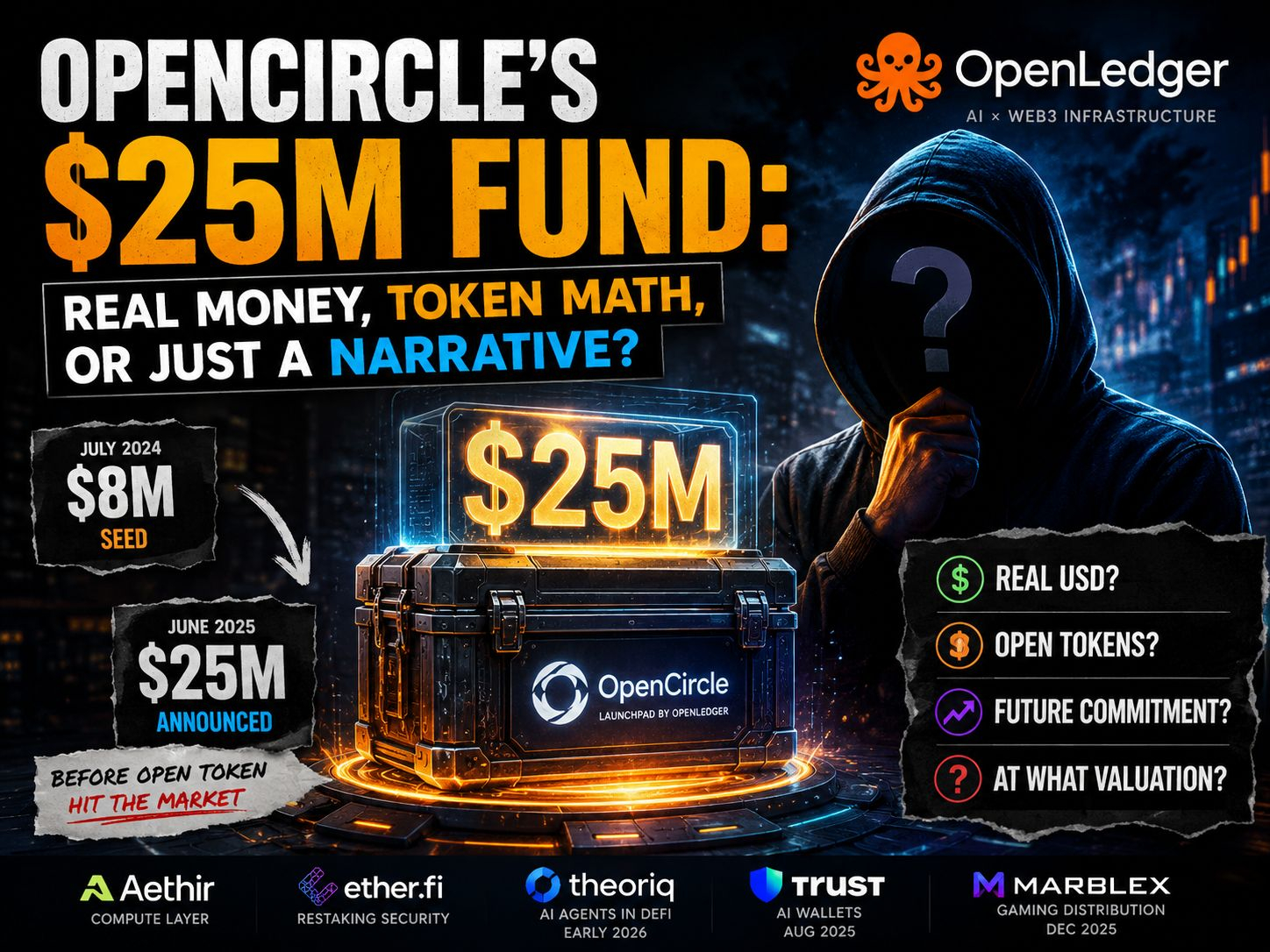
$8M seed in July 2024. Then a $25M fund was announced in June 2025, before OPEN token even hit the market. The number had nearly tripled. At first glance, it looked like momentum. But the more closely you look, the question just hangs there: what exactly was that $25M, really?
OpenCircle is OpenLedger’s startup launchpad, where projects building within the AI and Web3 ecosystem receive funding and ecosystem support. In terms of design, this model is not new. Many major L1s and L2s have done something similar. What OpenLedger wants to emphasize is the intersection of AI agents and on-chain infrastructure. Aethir provides compute. Ether.fi handles validator restaking for the security layer. Theoriq is bringing verifiable AI agents into live DeFi markets starting in early 2026. Trust Wallet is bringing AI-powered wallets into the consumer layer starting in August 2025. These pieces fit together. The names all sound familiar. On a quick read, the story feels consistent.
But the $25M figure is where it gets interesting.
The CoinDesk announcement in June 2025, three months before OPEN’s TGE in September 2025, never made clear what denomination that fund was actually in. Real USD? OPEN tokens? Or a commitment to raise more after the token starts trading? This is not a technical question. It is a question about the nature of the commitment. If the $25M is counted in OPEN tokens at an ATH of $1.82, and then the token corrects by half, builders are really only looking at $12.5M of actual purchasing power. If it is counted at the TGE price, the number changes again. And there is another issue. When the announcement was made in June 2025, OPEN did not yet have a public market price. So what exactly was the $25M denominated in, and at what valuation? No one knows, because no one disclosed it. And honestly, that ambiguity is probably not accidental.
The irony is that this mechanism creates a fairly interesting internal loop, in a negative sense. Announcing a $25M fund before TGE creates a big narrative, the narrative draws attention, attention creates buying pressure, the token rises, and the fund’s notional value rises with it, if the fund is OPEN-denominated. In other words, the announcement of the fund itself becomes a mechanism for inflating the value of that fund. Not a conspiracy. Just misaligned incentive design. The team benefits from perception, while builders absorb the risk of reality. The second question is just as important: has any project actually received funding from OpenCircle and is building now? Not “in the review pipeline” or “currently being evaluated,” but publicly identifiable projects with a real product or testnet. If the answer is no, after several months since the announcement, then that $25M is more of a floating number in a slide deck than capital that is actually being deployed.
The structural consequence here is not immediately obvious, but it is very real. Strong founders read the term sheet carefully. What is the denomination? What is the unlock schedule? Is there milestone-based tranching? What are the liquidation preferences? If OpenCircle does not answer these questions clearly, then top-tier builders will not apply. The people who do apply are the ones who are not experienced enough to ask the right questions. That is classic adverse selection in VC, and token-funded launchpads suffer from it even more because they also inherit the volatility of the underlying asset. The ecosystem gradually fills with average-quality projects, and that is not the kind of ecosystem Ether.fi, Trust Wallet, or Theoriq would really want to have their names attached to.
To be fair, OpenLedger does have real signals. The Trust Wallet partnership in August 2025 brought AI wallets to the consumer layer. That is real go-to-market, not just a whitepaper. The $5M Blockchain-AI research program with Cambridge in November 2025 is the kind of investment that attracts serious long-term researchers, not short-term attention. MARBLEX in December 2025 opened a gaming distribution vector. Theoriq in January 2026 brought AI agents into live DeFi. If executed properly, this is a technical thesis with real substance. I do not think these partnerships are decorative. They are building an infrastructure stack with its own logic, and each piece can stand on its own.
The problem is that OpenCircle’s $25M headline is the biggest one, but also the least clearly explained. The $8M seed was real, clear, and publicly recorded. But the gap from $8M to $25M was not filled by any announced round in between. The question is not whether the fund exists. The question is: whose commitment is it, to whom, in what form, and under what conditions? Those are four different questions. None of them have been answered yet.
Maybe OpenCircle really is a hard $25M USD fund waiting to be deployed. Or maybe this is an architecture of expectation announced before TGE, with a number calculated at a token price that the market never truly confirmed?
@OpenLedger $OPEN #OpenLedger