One thing I keep getting stuck on is how quickly AI infrastructure costs are starting to separate large companies from everyone else.$OPEN #OpenLedger @OpenLedger
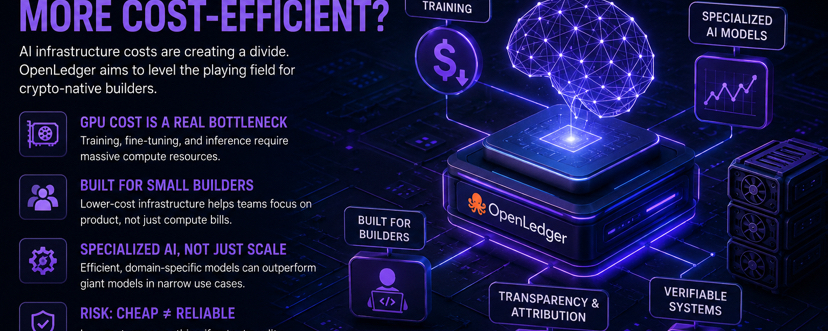
For years, crypto has talked about open access and decentralization. AI is starting to move in the opposite direction. The larger models become, the more expensive they are to train, fine-tune, and maintain. That creates a difficult reality for smaller teams trying to build specialized AI products inside crypto.
The assumption many people make is simple: if open-source models exist, anyone can compete.
I’m not sure that remains true once GPU costs enter the picture.
Training infrastructure has quietly become one of the biggest bottlenecks in AI development. Even teams using open-source models still need enormous compute resources for tuning, optimization, inference, and deployment. In many cases, the model itself is no longer the expensive part. The infrastructure surrounding it is.
That matters because crypto AI projects are increasingly moving toward domain-specific systems rather than general-purpose assistants. A trading assistant, an on-chain risk model, or a DeFi analytics engine does not necessarily need a trillion-parameter model. But it still needs reliable training pipelines and efficient fine-tuning.This is where OpenLedger becomes interesting.
Instead of positioning itself purely as another AI narrative token, OpenLedger appears to focus on the infrastructure side of specialized AI creation. The broader idea seems to be reducing the operational friction involved in training and adapting smaller AI systems for specific use cases.That distinction is important.
Most discussions around AI still revolve around scale. Bigger models, more parameters, larger datasets. But many practical crypto applications may depend more on efficiency than raw size.
A lightweight model trained specifically for on-chain analytics could potentially outperform a much larger general-purpose system inside a narrow environment. The challenge is making that process affordable enough for smaller builders.
OpenLedger’s approach appears to lean into that exact problem.If smaller teams can access lower-cost training and fine-tuning infrastructure, the economics of AI development start changing. Instead of needing massive funding rounds simply to cover compute expenses, developers could focus more resources on product iteration and data quality.That may sound like a small difference, but operational costs shape entire ecosystems.
When compute becomes expensive, experimentation slows down. Smaller builders take fewer risks. Independent developers disappear. Innovation starts concentrating around teams that can continuously absorb infrastructure costs.Crypto has already seen this pattern before in mining, liquidity provision, and validator economics.AI may be entering a similar phase now.
Imagine a small crypto-native research team building an AI system focused entirely on wallet behavior analysis. Their goal is not to compete with frontier models. They simply want a specialized system capable of identifying unusual on-chain activity patterns across multiple chains.
Without efficient infrastructure, most of their budget could disappear into GPU rental costs alone. Fine-tuning cycles become slower. Testing becomes limited. Iteration quality drops because every adjustment carries direct financial pressure.
In that environment, even technically strong teams struggle to survive.If OpenLedger can genuinely reduce the cost of specialized model development, that could create a more sustainable path for smaller AI builders inside crypto ecosystems.
But this is also where the risk becomes obvious.
Cheap compute by itself does not solve the harder problem.Lower costs only matter if output quality remains reliable.A poorly trained low-cost model still creates bad decisions, inaccurate analytics, and unreliable automation. In crypto environments where financial decisions are involved, low-quality AI can become extremely dangerous very quickly.
This is the part many infrastructure discussions ignore.
Efficiency matters, but trust matters more.If specialized AI systems are trained faster and cheaper, users still need confidence in attribution, transparency, and performance consistency. Otherwise, the ecosystem simply shifts from expensive centralized AI to inexpensive unreliable AI.That tradeoff would not actually improve the industry.
What makes this more complicated is that crypto users increasingly expect verifiable systems. They want to know where outputs originate, how models are trained, and whether incentives remain aligned over time.Infrastructure alone cannot answer those questions.
The more I look at this, the less simple it feels.
OpenLedger may be targeting a real structural problem in AI economics, especially for crypto-native builders working with limited budgets. The focus on training efficiency and specialized AI infrastructure makes more sense than many purely narrative-driven AI projects currently entering the market.
But sustainable AI ecosystems usually depend on three things working together at the same time: performance, affordability, and trust.
If one breaks, the entire system weakens.So the real question is not whether OpenLedger can make AI cheaper.It is whether specialized AI can become more accessible without creating a new generation of low-quality, opaque systems that users eventually stop trusting.$OPEN #OpenLedger @OpenLedger 

Статия
Can OpenLedger Reduce the Cost of Specialized AI?
--
Отказ от отговорност: Включва мнения на трети страни. Това не е финансов съвет. Може да включва спонсорирано съдържание. Вижте Правилата и условията.