
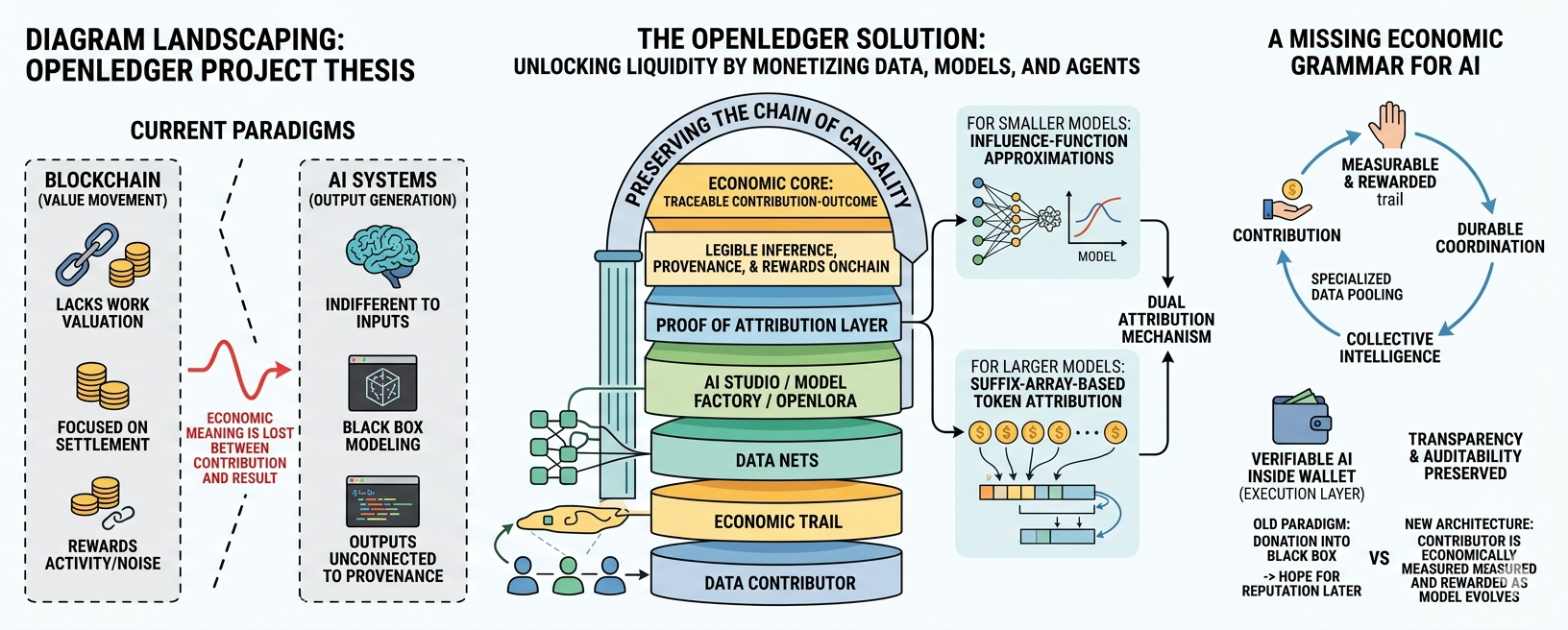

I’ve been watching OpenLedger the way I usually watch newer crypto systems that claim to sit at the edge of two overworked industries: one full of chains that learned how to move value but never learned how to value work, and one full of AI systems that can produce outputs while remaining almost completely indifferent to where their inputs came from. OpenLedger presents itself as an AI blockchain “unlocking liquidity to monetize data, models and agents,” and that phrasing matters to me less as a slogan than as a thesis about what the system thinks the missing primitive is. The project’s own materials keep circling the same structural problem: data is contributed, models are trained, agents act, and almost all of the economic meaning gets lost somewhere between the contribution and the result. OpenLedger says it is trying to keep that chain of causality intact through “Proof of Attribution,” DataNets, and a model-building stack that includes AI Studio, Model Factory, and OpenLoRA; in its technical paper, it describes a dual attribution approach that uses influence-function approximations for smaller models and suffix-array-based token attribution for larger ones, with the goal of making inference, provenance, and rewards legible onchain. What I find interesting is not that it says these words, but that it is choosing this battleground at all, because most protocols still mistake coordination for community and activity for structure. They reward motion. They reward noise. They reward the appearance of adoption. But a system like this is really making a different claim: that the economic core of AI should be the traceable relationship between contribution and outcome, not just the visible performance of the final model. That is a harder claim than it sounds, because it asks the chain to do more than settle transactions; it asks it to preserve lineage. It asks the protocol to become a memory of how intelligence was assembled, not just a marketplace where intelligence is consumed.
That is where I start to separate the serious designs from the decorative ones. In every market cycle, I’ve seen projects lean too quickly into composability before they have earned coherence, and OpenLedger seems at least aware that the real problem is not whether AI can be attached to a blockchain, but whether the blockchain can impose an accounting discipline on AI without flattening it into a toy incentive loop. The emphasis on attribution is not just about fairness, even if fairness is the obvious moral framing; it is about making coordination durable enough that specialized data can be pooled without being socially irrational to contribute. If the system works as described, then a contributor is no longer donating raw material into a black box and hoping for reputation later. The contributor becomes part of an economic trail that can be measured, rewarded, and carried forward as the model evolves. That is a very different architecture from the usual protocol that hands out points for participation while the actual value creation remains opaque and externalized. OpenLedger’s own ecosystem language reinforces that direction: it talks about a decentralized AI platform that validates outputs and actions using collective intelligence, and it has also described integrations where verifiable AI sits inside wallets as an execution layer with transparency and auditability preserved rather than hidden behind convenience. I do not read that as proof that the design is finished; I read it as an attempt to build a missing economic grammar for AI systems that need more than a dashboard and a token. The question, for me, is whether attribution can remain meaningful at scale, whether the reward logic can survive adversarial behavior, and whether the network can keep the system from turning into another culture of extractive participation dressed up as shared ownership. Those are the questions that decide whether this is a real structural shift or just a more elegant way to describe the same old coordination problem.
