
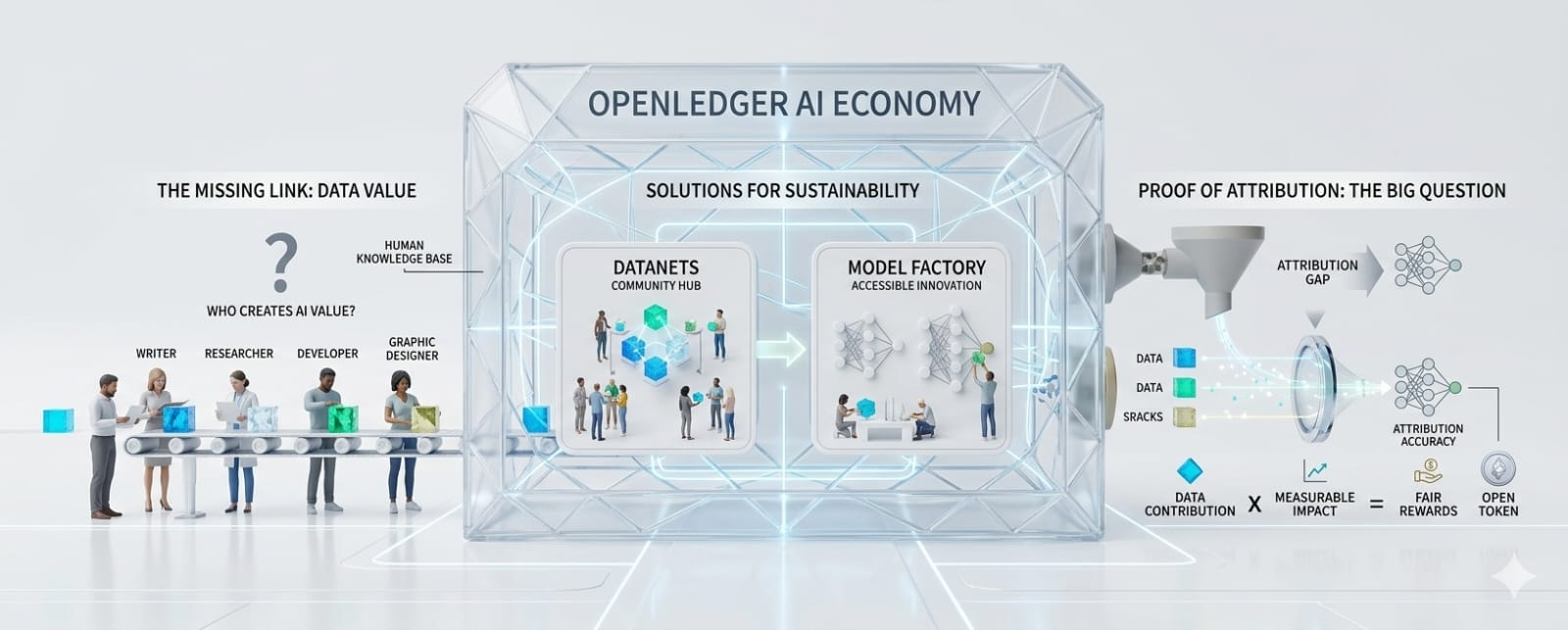
Most projects in AI and blockchain are presented in a very predictable way. There is usually a lot of discussion about bigger models, faster inference, lower costs, higher throughput, and new technical breakthroughs. Every few months a new system arrives claiming to be smarter, faster, or more efficient than the previous one. While those improvements are important, I often feel that the industry spends so much time talking about model performance that it overlooks a much deeper question.
Who is actually creating the value that AI depends on?
The more I think about it, the more I realize that the real foundation of AI is not the model itself. It is the data. Every answer generated by an AI system is built on an enormous amount of human-created information. People write articles, share opinions, publish research, create images, contribute code, ask questions, provide corrections, and document experiences. These contributions collectively form the knowledge base that modern AI systems learn from.
What I find interesting is that when AI creates economic value, most of that value tends to flow toward the companies that own the models, the infrastructure, or the distribution channels. The people whose knowledge, creativity, and effort helped make those systems useful are often invisible in the process. Whether that is sustainable in the long run is a question that I think will become increasingly important as AI continues to grow.
This is where OpenLedger caught my attention.
At first glance, it is easy to assume that OpenLedger is just another project trying to combine AI and blockchain. There are already many projects in this category, and not all of them bring something genuinely new to the table. However, after looking deeper, I noticed that OpenLedger is approaching the problem from a different angle. Instead of focusing only on building better models, it seems more interested in understanding how value is created and distributed within AI ecosystems.
The core idea revolves around the belief that data should not simply be treated as a resource that is collected and consumed. Instead, data should be viewed as a contribution that can potentially be measured, verified, and rewarded. That distinction may sound subtle, but it changes the entire conversation.
One of the concepts OpenLedger introduces is the idea of Datanets. Rather than relying on anonymous pools of information, Datanets are designed as structured environments where communities can contribute, verify, and improve data for specific AI use cases. The interesting part is that contributors are not viewed as passive participants. They become active members of a system where data quality and participation matter.
This approach addresses something that often gets overlooked in discussions about AI. The quality of a model is heavily influenced by the quality of the data it learns from. If contributors have incentives to provide accurate and useful information, there is a possibility of creating a healthier cycle between data creation and model development.
Another aspect that stood out to me is OpenLedger's Model Factory. In today's AI landscape, many people have valuable ideas but lack the technical resources required to build and deploy models. The barriers can be significant, ranging from infrastructure costs to machine learning expertise. If tools become easier to access, innovation no longer remains concentrated within a handful of large organizations. More individuals and smaller teams can experiment, build, and contribute to the ecosystem.
However, the most ambitious part of the project is something called Proof of Attribution.
In my opinion, this is where OpenLedger becomes genuinely interesting.
One of the biggest unresolved challenges in AI is understanding how individual data contributions influence model outputs. Once information enters a model, everything becomes blended together. It becomes extremely difficult to determine which source contributed to a specific result or how much value a particular piece of data created.
Proof of Attribution is an attempt to solve that problem. The idea is to create a system capable of identifying and measuring how data contributes to AI outputs. If successful, contributors could potentially receive rewards based on the actual impact of their contributions rather than relying on assumptions or generalized incentives.
The reason this matters goes beyond compensation. Attribution introduces transparency. It creates a clearer relationship between the creation of knowledge and the value generated from that knowledge. As AI becomes more deeply integrated into society, understanding where information comes from and how it influences outcomes may become increasingly important.
From a practical perspective, OpenLedger also benefits from EVM compatibility. This may not sound exciting compared to concepts like attribution and decentralized AI, but it could be one of the project's most important advantages. Developers already familiar with Ethereum tools, wallets, and smart contracts can interact with the ecosystem without having to learn an entirely new framework. Adoption often depends as much on accessibility as it does on innovation.
The OPEN token also appears to be designed with utility in mind. Rather than existing solely as a speculative asset, it is connected to activities such as network usage, inference, contributor rewards, governance, and ecosystem participation. Whether that utility ultimately translates into sustainable demand remains to be seen, but the intention is to align incentives across different participants in the network.
That said, I do not think the path forward is simple.
The first major challenge is attribution accuracy. The entire concept depends on the system's ability to correctly identify and measure contributions. If attribution is unreliable, trust in the reward mechanism could weaken quickly.
The second challenge is adoption. Strong technology alone is rarely enough. Developers, contributors, and users must find sufficient value in the ecosystem to actively participate. Without meaningful adoption, even well-designed systems can struggle to gain momentum.
The third challenge is model quality. At the end of the day, users care about outcomes. They care about whether an AI system is useful, reliable, and effective. Questions of attribution and ownership are important, but they cannot replace the need for high-quality AI performance.
What makes OpenLedger interesting to me is not the promise of a perfect solution. It is the fact that it is asking questions that many people in the industry still avoid. The project is exploring whether AI can evolve into an economy where contributions are visible, ownership is more transparent, and value distribution becomes more measurable.
That is a much larger challenge than simply building a faster model.
As AI continues to advance, discussions around intelligence alone may no longer be enough. Questions about who contributes, who benefits, and how value should be distributed could become just as important as technical performance itself.
Whether OpenLedger succeeds or not remains uncertain. Designing an AI economy is significantly more complicated than designing an AI model. But the questions it raises are likely to become increasingly relevant over the coming years.
And perhaps that is the real reason it deserves attention. Not because it claims to have all the answers, but because it is focused on one of the most important questions facing the future of AI: how do we create a system where the people who help generate intelligence are not forgotten when that intelligence creates value?
