

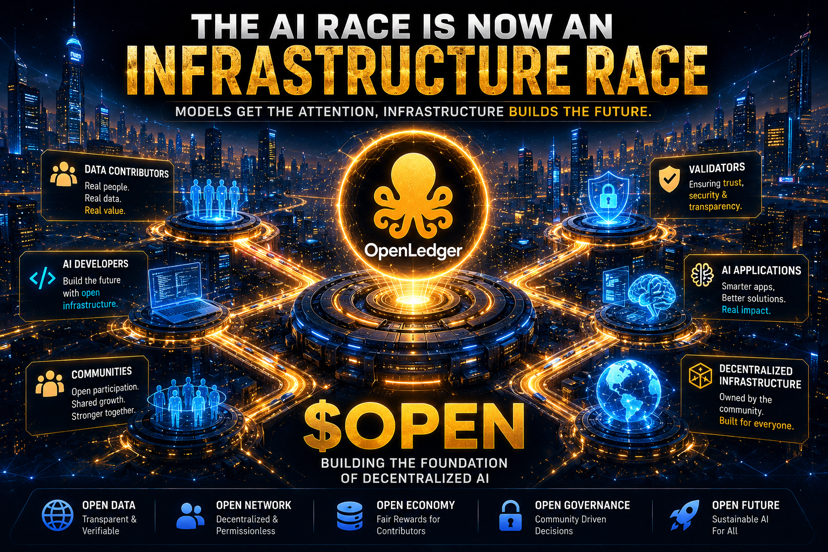
For years, the conversation around Artificial Intelligence has focused on one thing: better models.
Every new breakthrough is usually measured by how intelligent, accurate, or capable an AI system becomes. But as the industry matures, a bigger question is emerging.
What infrastructure will support the next generation of AI?
Models do not exist in isolation. They require data, contributors, computing resources, validation mechanisms, and sustainable economic systems. Without these foundations, even the most advanced AI systems struggle to scale effectively.
This is one reason why @OpenLedger has become an interesting project to follow.
The vision behind $OPEN focuses on the infrastructure layer of decentralized AI. Rather than concentrating only on the intelligence produced by AI, OpenLedger explores the systems that make AI ecosystems possible in the first place.
As AI adoption accelerates worldwide, demand for transparent data flows, contributor participation, and open infrastructure may continue to increase. The future of AI could depend not only on who builds the smartest models but also on who builds the strongest foundations.
This shift is important because infrastructure often creates long-term value. History shows that technologies capable of supporting entire ecosystems frequently become just as important as the applications built on top of them.
OpenLedger represents an approach that recognizes this reality. By connecting data, contributors, developers, and decentralized networks, the project is exploring how AI ecosystems can become more open, transparent, and sustainable.
The next stage of the AI revolution may not be won solely by intelligence.
It may be won by infrastructure.
$OPEN #OpenLedger #ArtificialIntelligence #FutureOfAI #DataEconomy