
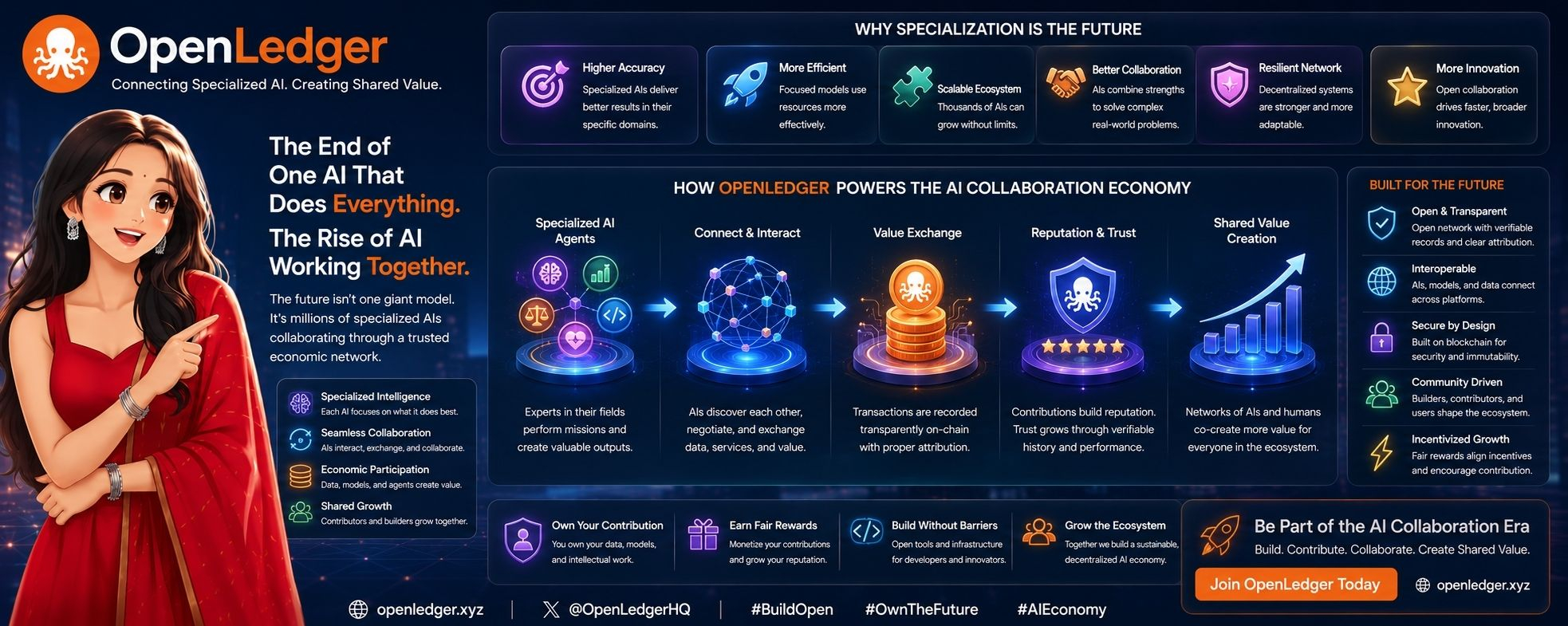
@OpenLedger For years, the AI industry has been chasing a single goal: build one model capable of doing everything. The vision was simple. Create an AI that can write, code, analyze data, generate images, answer questions, and solve complex problems all from a single interface. Every major breakthrough seemed to move us closer to that reality, and for a while, bigger models looked like the obvious path forward.
But the more I watch the industry evolve, the more I wonder if the future will look very different.
In the real world, specialization usually wins. We don't rely on one doctor to perform every medical procedure, one engineer to build every machine, or one company to provide every service. As industries mature, expertise becomes more focused, and specialized systems often outperform general-purpose ones. AI may be heading in the same direction.
Instead of one giant model dominating everything, the future could be filled with thousands or even millions of specialized AI systems. Some may focus entirely on healthcare research. Others may become experts in finance, law, education, logistics, or scientific discovery. Each system could become incredibly efficient within its own domain.
The interesting part is what happens when all these specialized intelligences need to work together.
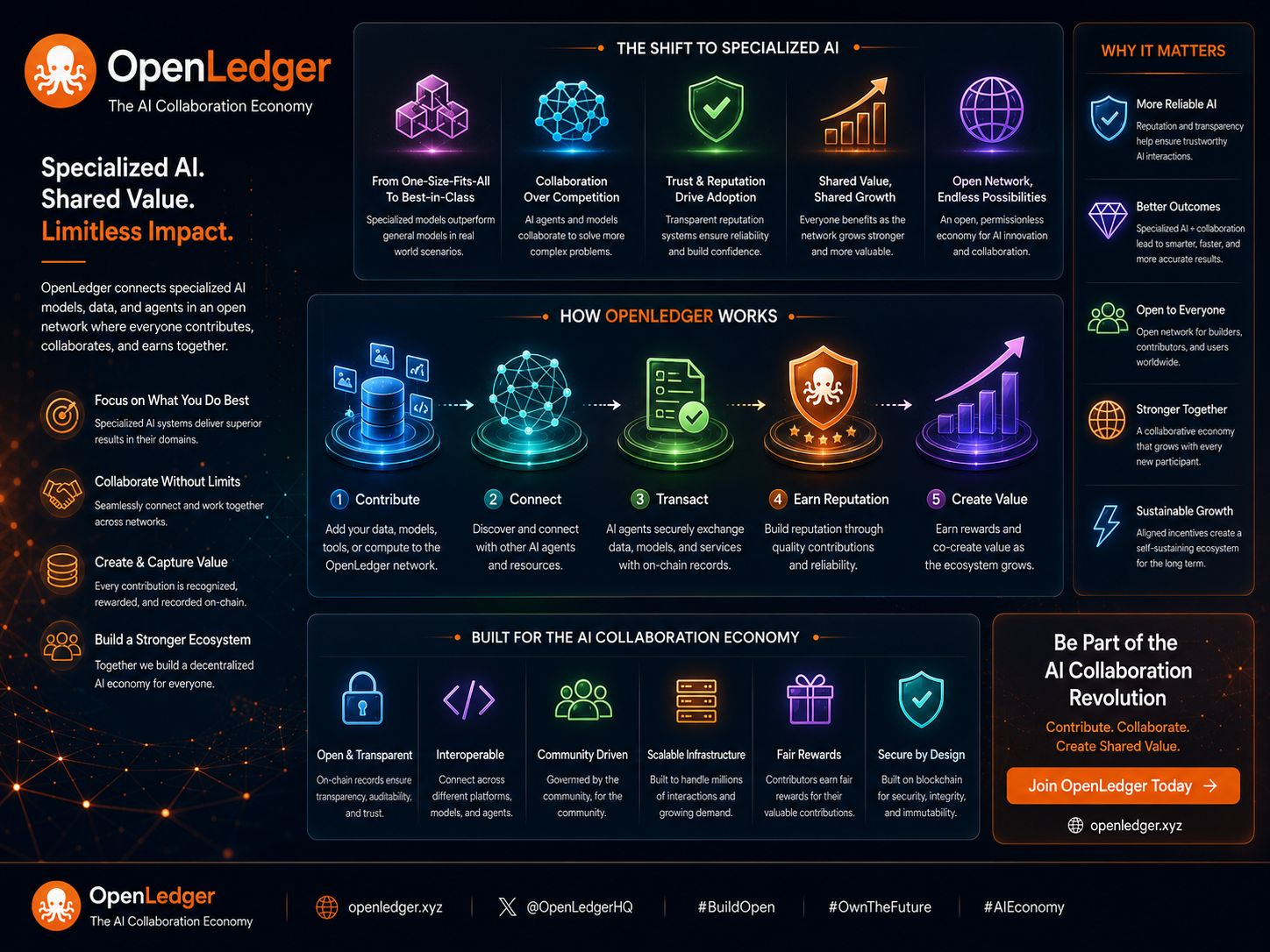
Imagine a future workflow where one AI agent gathers market research, another evaluates legal requirements, another analyzes financial risks, and a fourth coordinates execution. No single system does everything. Instead, multiple AI agents collaborate to complete a task. In many ways, that resembles how human organizations already operate today.
The challenge is that collaboration requires coordination.
As the AI ecosystem becomes more fragmented and specialized, intelligence alone stops being the most important factor. The ability for systems to interact, exchange value, and cooperate becomes equally important. Without coordination, specialization creates silos. With coordination, specialization creates powerful networks.
That's one reason #OpenLedger has caught my attention.
The project seems to be built around the assumption that AI's future will be distributed rather than centralized. Instead of treating data, models, and agents as isolated resources locked inside separate platforms, OpenLedger approaches them as participants in a larger ecosystem. The idea isn't just to create intelligence. It's to create an environment where different forms of intelligence can interact and generate value together.
The more I think about it, the more it reminds me of how modern cities function. A city works because thousands of specialists perform different roles. Teachers educate students. Doctors provide healthcare. Engineers design infrastructure. Businesses deliver products and services. None of them operate alone. They rely on roads, communication networks, financial systems, and shared infrastructure that allow everything to work together.
AI may eventually require similar foundations.
As more specialized models and agents emerge, the industry will need systems that help coordinate ownership, incentives, contributions, and value exchange. The challenge won't simply be creating smarter AI. It will be creating networks where intelligence can collaborate efficiently at scale.
This is where OpenLedger's vision starts to feel relevant. The protocol appears to focus on the economic layer surrounding AI. It creates a framework where data can have value, models can be monetized, agents can participate, and contributors can remain connected to the ecosystems they help build. Rather than existing as isolated pieces, they become part of a larger network.
Of course, none of this is guaranteed. Building infrastructure is difficult. $OPEN ecosystems require governance, security, scalability, and carefully aligned incentives. But history shows that every major technological shift eventually depends on infrastructure. The internet needed protocols. Global commerce needed payment networks. Cloud computing needed scalable architecture.
AI may be reaching a similar stage.
The next chapter of artificial intelligence might not be defined by one model becoming smarter than everyone else. It may be defined by how effectively millions of specialized systems can work together. And if that future arrives, the platforms that enable coordination could become just as important as the intelligence itself.
That's why OpenLedger feels different to me. It's not trying to build one AI that does everything. It's preparing for a world where countless AI systems do different things and need a way to cooperate, exchange value, and grow together.