
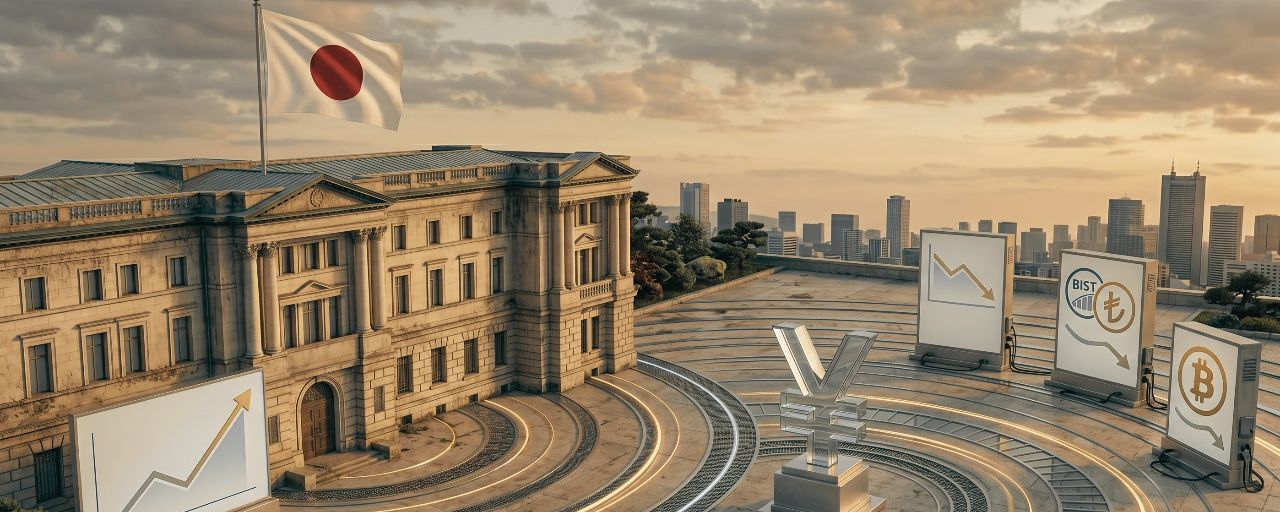
While all eyes on Wall Street are fixed on the new Fed Chair, or more precisely, on Kevin Warsh’s first press conference coming up on June 17, I believe the actual decision shaping the fate of global markets is being drafted in a completely different capital: Tokyo.
The Bank of Japan (BOJ) is expected to raise its policy rate from 0.75% to 1.0% at its June 15-16 meeting. Markets have already priced in this move with a 97% probability. A 25-basis-point hike might look negligible at first glance, but context changes everything: Japan hasn't seen this level since 1995. That’s 31 years. An entire generation.
The Silent Power of the Carry Trade
To understand why a decision made in a distant Tokyo boardroom can send shockwaves through the stock exchanges of Istanbul, New York, and Frankfurt, we need to talk about the "yen carry trade."
The Mechanics of Cheap Money. For three decades, Japan has served as the world's cheapest source of capital. Near-zero interest rates offered global investors a simple mathematical equation: borrow yen from Japan, invest in high-yield assets elsewhere, and pocket the difference.
The Scale of the Trade. The sheer magnitude of this system is clearly outlined by Bank of America’s calculations. Japan is currently the largest foreign holder of US Treasury bonds, holding approximately $1.24 trillion, the highest level since February 2022. Having continued to buy US Treasuries in 13 of the last 14 months, it’s clear that the carry trade is still very much alive, massive, and functioning as the backbone of global liquidity.
Is History Repeating Itself?
The unwinding of the carry trade is not a new concept on Wall Street. Following the BOJ's surprise rate hike in August 2024, the Nikkei 225 plummeted by 12% in a single day, while the S&P 500 quickly lost 6%. Bitcoin took a massive hit, dropping 25% from $64,000 to $49,000 over the course of a week.
A Pattern of Corrections. Subsequent examples have followed a strikingly similar path:
After the March 2024 BOJ hike, Bitcoin fell 23%.
Following the July 2024 hike, it dropped 25%.
After the January 2025 hike, it saw a 30% decline.
And after the latest December 2025 hike, Bitcoin retreated to $86,000.
It's no wonder BCA Research describes this structure as a "ticking time bomb." The larger the system grows, the more violent its unwind becomes.
Why is This Time Different?
A few key variables are adding entirely new dynamics to the current picture.
Inflation and Growth Dilemma. First, Japan’s inflation outlook has shifted. The BOJ revised its core inflation forecast for fiscal year 2026 to 2.8%, making policy normalization an absolute necessity. Simultaneously, the growth forecast was lowered to 0.5%. This leaves the boardroom facing a classic central bank dilemma: fighting inflation versus supporting growth.
Geopolitical Shifts and Energy. Second, the geopolitical context has transformed. Throughout the Iran conflict, energy prices drove Japan's import inflation higher. However, the peace deal announced by Trump on June 14, set to be signed in Switzerland on June 19, will reopen the Strait of Hormuz. Oil prices are already pulling back, but the BOJ’s upcoming decision hasn't quite been priced in this new equilibrium yet.
Leadership Uncertainty Third, and perhaps most critically, BOJ Governor Kazuo Ueda was hospitalized just before the meeting. As Bloomberg noted, this development has sparked market anxiety about the central bank's ability to communicate its message. Even the way this rate decision is announced now carries extraordinary weight.
What Does This Mean for Emerging Markets and Turkey?
At first glance, a BOJ decision might seem like a distant development. However, reading local markets has become impossible without understanding the flow of global liquidity. I closely monitor the carry trade unwind spilling over into our markets through two main channels:
The Direct Channel. As the yen strengthens, capital flight from emerging market assets accelerates. Borsa Istanbul experiences foreign investor outflows, putting pressure on the Turkish Lira. Historical data show that during the last three BOJ hikes, the BIST dropped by an average of 4% to 7%.
The Indirect Channel. As global risk appetite diminishes, borrowing costs for emerging markets surge. The Treasury’s external borrowing margins widen, and the corporate Eurobond market can face severe contractions.
Ticking Time Bomb or a Passing Wave?
Right now, two distinct schools of thought are clashing.
The Systemic Risk Camp. The first camp, including BCA Research, Bank of America, and several US-based analysts, argues that the sheer size of the carry trade now poses a systemic risk. As Goldman Sachs analyst Geoffrey Kendrick puts it: "This time might be different because domestic bond yields are becoming competitive for Japanese investors."
The Normalization Camp. The opposing camp, supported by platforms such as Advisor Perspectives and LondonCryptoClub, argues that this decision is merely "normalization" and that doomsday scenarios are overblown. They argue that the portfolio behavior of Japanese institutional investors won't change overnight, and a slow unwinding of the carry trade is a process markets can easily absorb.
Conclusion: An Actor We Cannot Ignore
We will see which side is right over the coming weeks. But one thing is certain: The BOJ's decision arrives just one day before the Fed's decision. This sequencing is not a coincidence. Tokyo wants to show that it is no longer just following Wall Street's lead, but is an independent actor in global monetary policy.
For investors, deciphering a Tokyo interest rate decision is no longer just an academic exercise. In eras when global capital flows shift direction, the central question of portfolio management becomes: When the risk-off wave hits, how quickly will the exits from emerging markets be?
Nobody has the exact answer. But we are obligated to ask the question. Because the liquidity architecture of the last 30 years of capitalism is being quietly but surely rebuilt, and the chief architect is now sitting in Tokyo.
References
(Bank of America Global Research, 2026, Global Impact of BOJ Rate Shift)
(BCA Research, 2026, Carry Trade Analysis)
(Bloomberg, 2026, BOJ Ueda Hospitalization)
(CoinDesk, 2026, BOJ April Meeting Minutes, )
(BeInCrypto, 2026, BOJ Rate Hike Analysis)
(Advisor Perspectives, 2026, Japan Normalizing)
(OFX, 2026, Global Impact of Japan's Rate Shift)
(Bitcoin.com, 2026, Trump Iran Deal)