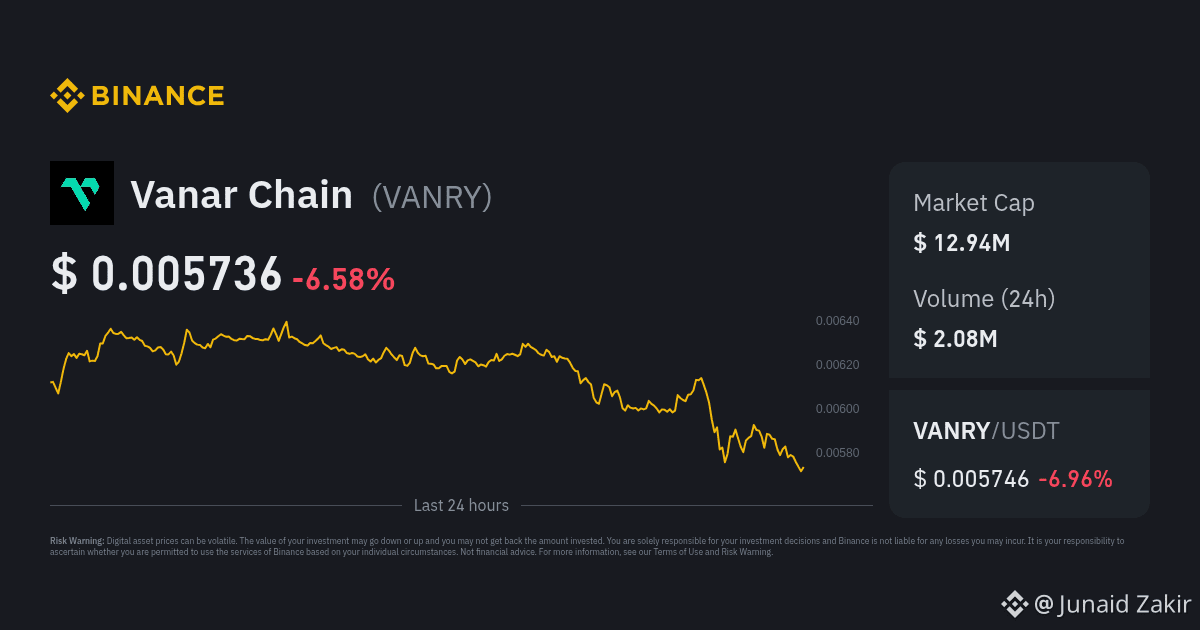
$VANRY Chain positions itself as an AI-native Layer-1 built to make on-chain data, semantic memory, and AI logic first-class primitives for Web3 applications. Unlike general-purpose EVM chains that retrofit AI features, Vanar’s stack — including components like Kayon (on-chain AI logic) and Neutron (semantic compression/storage) — is explicitly designed to support AI agents, persistent data, and low-cost deterministic transactions. This architecture aims to lower the engineering friction for builders who need vector search, similarity queries, or on-chain inference close to transaction execution. �
Vanarchain +1
From a tokenomics and security perspective, $VANRY functions as the network’s utility and incentive token. The protocol documents state a capped maximum supply (2.4 billion VANRY) and an issuance model that emphasizes block rewards for validators and participants rather than open, continuous minting — a design intended to align long-term security incentives while preserving predictable supply economics. For traders and stakers, understanding circulating vs. max supply and the schedule of block rewards is critical when modeling dilution risk and staking yields. �
Vanarchain Documentation +1
Adoption signals are mixed but trending positive. On-chain analytics and market trackers show active listings and liquidity across exchanges, while ecosystem updates highlight developer tooling (documentation, CreatorPad/Kickstart) and partnerships that target gaming, PayFi, and tokenized real-world assets. These product moves are consistent with Vanar’s stated goal of capturing demand where persistent data and AI logic materially improve UX (e.g., gaming economies, creator platforms, and AI-driven DeFi strategies). Still, as with any young L1, actual product-market fit depends on developer traction, meaningful mainnet dApp usage, and third-party integrations. �
Messari +1
Risks to weigh: new L1 projects face the twin challenges of liquidity/market depth and the “chicken-and-egg” problem—apps need users and users need apps. Technical differentiation (AI primitives, deterministic cost model) helps, but ecosystem growth requires robust developer incentives, security audits, and smooth UX for onboarding non-crypto users. Additionally, token price performance will be sensitive to listings, lockups, token unlock schedules, and the rhythm of on-chain activity—factors investors should model explicitly. �
Token Radar +1
Practical takeaway: if you’re bullish on AI + Web3 convergence, Vanar presents a coherent value proposition — an L1 whose primitives are targeted at AI workloads and persistent on-chain memory. For risk-aware exposure, study the $VANRY circulating supply, validator reward schedule, exchange liquidity, and any token lockup/vesting details before allocating capital. Follow the official channels (e.g., @vanar) for roadmap and migration announcements, and track on-chain metrics and exchange liquidity to judge whether the project is moving from promising architecture to live utility.
$VANRY