

The moment that forced me to rethink a lot of comfortable assumptions wasn’t dramatic. No hack, no chain halt, no viral thread. It was a routine operation that simply took too long. I was moving assets across chains to rebalance liquidity for a small application, nothing exotic, just stablecoins and a few contracts that needed to stay in sync. What should have been a straightforward sequence turned into hours of waiting, manual checks, partial fills, wallet state to syncs, and quiet anxiety about whether one leg of the transfer would settle before the other. By the time everything cleared, the opportunity had passed, and the user experience I was trying to test had already degraded beyond what I’d accept in production.
That was the moment I started questioning how much of our current infrastructure thinking is optimized for demos rather than operations. The industry narrative says modularity solves everything: execution here, settlement there, data somewhere else, glued together by bridges and optimistic assumptions. In theory, it’s elegant. In practice, the seams are where things fray. Builders live in those seams. Users feel them immediately.
When people talk about Plasma today, especially in the context of EVM compatibility, it’s often framed as a technical revival story. I don’t see it that way. For me, it’s a response to operational friction that hasn’t gone away, even as tooling has improved. EVM compatibility doesn’t magically make Plasma better than rollups or other L2s. What it changes is the cost and complexity profile of execution, and that matters once you stop thinking in terms of benchmarks and start thinking in terms of settlement behavior under stress.
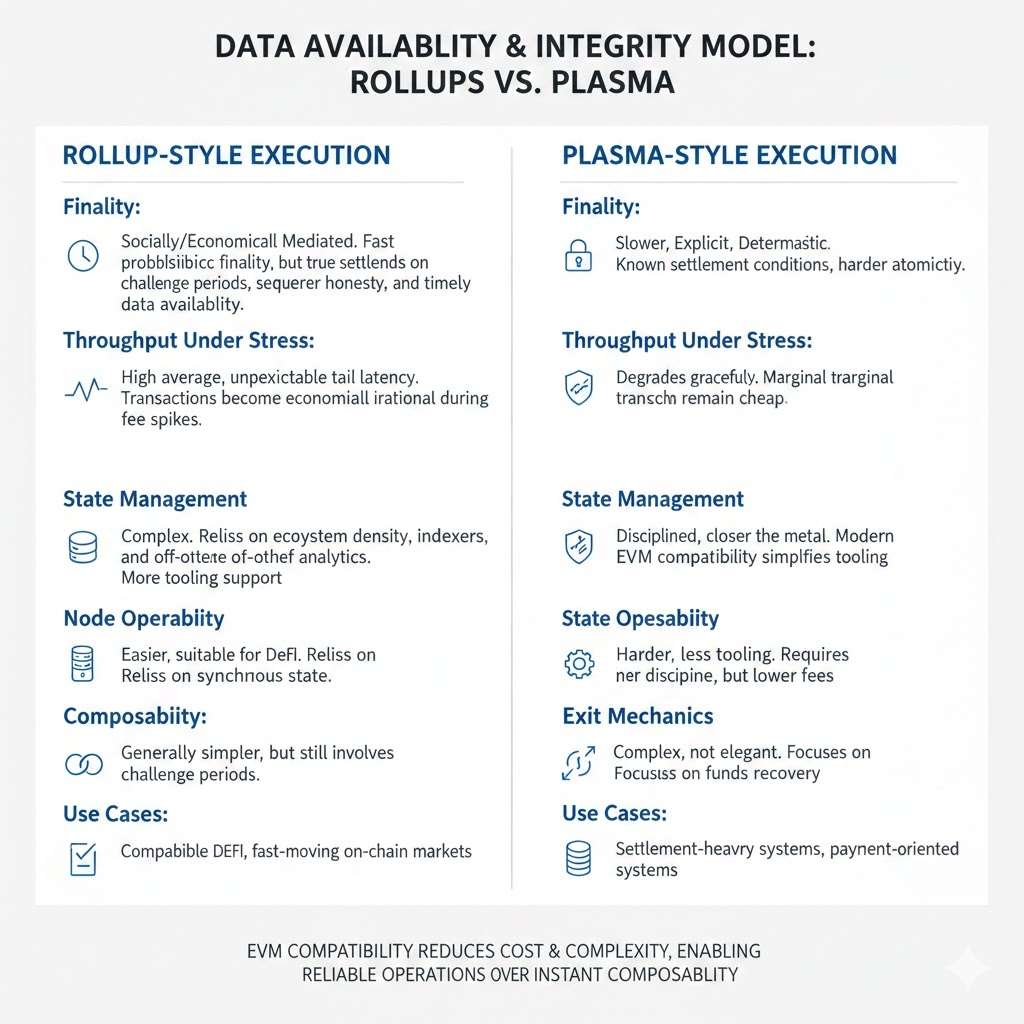
From an infrastructure perspective, the first difference you notice is finality. On many rollups, finality is socially and economically mediated. Transactions feel final quickly, but true settlement depends on challenge periods, sequencer honesty, and timely data availability. Most of the time, this works fine. But when you run your own infrastructure or handle funds that cannot afford ambiguity, you start modeling edge cases. What happens if a sequencer stalls? What happens if L1 fees spike unexpectedly? Those scenarios don’t show up in happy path diagrams, but they show up in ops dashboards.
Plasma style execution shifts that burden. Finality is slower and more explicit, but also more deterministic. You know when something is settled and under what assumptions. Atomicity across operations is harder, and exits are not elegant, but the system is honest about its constraints. There’s less illusion of instant composability, and that honesty changes how you design applications. You batch more. You reduce cross domain dependencies. You think in terms of reconciliation rather than synchronous state.
Throughput under stress is another area where the difference is tangible. I’ve measured variance during fee spikes on rollups where average throughput remains high but tail latency becomes unpredictable. Transactions don’t fail; they just become economically irrational. On Plasma style systems, throughput degrades differently. The bottleneck isn’t data publication to L1 on every action, so marginal transactions remain cheap even when base layer conditions worsen. That doesn’t help applications that need constant cross chain composability, but it helps anything that values predictable execution costs over instant interaction.
State management is where earlier Plasma designs struggled the most, and it’s also where modern approaches quietly improve the picture. Running a node on older Plasma implementations felt like babysitting. You monitored exits, watched for fraud, and accepted that UX was a secondary concern. With EVM compatibility layered onto newer cryptographic primitives, the experience is still not plug and play, but it’s no longer exotic. Tooling works. Contracts deploy. Wallet interactions are familiar. The mental overhead for builders drops sharply, even if the user facing abstractions still need work.
Node operability remains a mixed bag. Plasma systems demand discipline. You don’t get the same ecosystem density, indexer support, or off the shelf analytics that rollups enjoy. When something breaks, you’re closer to the metal. For some teams, that’s unacceptable. For others, especially those building settlement-heavy or payment oriented systems, it’s a reasonable trade. Lower fees and simpler execution paths compensate for thinner tooling, at least in specific use cases.
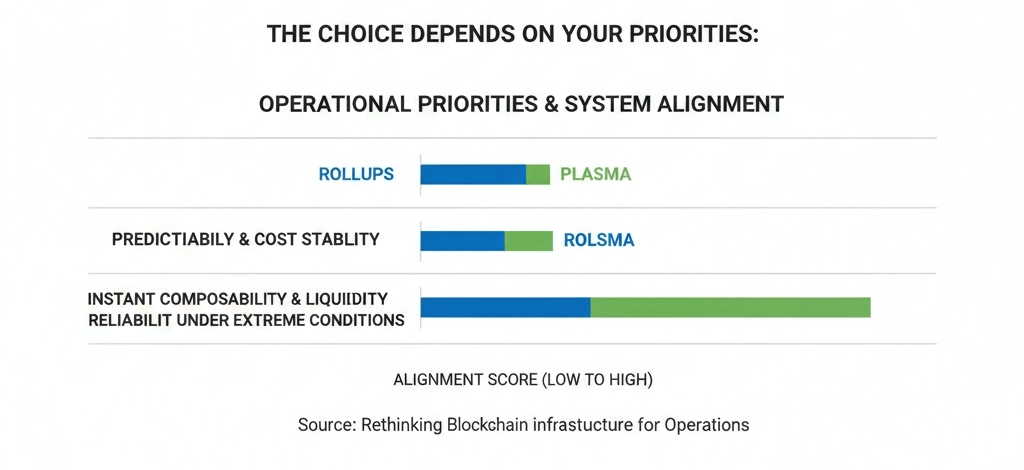
It’s important to say what this doesn’t solve. Plasma is not a universal scaling solution. It doesn’t replace rollups for composable DeFi or fast moving on chain markets. Exit mechanics are still complex. UX around funds recovery is not intuitive for mainstream users. Ecosystem liquidity is thinner, which creates bootstrapping challenges. These are not footnotes; they are real adoption risks.
But treating tokens, fees, and incentives as mechanics rather than narratives clarifies the picture. Fees are not signals of success they are friction coefficients. Tokens are not investments, they are coordination tools. From that angle, Plasma’s EVM compatibility is less about attracting attention and more about reducing the cost of doing boring things correctly. Paying people. Settling obligations. Moving value without turning every operation into a probabilistic event.
Over time, I’ve become less interested in which architecture wins and more interested in which ones fail gracefully. Markets will cycle. Liquidity will come and go. What persists are systems that remain usable when incentives thin out and attention shifts elsewhere. Plasma’s re emergence, grounded in familiar execution environments and clearer economic boundaries, feels aligned with that reality.
Long term trust isn’t built through narrative dominance or architectural purity. It’s built through repeated, unremarkable correctness. Systems that don’t surprise you in bad conditions earn a different kind of confidence. From where I sit, Plasma’s EVM compatibility doesn’t promise excitement. It offers something quieter and harder to market, fewer moving parts, clearer failure modes, and execution that still makes sense when the rest of the stack starts to strain. That’s not a trend. It’s a baseline.

