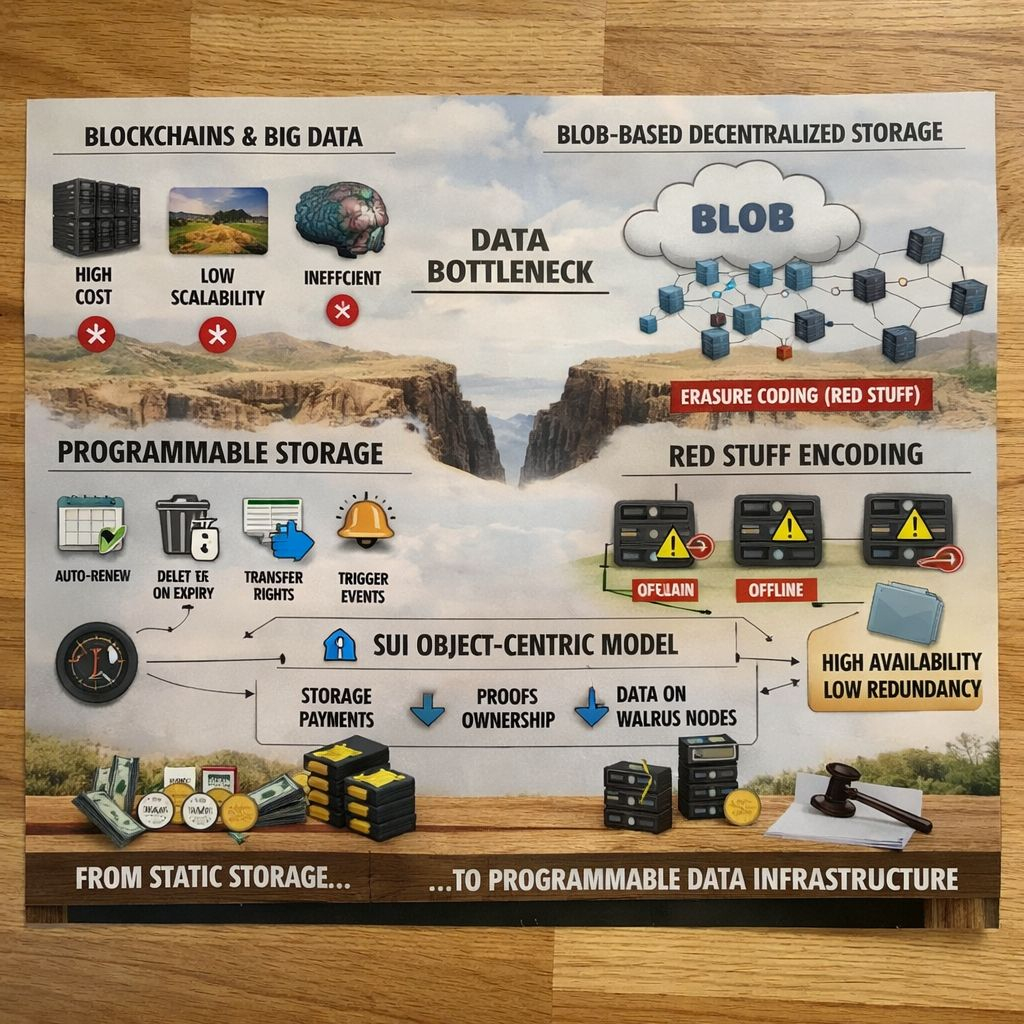
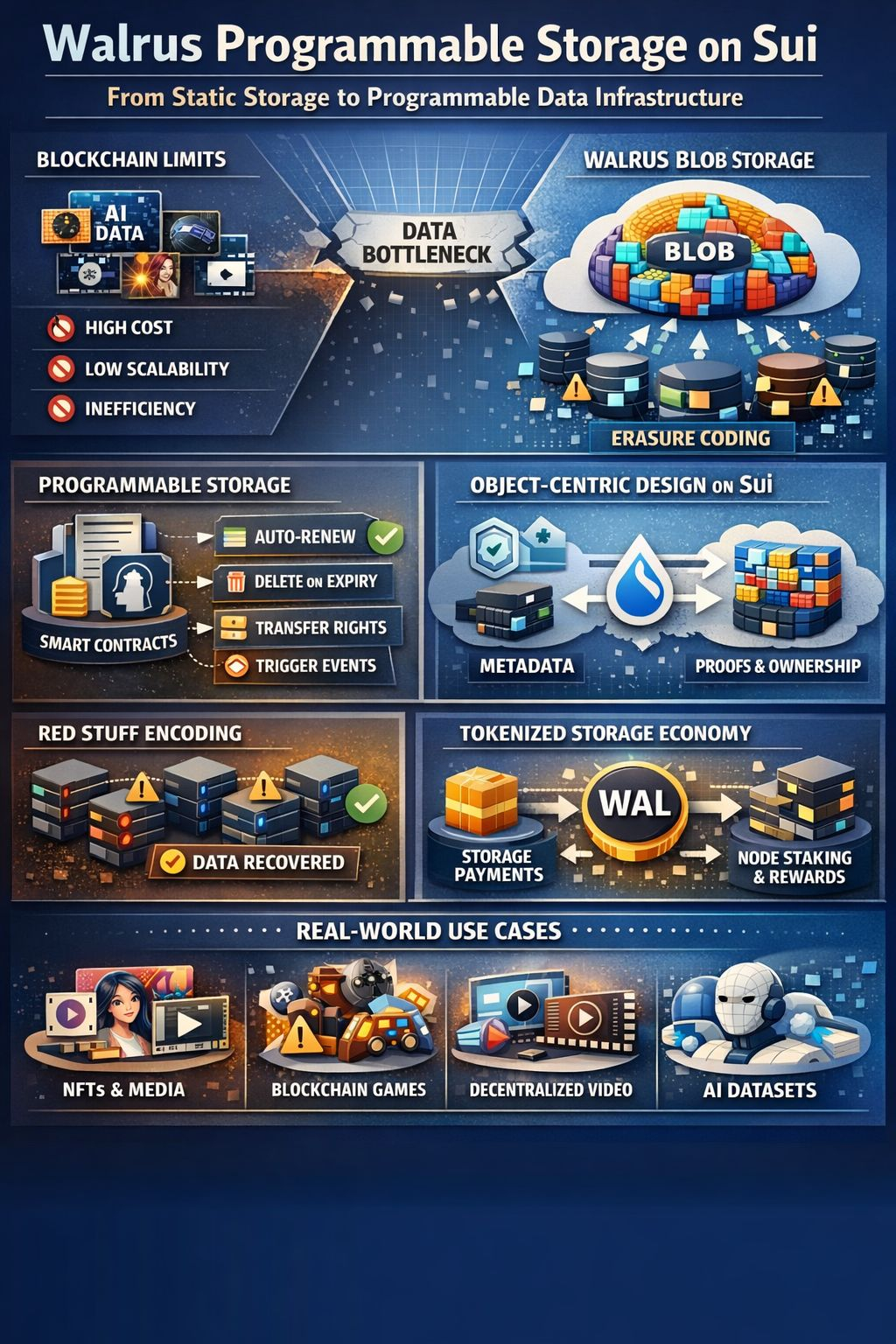
Blockchain technology has always been about decentralized computation and secure transactions, but an age-old problem has been efficient, scalable, and adaptable data storage. However, videos, images and AI datasets have no native method to store their large files on any blockchain stream, as traditional blockchains are incredibly expensive and inefficient at this level of atomicity. Meet Walrus, a decentralised storage protocol on top of the Sui blockchain whose launch of programmable storage is redefining how developers interact with onchain data — from a static liability to an active, programmable resource.
In a nutshell, Walrus is a decentralized storage network designed for what the team calls blob data — Binary Large Objects like media files, datasets, documents, and other large non-structured data. The infrastructure is meticulously built to address fundamental limitations of traditional cloud and conventional blockchain storage systems. Instead of replicating everything over the entire network (an expensive and inefficient way of working) Walrus employs a very efficient form of erasure coding that shards data into many fragments and then securely buoyed and distributed among many independent nodes.
What sets Walrus apart from the competition, such as Filecoin, Arweave, or any other storage protocol for that matter, is programmable storage. Programmable storage is a more advanced feature than basic storage solutions, which already store data and make it available for retrieval. Thus, stored blobs and the storage that they occupy are no longer a passive store — they can be referenced, manipulated, integrated, and even traded directly within smart contracts on the Sui blockchain. The storage-oriented logic gives developers the ability to differentiate more around the storage — so much more than just data hosting.
Walrus does this by deeply embedding with Sui’s unique object-centric and Move based architecture. Walrus stores data encrypted and offchain on decentralized nodes, while the metadata, proofs of availability and control logic are always on Sui. Since Walrus represents data and storage as Sui objects, it allows this data to then be attached directly to programmable logic — enabling entirely new types of rich data-centric applications that would’ve otherwise been impossible.
A relevant example of this can be shown in the implementation of storage automation. To give an example, smart contracts can be coded to automatically renew or to delete the stored data after a time, create alerts based on usage, transfer storage rights from one party to another (which is impossible in normal storage systems). It makes the data interactive/portable, greatly increasing the use case capacity of dApps.
At the core of Walrus is another important innovation, the Red Stuff encoding algorithm. With this algorithm, redundancy can be reduced, while the resiliency remains high — that is, even if a large number of storage node goes offline, data is still accessible. This enhances dependability and decreases prices big time in comparison with conventional methods.
In addition to the above technical progress, Walrus also provides a tokenized storage economic ecosystem, which is based on the native WAL token. It is used as the payment token for storage, as the staked token that incentives secure and performant nodes and as the governance token for decentralized governance. This results in an incentive structure that balances reliability and sustainability: Node operators stake WAL to participate in hosting data and securing the network.
Another key aspect of this coupling is the synergistic nature of Walrus with Sui’s high-throughput, low-latency infrastructure. The parallel and low-finality nature of transaction processing on Sui can allow Walrus storage interactions to be very cheap and efficient in contrast to other blockchain environments. Such design choice renders it desirable for fast-access use cases of big datasets — NFT platforms, decentralized media services, games, and AI training frameworks.
To sum up, Walrus programmable storage on Sui is spearheading a transformation of the way blockchain data is structured, traded and used by using decentralized standing, cost-efficient encoding, and onchain programmability — treating data not merely as an immutable asset but a dynamic resource in value chain. A new kind of application can now be built where data is not just stored — but it is owned, governed, automated and woven deeply into application logic. Touching on just one part of the complex ecosystem of Web3, blocks will demand more sophisticated data management as blockchain pallets continue to advance, and Walrus could lay the foundational approach for data in Web3 for years to come. @Walrus 🦭/acc #walrus $WAL