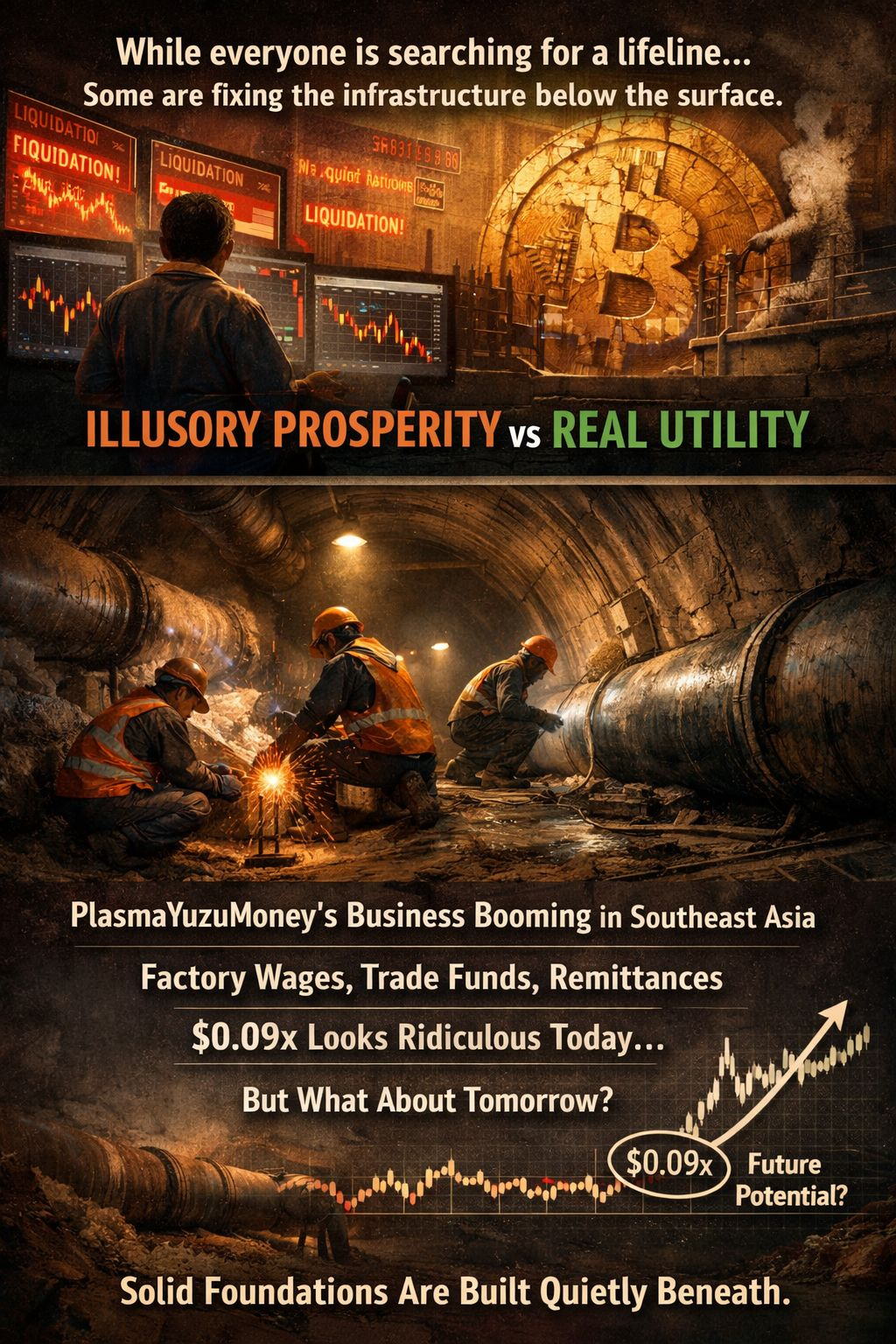
Last night, watching massive liquidation waves roll across the chart after the big plunge, one phrase came to mind: illusory prosperity.
After staying in this market long enough, we’ve become conditioned to chase explosive volume spikes and flashy green candles. We cling to the hope that some sudden rally or new narrative will pull us back to breakeven. That anxiety exists because our assets are too fragile—so fragile that even a minor shake makes it feel like everything could collapse.
But in the middle of that panic, I started paying attention to something completely different: small business operators in Southeast Asia who barely check crypto timelines at all.
And the contrast was striking.
While we were mourning a 10% drop, PlasmaYuzuMoney’s activity in Southeast Asia was growing steadily, against the market trend. Their Neobank has already locked in $70 million within just a few months.
This capital is nothing like speculative crypto funds.
It’s payroll money for factories, inventory money for traders, and remittances sent home by migrant workers.
This money doesn’t care about narratives.
It only cares about reliability and smooth flow.
And Plasma’s role here is so understated that it almost feels dull.
No flashy disruption slogans.
Just zero gas fees, instant settlement, and direct integration with traditional banking systems.
It’s like underground city drainage systems—nobody notices them until a flood hits or the infrastructure fails. Only then do people realize how critical those invisible pipelines really are.
So why does a price like $0.09x look ridiculous today?
Because the market has a distorted sense of time.
Retail traders measure progress in days—no updates means the project is “dead.”
But real-world adoption is measured in years.
Regulatory approvals, merchant onboarding, bank integrations—these are slow, messy, unglamorous tasks. But they’re the real foundation.
The current low valuation is the market treating a heavy infrastructure project like a speculative meme asset. That mismatch is exactly where the opportunity lies.
Imagine that by 2026, even 5% of Southeast Asia’s cross-border transactions move through this invisible pipeline. That’s settlement volume in the billions.
Looking back from that future, today’s chart would look like a once-in-a-lifetime entry point—while at the time, everyone was panicking over falling prices.
This isn’t just investing. It’s recognizing where real power is accumulating.
I’d rather grow old holding this “boring underground pipeline” than chase glittering castles in the sky.
When the storm ends, it’s never the loudest voices that survive—
it’s the systems that were built deepest into the ground.