

Most blockchains sound confident on paper, but awkward in real life. They promise adoption, yet the moment a normal user hits a wallet pop-up, a fee spike, or an unexpected delay, the experience breaks and the user quietly disappears. Vanar does not feel like it was designed in isolation. It feels like it came from people who have already watched users drop off and asked, honestly, why did that happen?
The best way I can describe Vanar is not as a piece of infrastructure, but as a quiet decision to stop testing people’s patience. Instead of asking users to learn how blockchains behave, Vanar tries to behave in a way users already understand.
Predictable Costs Build Trust Before Anything Else
In real products, price confusion is poison. People do not mind paying small fees, but they hate not knowing what will happen next. Many chains still treat fees like a moving target, something users must constantly adapt to. Vanar goes the opposite way and anchors transaction costs to a stable, real-world value.
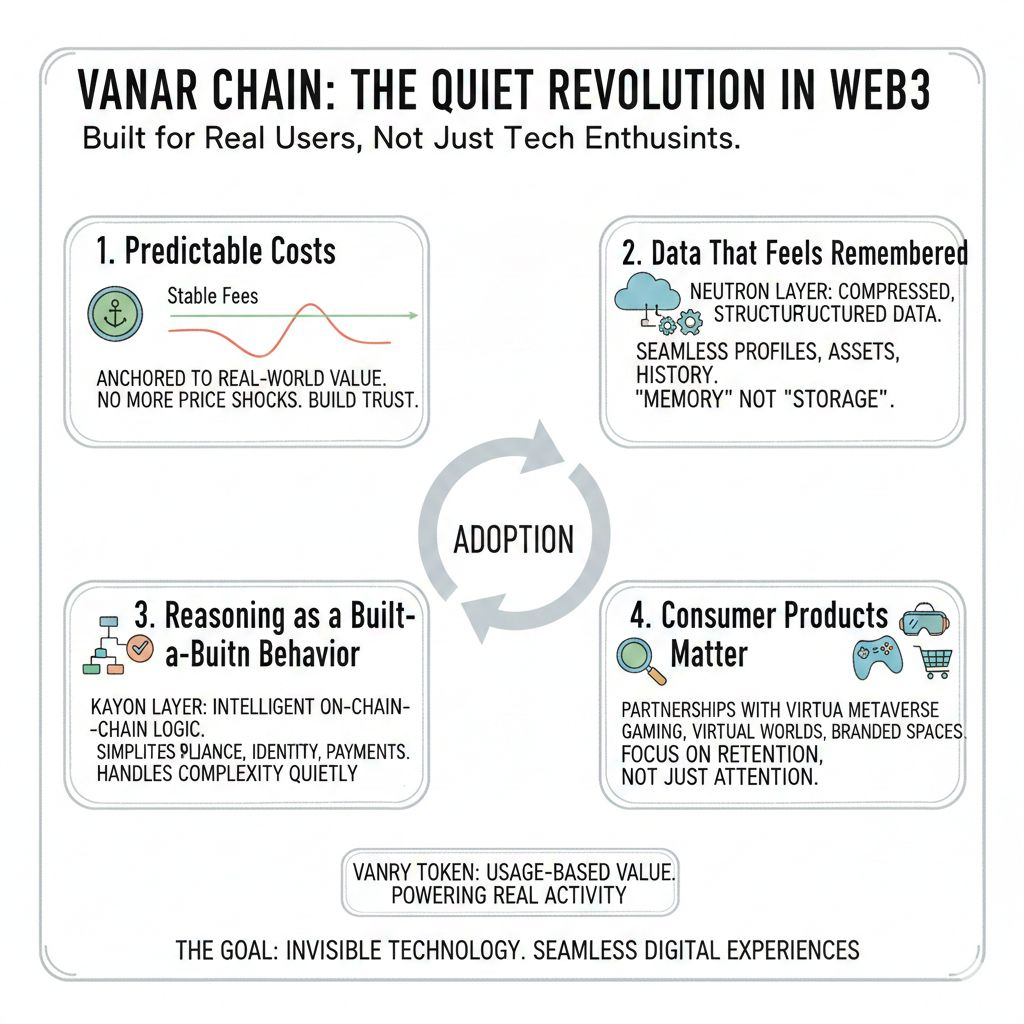
This choice is less technical than it sounds. It removes anxiety. When users know that clicking a button today will cost roughly the same tomorrow, they stop thinking about the network and start focusing on what they came to do. Games become playable. Marketplaces feel safe. Digital experiences feel normal.
That sense of normality is rare in Web3, and it is usually the first thing mainstream users look for.
Data That Feels Remembered, Not Just Stored
Another place where Vanar feels unusually practical is how it treats data. Most blockchains store information, but recalling or reusing it later often feels clumsy. Vanar’s Neutron layer treats data more like memory than storage.
Memory matters because real applications are built on continuity. Profiles, assets, histories, permissions, and context all need to carry forward smoothly. By focusing on compressed, structured data that applications can easily reference, Vanar is clearly thinking about long-term use, not one-time transactions.
This is the difference between a chain that records activity and a chain that supports lived digital experiences.
Reasoning as a Built-In Behavior
Speed is easy to advertise. Intelligence is harder to show, but far more valuable. Vanar’s Kayon layer points toward a system where interacting with on-chain data does not always require technical tools or deep blockchain knowledge.
Instead of forcing users or teams to translate raw data into meaning elsewhere, the idea is to bring reasoning closer to the system itself. For real-world use cases like payments, identity, and compliance-heavy environments, this matters. It reduces friction not by hiding complexity, but by handling it quietly.
That is usually how good systems earn trust.
Why Consumer Products Matter So Much
Vanar’s close relationship with consumer-facing ecosystems like Virtua Metaverse is not accidental. Gaming, virtual worlds, and branded digital spaces are unforgiving environments. If something feels slow, confusing, or expensive, users do not complain. They leave.
Building infrastructure that survives in those environments forces discipline. It pushes teams to prioritize stability, clarity, and repeat behavior over flashy metrics. Vanar’s focus here suggests a long-term mindset centered on retention, not just attention.
Where VANRY Fits Naturally
VANRY makes the most sense when viewed as a usage token, not a story token. Its role is tied to how the network functions, how data is handled, and how applications operate over time.
This fits Vanar’s broader philosophy. If user costs remain predictable, token value must come from real activity and sustained demand, not constant excitement. That path is slower, but it is also harder to fake.
A Subtle but Important Direction
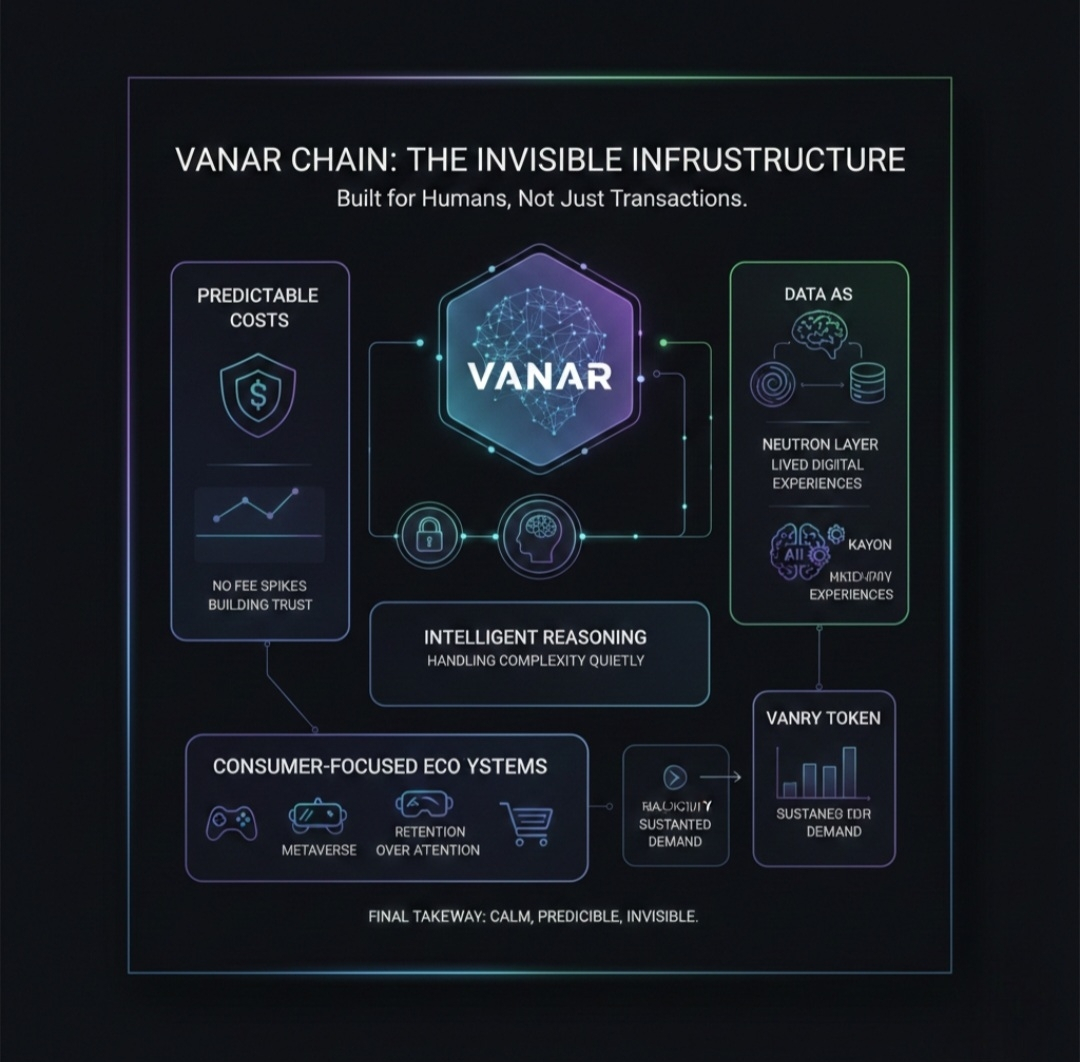
Recently, Vanar’s direction feels more focused. Instead of positioning itself everywhere, it is presenting a clearer picture of an integrated stack where execution, memory, and reasoning work together. It is less about loud announcements and more about quiet alignment.
That kind of clarity usually shows up when a team knows who they are building for.
Final Takeaway
Vanar’s strength is not loud innovation, but the decision to build blockchain infrastructure that feels calm, predictable, and almost invisible—because real adoption begins when users stop noticing the technology at all.