
When I look at most Layer-1 blockchains, I often get the same feeling:
everything is technically impressive, but strangely unhuman.
We talk endlessly about speed, throughput, and architecture diagrams, yet rarely ask the most important question:
where do real users actually struggle?
That’s why Vanar Chain stands out to me. It begins with a different question altogether:
“Why do people leave blockchains?”
What problem is Vanar really trying to solve?
Most users don’t abandon blockchains because they’re slow.
They leave because:
onboarding feels confusing
fees change without warning
every step interrupts the experience
Vanar’s perspective is that adoption isn’t a marketing problem — it’s a behavior problem.
If a user has to stop and think at every interaction, they won’t come back, no matter how fast the chain is.
A key difference: Vanar doesn’t want to be an “empty chain”
Many blockchains launch like newly built cities — the roads exist, but no one lives there.
Vanar is clearly trying to avoid that mistake.
Instead of launching infrastructure alone, it brings real products with it:
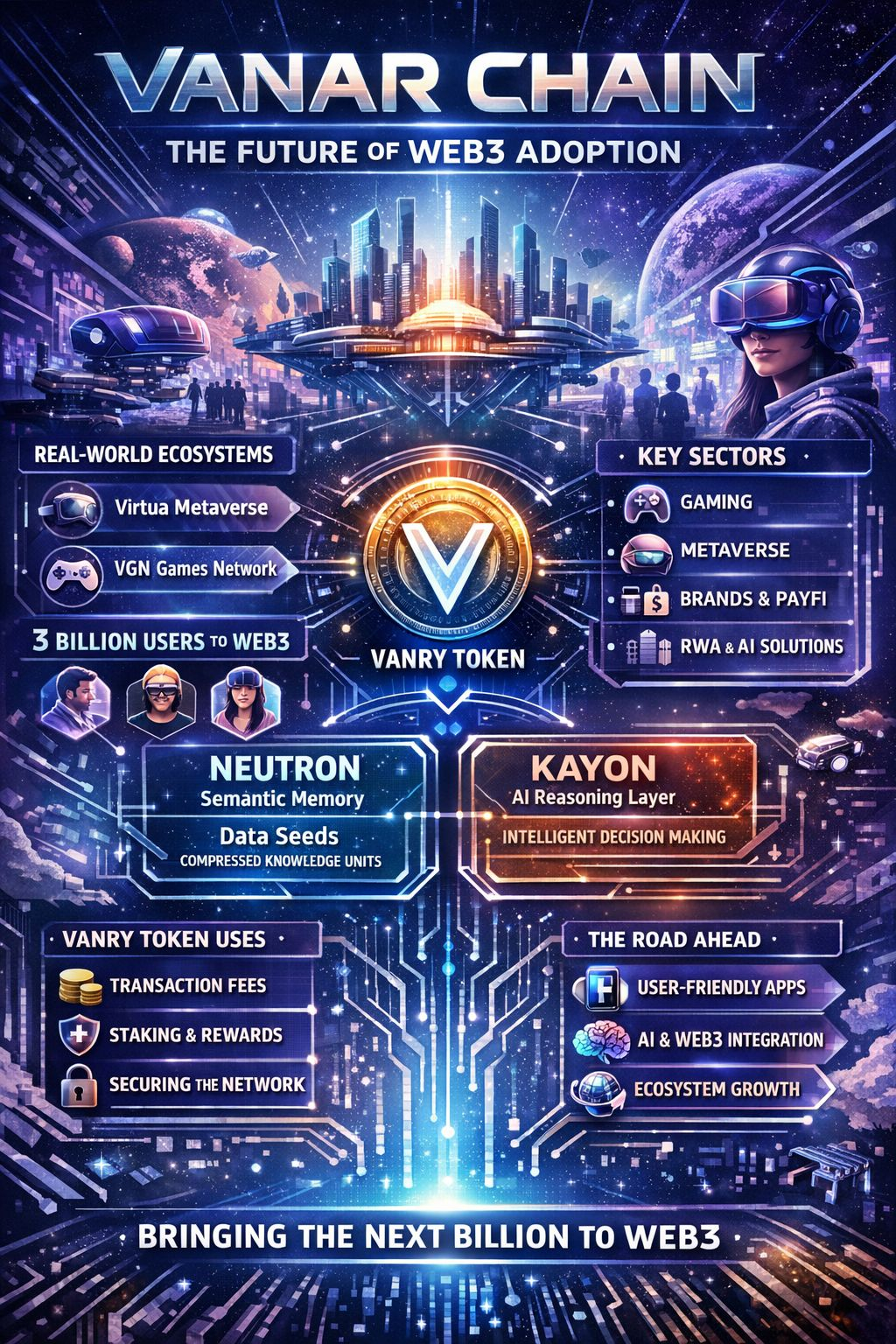
Virtua Metaverse
VGN Games Network
These aren’t decorations or demos.
They are places where real users actually touch the chain.
Vanar’s value won’t come from developer excitement alone, but from how often users return.
The AI angle — but in a practical way
Today, almost every project claims to be “AI-powered,” but in most cases AI is just a buzzword.
Vanar’s approach feels different because it focuses on infrastructure-level design, not flashy promises.
Neutron: Giving the blockchain memory
Traditional blockchains store data, but they don’t remember it in a meaningful way.
Neutron’s idea is to store data so applications can later understand it, reuse it, and build on it.
It’s like giving the chain memory instead of just an archive.
Kayon: Teaching the chain how to reason
If Neutron is memory, Kayon is logic.
Kayon aims to allow AI systems to:
understand context
follow rules
make automated decisions
If executed well, this could be powerful for games, financial logic, and brand automation in the future.
The VANRY token — beyond speculation
VANRY wasn’t designed only for trading.
It plays a role in the chain’s everyday operations:
transactions
staking
network security
What matters is that Vanar is trying to tie the token’s value to actual ecosystem activity, not just hype.
Why Vanar could actually matter
Because Vanar accepts an uncomfortable truth:
Most people don’t want to learn blockchain.
Gamers want fun.
Brands want simplicity.
Mainstream users don’t tolerate friction.
Vanar’s entire design philosophy seems focused on reducing that friction.
What does their plan look like?
Rather than moving fast, Vanar appears to be building steadily:
turning AI-native ideas into usable tools
keeping the developer environment familiar
growing organic usage through ecosystem products
strengthening community and staking over time
It may look slow, but this is often how long-lasting systems are built.
What should people watch going forward?
Price charts alone won’t tell the Vanar story.
The real questions are:
Are builders actually using Neutron?
Is Kayon solving real problems, or staying conceptual?
Are Virtua and VGN bringing users back repeatedly?
Is activity recurring, not just one-time experimentation?
These answers will define Vanar’s future.
Benefits, in simple terms
For users:
Blockchain feels less visible, experiences feel more natural.
For builders:
AI-friendly tools on a chain where real users already exist.
Is Vanar just an idea?
No.
There is a live chain, ecosystem products, staking infrastructure, and an active community.
Vanar clearly exists — the real question now is how well it executes.

What happened in the last 24 hours?
There were no loud or flashy announcements — and that may actually be a good sign.
Most discussion around Vanar focused on usage, retention, and ecosystem behavior, not price noise.
That’s often what happens when a project slowly shifts from narrative to reality.
Final thought
Vanar Chain is built on the belief that the next billion users won’t learn crypto —
crypto itself will have to behave more like humans do, and Vanar is quietly moving in that direction.