Bitcoin remains the most liquid and trusted asset in the digital economy. Trillions of dollars in value have flowed through its network over the years, and it continues to serve as the primary settlement layer of crypto markets. Yet despite this dominance, Bitcoin’s liquidity is largely static. Most BTC sits idle, moved infrequently, and rarely participates in high-velocity financial activity such as derivatives trading, real-time swaps, or advanced DeFi strategies.
This is not because demand is missing. It is because Bitcoin, by design, prioritizes security and decentralization over speed and flexibility. Confirmation times are slow, block space is scarce, and programmability is intentionally limited. These characteristics protect Bitcoin’s role as sound money, but they also restrict how efficiently its liquidity can be deployed.
Plasma (XPL) is emerging as a response to this structural imbalance. Rather than attempting to alter Bitcoin itself, @Plasma is building a high-performance execution environment that allows Bitcoin-anchored liquidity to operate at modern market speeds. Its approach focuses on execution efficiency, separation of concerns, and infrastructure readiness—qualities increasingly demanded by traders, protocols, and institutional participants.
This article explores Plasma’s vision, architecture, recent progress, token economics, and strategic positioning within the broader crypto landscape.
The Structural Problem: Idle Bitcoin Liquidity
Bitcoin’s market depth is unmatched. It anchors global price discovery, dominates derivatives volume, and acts as the reserve asset of the crypto ecosystem. However, most Bitcoin liquidity remains underutilized in on-chain environments.
The reasons are well known:
Slow execution: Bitcoin’s block times and confirmation requirements make it unsuitable for fast trading or dynamic strategies.
Limited programmability: Bitcoin Script is intentionally restrictive, limiting the complexity of financial applications.
High opportunity cost: Using Bitcoin directly for active strategies often means sacrificing speed and capital efficiency.
As crypto markets evolve, participants increasingly expect execution conditions comparable to centralized platforms—low latency, high throughput, and predictable performance. Traditional Bitcoin infrastructure struggles to meet these expectations.
This gap between liquidity and usability is where Plasma positions itself.
Plasma’s Core Thesis: Execution Without Compromising Bitcoin
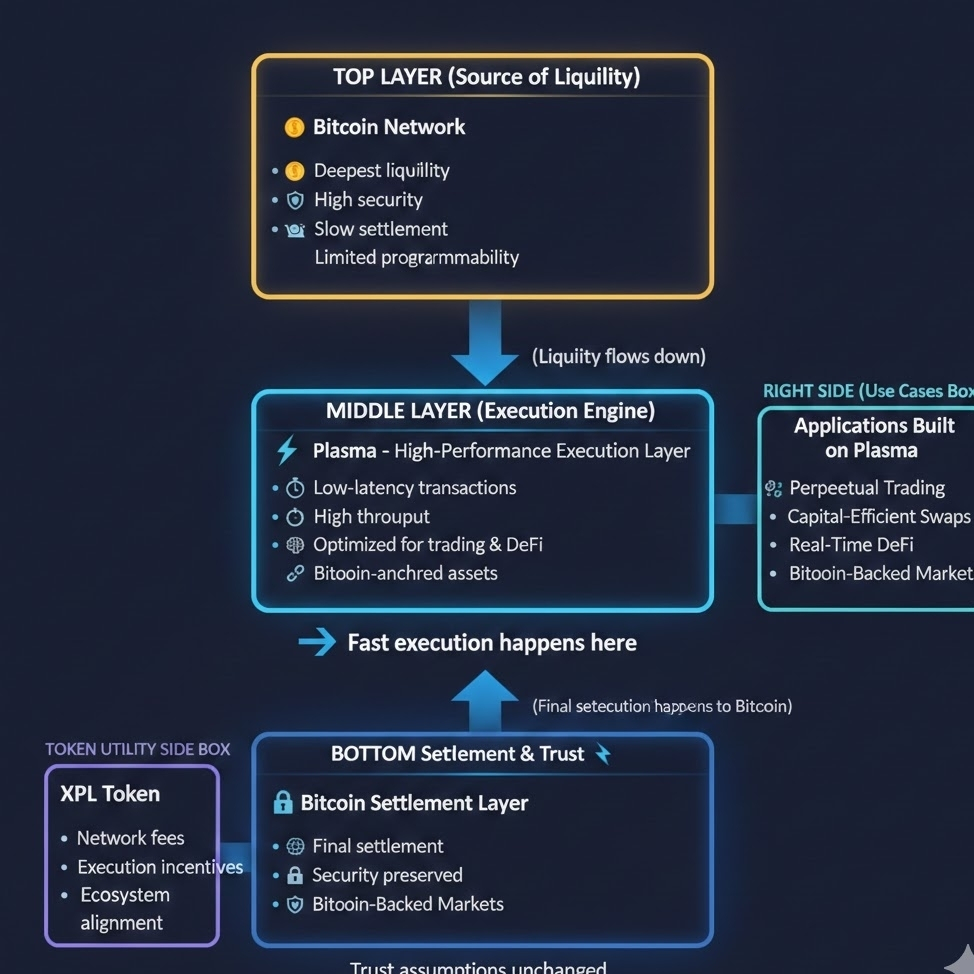
Plasma is not a new Bitcoin competitor, nor is it a replacement Layer-1. Its design philosophy starts from a simple assumption: Bitcoin should remain what it does best—a secure, neutral settlement layer—while execution should happen elsewhere.
By separating execution from settlement, Plasma enables fast, flexible activity without weakening Bitcoin’s core security model. This architectural separation allows Bitcoin liquidity to be used productively while maintaining trust assumptions that market participants already accept.
In practical terms, Plasma acts as a high-performance execution layer where Bitcoin-linked assets can be traded, settled, and composed efficiently.
Why Timing Matters: Market Demands Are Shifting
Crypto infrastructure is entering a new phase. Early cycles prioritized experimentation and narrative-driven growth. Today, the focus is shifting toward reliability, performance, and capital efficiency.
Several trends are converging:
Rising on-chain activity
DeFi, perpetuals, and automated trading systems are pushing networks to their limits.
Institutional participation
Professional capital demands predictable execution, deep liquidity, and robust infrastructure.
Execution sensitivity
In high-frequency and derivatives markets, milliseconds matter. Slow settlement directly impacts profitability.
Bitcoin’s re-centrality
As volatility increases, Bitcoin increasingly acts as the anchor asset for risk management and capital allocation.
Plasma’s execution-first architecture aligns closely with these evolving requirements.
Architectural Overview: Performance as a First-Order Priority
Plasma is engineered with performance at its core. Unlike general-purpose smart contract platforms that attempt to serve every use case, Plasma optimizes specifically for execution efficiency tied to Bitcoin liquidity.
Key Architectural Principles
1. Low-Latency Execution
Plasma’s execution layer is designed to process transactions quickly and predictably, enabling use cases that are impossible directly on Bitcoin.
2. High Throughput Under Load
Stress testing has been a major focus, ensuring that performance remains consistent even during peak demand.
3. Bitcoin-Anchored Liquidity Compatibility
Rather than abstracting away Bitcoin, Plasma is designed to work alongside it, enabling BTC-based assets to move fluidly.
4. Separation of Execution and Settlement
Execution happens fast; settlement retains strong security guarantees. This division reduces bottlenecks while preserving trust.
This architecture allows Plasma to complement Bitcoin rather than compete with it.
Execution Layer vs. Settlement Layer: A Strategic Design Choice
Historically, many blockchains attempted to do everything at once: execution, settlement, consensus, and security all within a single layer. While elegant in theory, this approach often leads to trade-offs that limit scalability.
Plasma takes a different path. By decoupling execution from settlement, it avoids forcing Bitcoin to behave like a high-speed trading engine. Instead, Plasma absorbs execution complexity, allowing Bitcoin to remain stable and conservative.
This mirrors architectural decisions seen in traditional finance, where clearing, settlement, and execution are handled by specialized systems rather than a single monolith.
Recent Network Progress: Signals Over Noise
One of Plasma’s most notable characteristics is its restrained development strategy. Rather than aggressively marketing unfinished features, the project has emphasized measurable infrastructure progress.
1. Network Stability Testing
Recent stress tests indicate that @Plasma maintains consistent performance even under heavy transaction volumes. This is critical for applications like perpetual trading, where congestion can lead to liquidation cascades and systemic risk.
2. Developer Tooling Improvements
Plasma has focused on lowering friction for builders. Improved tooling, documentation, and deployment workflows reduce the cost of experimentation and accelerate ecosystem growth.
3. Liquidity-Focused Application Prioritization
Rather than supporting every possible DeFi primitive, Plasma is prioritizing applications that directly leverage Bitcoin’s capital base. These include:
Perpetual and derivatives markets
Capital-efficient swaps
Trading-oriented liquidity venues
This targeted approach suggests a deliberate focus on real demand rather than speculative experimentation.
Avoiding the Hype Trap
Many crypto projects expand horizontally—launching numerous features and narratives simultaneously to capture attention. Plasma appears to be moving in the opposite direction.
Its development cadence suggests:
Infrastructure readiness over narrative expansion
Performance benchmarks over marketing metrics
Sustainable growth over short-term hype
This discipline may limit short-term visibility but strengthens long-term credibility, especially among serious market participants.
Token Utility: The Role of XPL in the Network
The XPL token is positioned as an operational component of the Plasma network rather than a purely speculative asset. Its economic role is designed to align incentives across participants.
Core Functions of XPL
1. Transaction Fees
XPL is used to pay for activity within the execution layer, creating direct demand tied to network usage.
2. Network Incentives
Participants who support network operations are incentivized through $XPL , aligning performance with rewards.
3. Ecosystem Alignment
By linking token utility to real usage, Plasma aims to ensure that builders, users, and infrastructure providers benefit together.
This utility-first design is increasingly important in a market where users are more critical of token value capture mechanisms.
Economic Sustainability and Long-Term Viability
Token models that rely solely on speculation often struggle to maintain value once narratives fade. Plasma’s emphasis on functional utility creates a more durable economic foundation.
As execution volume grows and Bitcoin-linked applications scale, demand for XPL is expected to correlate with real activity rather than market sentiment alone. This dynamic improves the likelihood of sustainable value accrual.
Competitive Landscape: Where Plasma Fits
Plasma does not compete directly with general-purpose Layer-1s or smart contract platforms. Its differentiation lies in its focus on execution efficiency specifically for Bitcoin liquidity.
Key Differentiators
Bitcoin-centric design rather than asset-agnostic abstraction
Execution specialization instead of broad feature sets
Infrastructure depth over application breadth
This positions @Plasma as a backend execution layer rather than a consumer-facing ecosystem.
Serving a High-Value Niche
Rather than attempting to attract every developer and user, Plasma targets a specific, high-value segment:
Traders requiring fast execution
Protocols dependent on deep, stable liquidity
Systems that benefit from Bitcoin’s capital base
Serving this niche effectively could make Plasma a critical piece of Bitcoin-centric financial infrastructure.
Use Case Outlook: What Plasma Enables
As Plasma matures, several use cases become increasingly viable:
High-frequency Bitcoin derivatives
Capital-efficient liquidity markets
Real-time trading strategies anchored to BTC
Institutional-grade execution environments
These are areas where Bitcoin’s liquidity is valuable but currently underutilized.
Risk Considerations
No infrastructure project is without risk. Plasma’s success depends on:
Adoption by builders and traders
Continued network stability under real-world conditions
Clear integration pathways for Bitcoin-linked assets
However, its focused scope reduces complexity compared to broader platforms attempting to serve every use case.
Final Perspective: Execution as the Missing Layer
Plasma is not attempting to redefine Bitcoin. It is acknowledging Bitcoin’s strengths and building around its limitations. By providing a high-performance execution layer, Plasma enables Bitcoin liquidity to operate at the speed modern markets demand.
In an ecosystem crowded with narratives, Plasma stands out through technical clarity, disciplined execution, and relevance to real capital flows. If adoption continues along its current infrastructure-first path, Plasma has the potential to become a foundational backend for Bitcoin-centric DeFi and trading systems.
Rather than chasing attention, Plasma is addressing a structural inefficiency. And in mature markets, solving real problems tends to matter more than telling compelling stories.