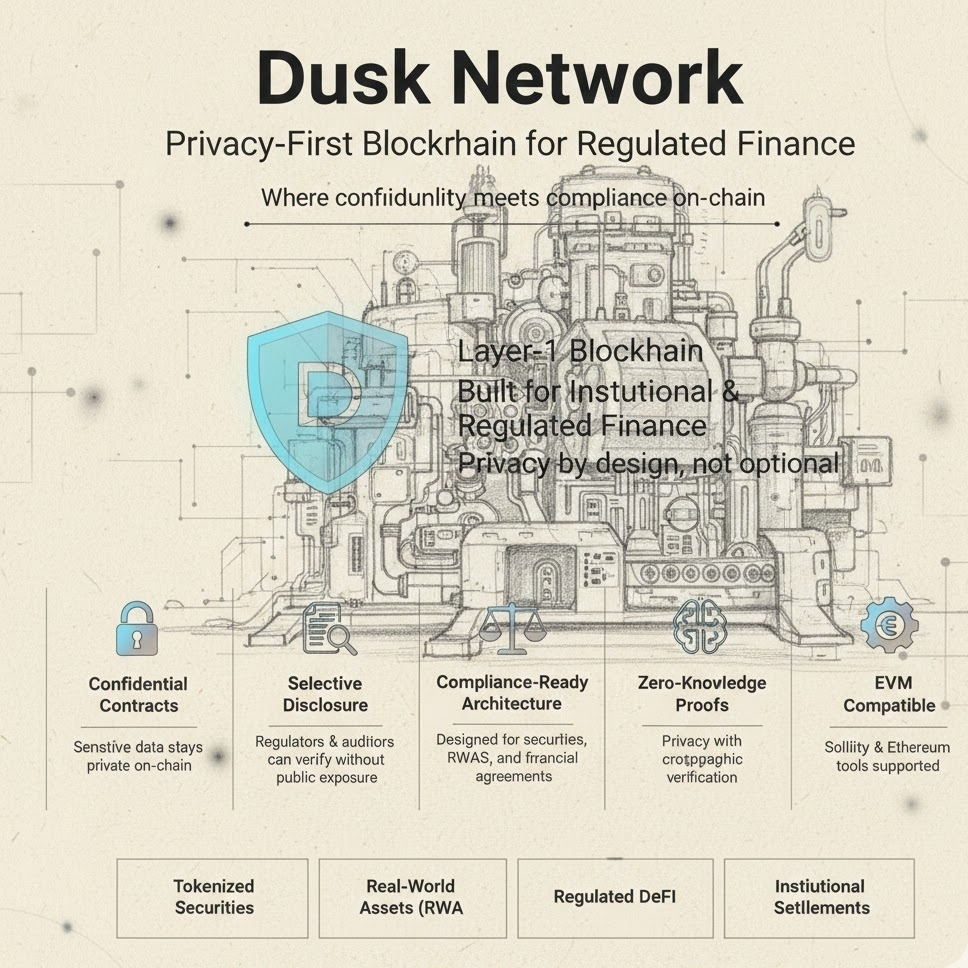
Introduction: A Different Kind of Layer-1 By 2026, the blockchain industry has matured enough that its internal contradictions are impossible to ignore.
For more than a decade, public blockchains optimized relentlessly for transparency, composability, and permissionless access. While this design unlocked powerful new financial primitives, it also created a fundamental mismatch with how real-world finance actually operates.
Traditional finance does not function in a fully transparent environment. Confidentiality is not a luxury it is a requirement. Contracts, ownership records, settlements, and regulatory reporting all depend on controlled disclosure rather than public broadcast. This reality has forced institutions to remain cautious about blockchain adoption, despite the technology’s promise.
Against this backdrop, the @Dusk has taken a markedly different path.
Dusk is not a Layer 1 designed to chase speculative DeFi trends or retail driven hype cycles. It is not competing in the race for maximum throughput, lowest fees, or viral narratives. Instead, Dusk is quietly building infrastructure for a specific and difficult problem: how to bring regulated financial activity on-chain without sacrificing privacy or violating legal frameworks.
This focus places Dusk in a category of its own not as a generic “privacy chain,” but as a blockchain purpose-built for institutional-grade, compliant, and confidential finance.
Why the Standard Crypto Lens Fails to Explain $DUSK
Most crypto projects are evaluated through familiar metrics: TVL growth, ecosystem incentives, retail participation, token velocity, and price action. These metrics make sense for permissionless DeFi platforms but fail almost entirely when applied to Dusk.
Dusk is not designed around public financial experimentation. Its architecture assumes that full data transparency is often unacceptable. Financial agreements, settlement instructions, asset ownership structures, and regulatory disclosures are inherently sensitive. Broadcasting them to a public ledger introduces risks that institutions cannot tolerate.
In traditional systems, privacy is enforced by access control, legal agreements, and closed infrastructure. Dusk asks a more ambitious question:
Can confidentiality be enforced cryptographically, while still benefiting from decentralized settlement and verification?
The project’s answer is a carefully engineered balance between privacy and auditability — a middle ground most blockchains avoid because of its complexity.
Privacy as a Foundation, Not an Add-On
One of the most important distinctions between Dusk and many privacy-focused projects lies in where privacy is implemented.
In many blockchains, privacy is layered on top of an otherwise transparent execution environment. Optional mixers, shielded pools, or specialized transactions coexist with a fundamentally public ledger. This creates fragmented privacy guarantees and often raises red flags for regulators.
Dusk takes a different approach.
Privacy is native to the execution layer. Confidentiality is not an optional feature; it is embedded into how smart contracts operate. Using zero-knowledge proofs and cryptographic primitives, Dusk allows contracts to process sensitive data without revealing that data publicly.
This design enables a crucial capability:
transactions and contracts can be private by default, yet still verifiable when required.
Instead of forcing all participants to see everything, Dusk supports selective disclosure. Authorized entities — such as regulators, auditors, or counterparties — can verify specific claims without accessing the full underlying data.
This mirrors real-world financial workflows far more closely than public execution ever could.
Selective Disclosure: The Missing Link Between Blockchain and Regulation
A common criticism of privacy-focused blockchains is that they obstruct regulatory oversight. Dusk’s architecture directly challenges this assumption.
Selective disclosure allows parties to generate cryptographic proofs that confirm compliance without revealing unnecessary information. For example:
A regulator can verify that a transaction meets KYC or AML requirements without seeing the full transaction history.
An auditor can confirm asset backing or settlement correctness without accessing confidential contract terms.
A counterparty can validate ownership or eligibility without learning unrelated financial data.
This capability is not theoretical. It reflects how compliance works in traditional finance, where institutions disclose information only to authorized entities, not to the public.
By aligning cryptographic privacy with regulatory logic, Dusk positions itself as a bridge rather than a rebellion against existing financial systems.
A Design Philosophy Geared Toward Institutions
Dusk’s communication style reinforces its institutional focus.
A review of the project’s public content — particularly technical discussions and long-form explanations — reveals a noticeable absence of price speculation or promotional narratives. Instead, the emphasis is on:
Explaining zero-knowledge proofs and confidential computation
Detailing validator mechanics and execution logic
Discussing architecture decisions and trade-offs
Exploring asset issuance and lifecycle management
This approach is typical of infrastructure projects targeting developers, enterprises, and regulators, not short-term retail attention.
Rather than selling a vision of instant disruption, Dusk presents itself as a tooling layer — one meant to integrate with existing financial logic rather than replace it overnight.
Tokenized Assets: Where Dusk’s Design Truly Shines
The relevance of Dusk becomes especially clear in the context of real-world asset tokenization.
Tokenizing securities, bonds, funds, or regulated financial instruments requires more than smart contracts. It demands:
Controlled access to sensitive data
Compliance with jurisdictional rules
Reporting and audit capabilities
Protection of investor and issuer confidentiality
Public blockchains struggle here. Exposing ownership records, settlement flows, or contractual logic can violate legal and competitive boundaries.
Dusk’s confidential smart contracts address these challenges directly. Assets can exist on-chain while sensitive information remains protected. Compliance logic can be enforced programmatically, and verification can occur without global transparency.
This makes $DUSK particularly well-aligned with institutional pilots exploring blockchain-based capital markets infrastructure.
EVM Compatibility Without Compromising Privacy
One of the major barriers to adoption for new Layer-1 networks is developer friction. Dusk mitigates this risk through EVM compatibility.
Developers familiar with Solidity and Ethereum tooling can transition more easily to Dusk’s environment. Existing mental models remain relevant, even though the execution context is privacy-aware.
This compatibility does not trivialize Dusk’s architecture — confidential execution still requires new patterns and understanding. However, it significantly lowers the barrier compared to entirely novel virtual machines or languages.
For institutions experimenting cautiously with blockchain technology, this matters. It reduces onboarding time, tooling costs, and integration complexity.
Auditability Without Transparency
Auditability is often conflated with transparency in crypto discussions. Dusk separates the two.
A system can be auditable without being publicly visible. In fact, most real-world audits operate this way. Auditors receive access under legal and procedural constraints, not through open ledgers.
Dusk’s selective disclosure model allows precisely this. Authorized audits can be performed without exposing data to unrelated parties. This preserves confidentiality while maintaining accountability.
For regulated finance, this distinction is not optional — it is foundational.
The Broader 2026 Narrative: Infrastructure Over Speculation
As the crypto industry matures, narratives are shifting. The focus is slowly moving away from short-term yield farming and toward infrastructure that can support real economic activity.
In this environment, Dusk is increasingly discussed not as a privacy token, but as a regulated-finance-ready blockchain.
Market conversations still include price speculation — that is unavoidable — but the dominant discourse around Dusk centers on:
Institutional readiness
Asset tokenization frameworks
Compliance-aware blockchain design
Confidential smart contracts
This positioning differentiates Dusk from generic Layer-1 competitors chasing mass adoption through incentives or throughput benchmarks.
Challenges and Constraints
No serious assessment would be complete without acknowledging the challenges ahead.
Privacy-centric systems face adoption friction. Regulatory frameworks differ across jurisdictions, and institutional requirements are complex. Developers must adapt to new paradigms, even with EVM compatibility. Competition among Layer-1 platforms is intense.
Dusk does not claim to solve all problems. Its scope is deliberately narrow: regulated, confidential, on-chain finance.
This restraint may limit short-term visibility, but it strengthens long-term credibility.
Quiet Execution Over Loud Promises
Perhaps the most defining characteristic of Dusk is its tone.
There are no exaggerated claims of replacing global finance overnight. No aggressive marketing cycles. No promises of instant network effects.
Instead, the project appears focused on methodical execution — building a system that aligns with how institutions actually operate.
In an industry often dominated by noise, this approach stands out.
Conclusion: A Platform Built for What Comes Next
Dusk is not trying to be everything to everyone. It is not chasing retail hype, meme narratives, or unsustainable growth tactics.
It is building infrastructure for a future where blockchain is not an experiment, but a component of regulated financial systems. A future where confidentiality and compliance are first-class citizens, not obstacles to decentralization.
If real-world asset tokenization and compliant on-chain finance continue to grow — as many indicators suggest — platforms like Dusk will not need aggressive promotion. Demand will emerge naturally from necessity.
Dusk’s role in that future is clear:
not as the loudest project, but as one of the most intentional ones.
And in institutional finance, intent matters more than noise.