

The first time I really understood how fragile most payment flows are, it wasn’t during a stress test or a whitepaper deep dive. It was during a routine operation that should have been boring.
I was moving assets across environments, one leg already settled, the other waiting on confirmations. The interface stalled. No error. No feedback. Just a spinning indicator and an ambiguous pending state. After a few minutes, I did what most users do under uncertainty, I retried. The system accepted the second action without protest. Minutes later, both transactions finalized.
Nothing broke at the protocol level. Finality was respected. Consensus behaved exactly as designed. But I had just executed a duplicate payment because the interface failed to represent reality accurately.
That moment forced me to question a narrative I’d absorbed almost unconsciously: that duplicate transactions, stuck payments, or reconciliation errors are blockchain failures, scaling limits, L2 congestion, or modular complexity. In practice, they are almost always UX failures layered on top of deterministic systems. Plasma made that distinction obvious to me in a way few architectures have.
Most operational pain does not come from cryptography or consensus. It comes from the seams where systems meet users. Assets get fragmented across execution environments. Finality is delayed or probabilistic but presented as instant. Wallets collapse complex state transitions into vague labels like pending or success. Retry buttons exist without any understanding of in flight commitments.
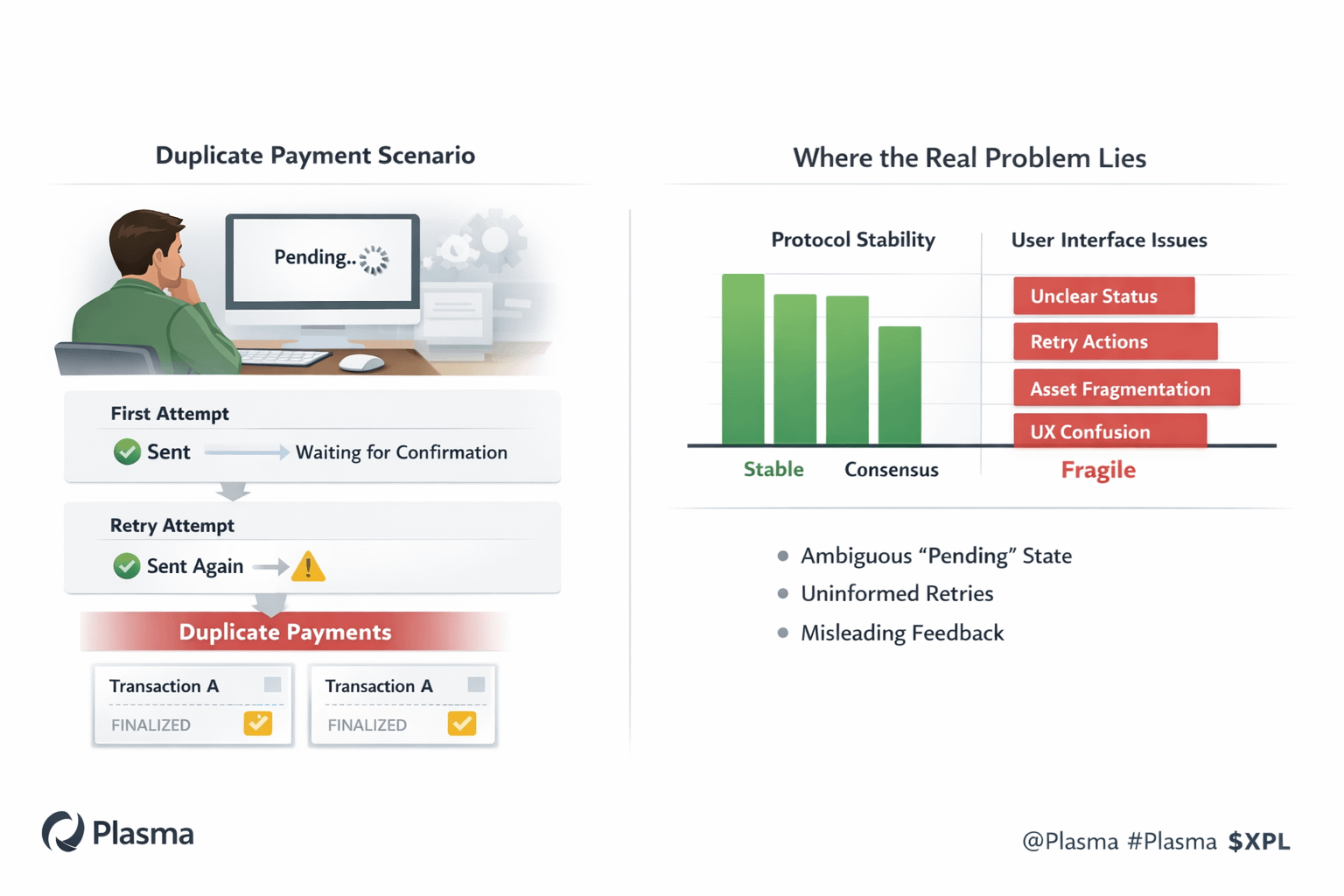
I have felt this most acutely in cross-chain and rollup heavy setups. You initiate a transaction on one layer, wait through an optimistic window, bridge to another domain, and hope the interface correctly reflects which parts of the process are reversible and which are not. When something feels slow, users act. When users act without precise visibility into system state, duplication is not an edge case, it is the expected outcome.
This is where Plasma quietly challenges dominant industry narratives. Not by rejecting them outright, but by exposing the cost of hiding complexity behind interfaces that pretend uncertainty does not exist.
From an infrastructure and settlement perspective, Plasma is less concerned with being impressive and more concerned with being explicit. Finality is treated as a hard constraint, not a UX inconvenience to be abstracted away. Once a transaction is committed, the system behaves as if it is irrevocable, because it is. There is far less room for ambiguous middle states where users are encouraged, implicitly or explicitly, to try again.
Running a node and pushing transactions under load reinforced this for me. Latency increased as expected. Queues grew. But state transitions remained atomic. There was no confusion about whether an action had been accepted. Either it was in the execution pipeline or it was not. That clarity matters more than raw throughput numbers, because it gives higher layers something solid to build on.
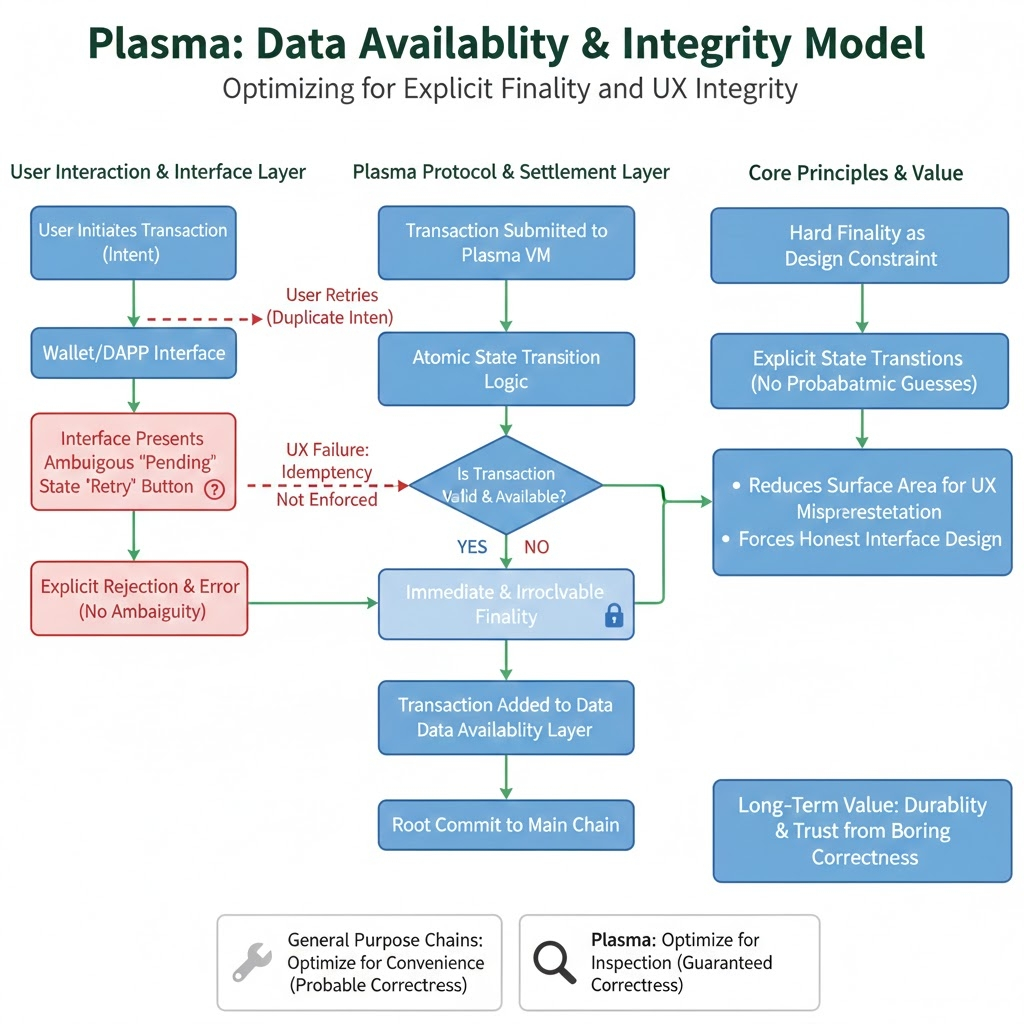
In more composable or modular systems, you often gain flexibility at the cost of settlement clarity. Probabilistic finality, delayed fraud proofs, and multi phase execution are not inherently flawed designs. But they demand interfaces that are brutally honest about uncertainty. Most current tooling is not. Plasma reduces the surface area where UX can misrepresent reality, and in doing so, it makes design failures harder to ignore.
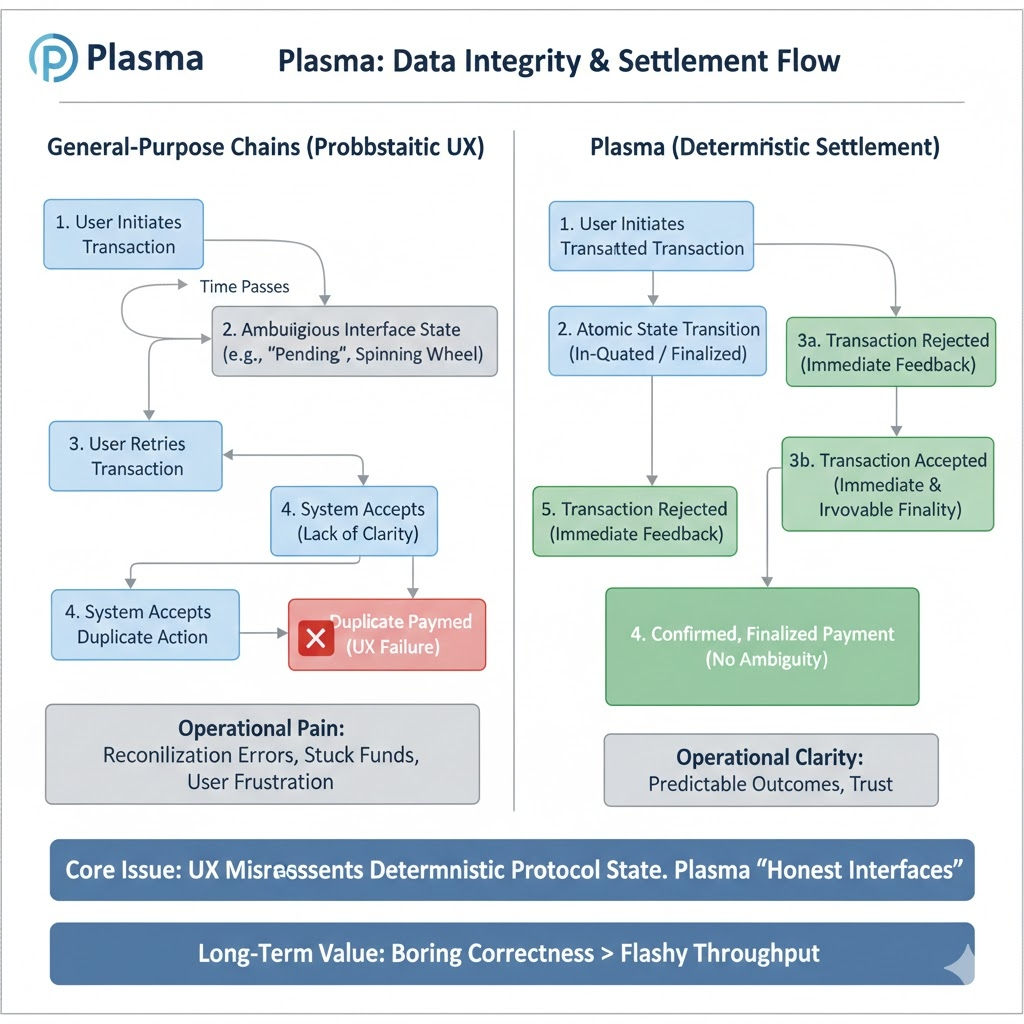
From a protocol standpoint, duplicate payments are rarely a chain bug. They usually require explicit replay vulnerabilities to exist at that level. What actually happens is that interfaces fail to enforce idempotency at the level of user intent. Plasma makes this failure visible. If a payment is accepted, it is final. If it is not, it is rejected. There is less room for maybe, and that forces developers to confront retry logic, intent tracking, and user feedback more seriously.
That does not mean Plasma’s UX is perfect. Tooling can be rough. Error messages can be opaque. Developer ergonomics trail more popular stacks. These are real weaknesses. But the difference is philosophical: the system does not pretend uncertainty is free or harmless.
Under stress, what I care about most is not peak transactions per second, but variance. How does the system behave when nodes fall behind, when queues back up, or when conditions are less than ideal? Plasma’s throughput is not magical, but it is stable. Consensus does not oscillate wildly. State growth remains manageable. Node operation favors long lived correctness over short-term performance spikes.
Fees, in this context, behave like friction coefficients rather than speculative signals. They apply back pressure when needed instead of turning routine actions into unpredictable costs. That predictability matters far more in real financial operations than in narratives built around momentary efficiency.
None of this comes without trade offs. Plasma sacrifices some composability and ecosystem breadth. It asks developers to think more carefully about execution flow and user intent. It does not yet benefit from the gravitational pull of massive tooling ecosystems, and onboarding remains harder than in more abstracted environments.
But these are explicit trade offs, not hidden ones.
What Plasma ultimately forced me to reconsider is where value actually comes from in financial infrastructure. Not from narratives, diagrams, or how many layers can be stacked before reality leaks through. Value comes from durability. From systems that behave the same way on a quiet day as they do during market stress. From interfaces that tell users the truth, even when that truth is simply wait.
Duplicate payments are a UX failure because they reveal a refusal to respect settlement as something sacred. Plasma does not solve that problem by being flashy. It solves it by being boringly correct. And in finance, boring correctness is often what earns trust over time.

