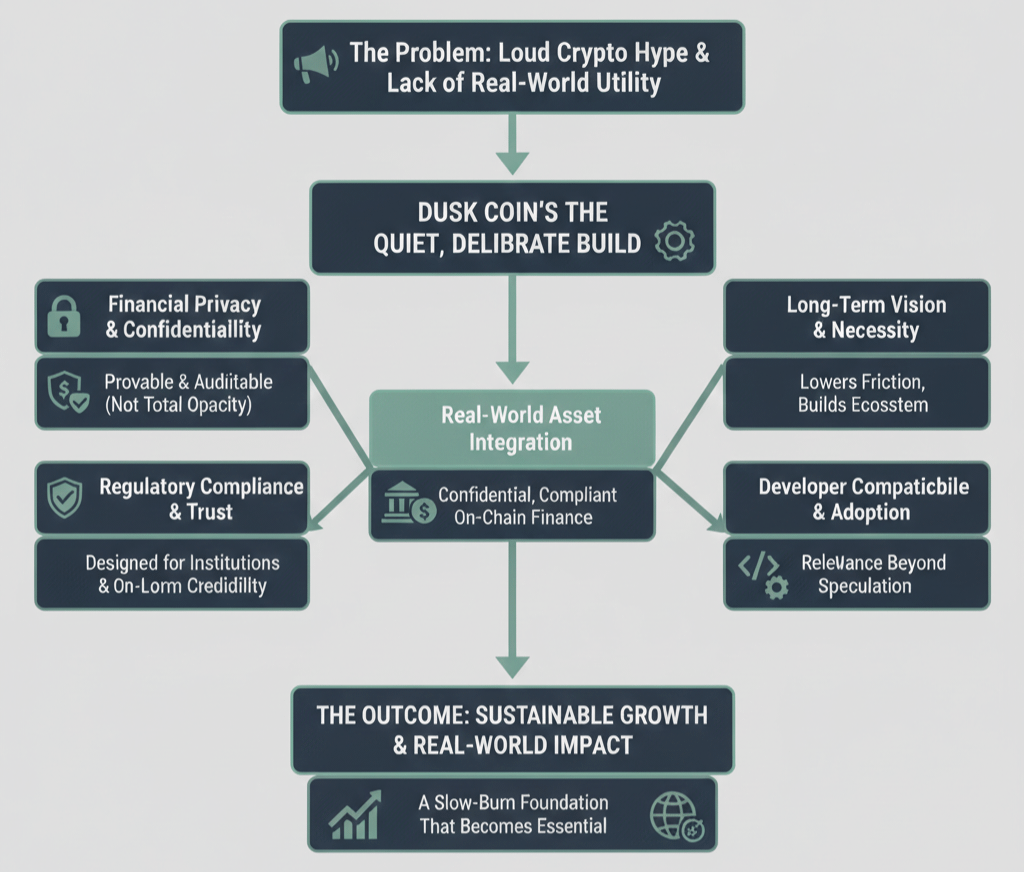
Crypto has always been loud. Every cycle brings a new wave of projects yelling about speed, scale and life-changing gains. I’ve learned to tune most of that out. Over time, the projects that really hold my attention are the quiet ones, the ones that keep building while everyone else is chasing the spotlight. That’s exactly how I see Dusk Coin. It never tried to be flashy or viral. It moved slowly, deliberately and with a very specific problem in mind and that’s why I’ve continued to take it seriously.
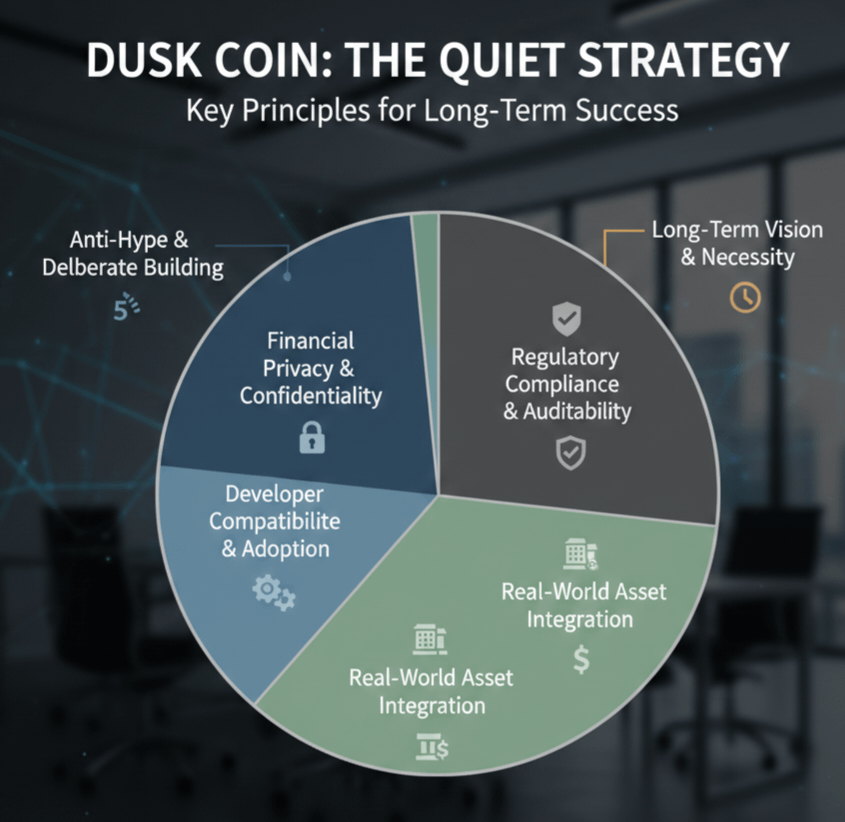
From the beginning, Dusk didn’t feel like it was built to impress traders. It felt like it was built to solve an uncomfortable issue most crypto projects prefer to avoid: how do you bring real financial privacy on-chain without instantly making the system unusable in the real world? That balance is hard. It requires thinking about regulation, institutions and long-term credibility, topics that aren’t exactly exciting in a hype-driven market. But to me, that’s precisely what made Dusk stand out.
I’ve always believed privacy itself was never the real problem. Traditional finance has operated with privacy for decades and no one questioned its legitimacy because of it. In crypto, the controversy came from poorly designed systems that treated privacy as total opacity. Dusk takes a more practical approach. Transactions can remain confidential but they’re still provable and auditable when it actually matters. Sensitive data isn’t broadcast to the world, yet accountability isn’t sacrificed. That just feels like common sense and it’s surprisingly rare in this space.
When Dusk’s main network finally went live in early 2026, it didn’t feel like a marketing milestone to me. It felt like a quiet confirmation that years of research had turned into something real. There were no wild promises or flashy launch narratives, just a system designed to let serious financial logic exist on-chain without exposing everything. That intent was obvious and it made the launch feel meaningful rather than performative.
Another thing I respect about Dusk is that it didn’t try to reinvent everything just for the sake of originality. Instead of isolating itself, it created an environment that feels familiar to developers who already know how to build smart contracts. That decision matters more than people think. Adoption doesn’t come from novelty alone; it comes from lowering friction. Dusk choosing compatibility over ego told me the team understands how ecosystems actually grow.
Where Dusk really clicks for me is real-world assets. Traditional finance depends on confidentiality. Deals aren’t public, balances aren’t transparent and compliance is non-negotiable. Most blockchains struggle here because radical transparency is baked into their design. Dusk isn’t fighting that reality, it was built for it. Seeing institutional-grade assets and regulated financial instruments align with the network didn’t surprise me at all. It felt like the natural direction of the technology.
I know a lot of people focus on price action, especially after the big moves going into 2026. There were rallies, pullbacks and plenty of noise around large holders. That’s normal at this stage. Personally, I don’t think short-term charts tell the real story. What matters to me is structure: is there real demand, real usage and a clear reason for the network to exist beyond speculation? On those fundamentals, Dusk feels stronger now than ever.
What keeps me optimistic is that Dusk doesn’t need hype to justify itself. Its relevance comes from necessity. As global regulations tighten and trust becomes more important, systems that ignored compliance will struggle, and systems that sacrificed privacy will lose credibility. Dusk sits right in the middle and that’s a powerful position to hold.
I don’t see Dusk as a fast trade or a quick win. I see it as a slow-burn foundation. It’s the kind of project that looks boring right up until the moment the market realizes it actually needs it. And in crypto, those are usually the projects that end up mattering the most.