


The majority of blockchains are casino-speaking, in that it is rapid, noisy, and constantly in search of the next big thing. Instead, Dusk is meant to be the converse: a market infrastructure that can be run on daily basis without any surprises. When you require regulated assets, real settlement and real participants, then “boring is a feature. It is not a question of whether the chain can do it or not. It is, will it act like that tomorrow, when it is pressured, when auditors are watching it?
Dusk takes a different path. Rather than screaming about privacy, it is about predictable operations: how messages travel over the network, how money is sent, how validators are reconciled, and how the smart-contract engine is architected like a regulated runtime, as opposed to a hectic sandbox.
Uncertainty Begins with the Way a Network Speaks.
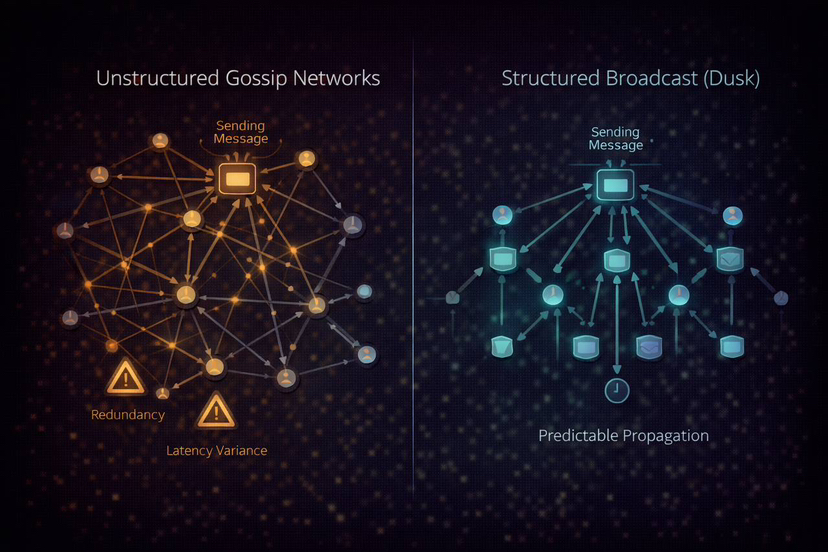
Dusk relies on the use of Kadcast which is an ordered form of broadcasting that directs messages through structured routes rather than raw gossip flooding. The overarching concept is straightforward you do not desire possibly it to every one. You desire a less uncontrollable propagation pattern. The whitepaper of Dusk refers to Kadcast as the system that transmits messages within the protocol. The academic literature also provides Kadcast as a structured broadcast protocol over blockchain networks.
Such a decision is an indication of something significant: Dusk views networking as infrastructure, but not vibes. In the case where a chain is aimed at market use cases, predictable message flow is important since it has an impact on the rate at which the system can reach an agreement and the perceived fairness of the experience among participants.
Fees That Act Like Billing.
Fees are another cause of instability in most chains. In many cases, the user is buying the pandemonium of the moment and not the labor itself. That is all right when speculation is the chief game but that is risky when it is settlement or regulated trading.
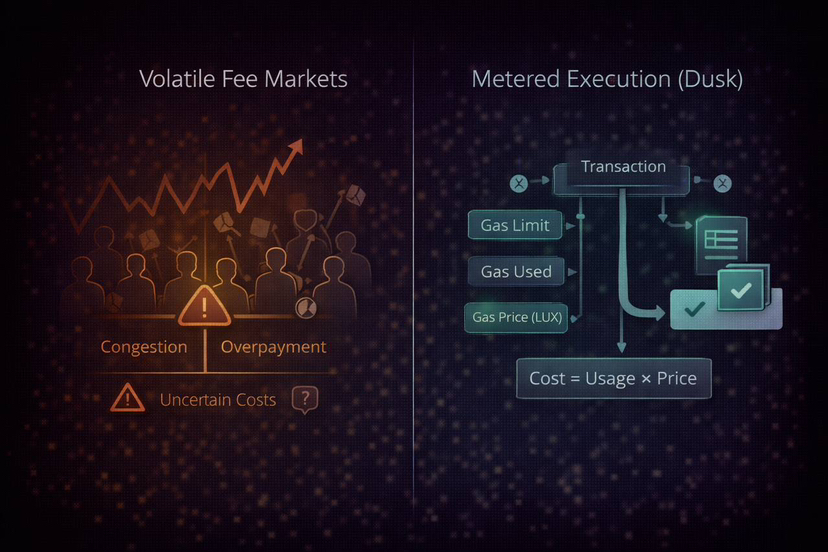
Dusk formalizes the fee model in a way that is quantifiable. Transactions use gas; a gas limit and gas price are set and a user is charged a gas used X gas price. This gas price is represented in LUX, 1 rupt LUX is equal to 10 -9 DUSK. This is the most boring type of framing. It is a bill, this is what you have required the system to do, and this is the price of it.
It is a predictable behavior even in cases where something fails. In the event that a transaction is run out of gas execution, it is reverted but the gas used is still billed. It is not punishment, it is just a fee to use the system resources. No platform is as treating compute in this way.
Discipline the Void of Fear Culture.
A chain demanding the real markets requires having a responsibility of the validators, yet it is essential to punish softly. When punishment is excessive in brutality or drama, smaller operators are forced out. The system might seem to be safe, yet few of the large players can overcome the social and financial stress.
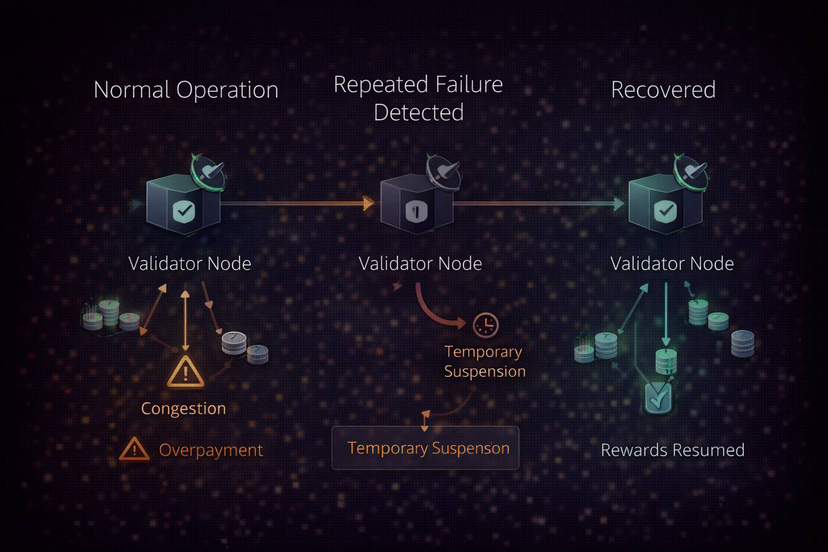
The coming of dusk emphasizes non-malicious failures which can be soft-slashing. The engineering updates refer to soft slashing as a reaction to less serious infractions with examples such as not broadcasting a block candidate when a block generator. The slashing milestone write-up is another way of thinking of soft slashing as taking place when a node does not issue a block- bad in the network, but not necessarily malicious.
This is important because it is a regulation you can communicate to professional operators: “When you fail repeatedly on duties, you get no rewards temporarily. Such a mentality is more like the SLA than the death penalty. It encourages credibility without transforming the network into a social battlefield.
A Smart-contract Engine Implemented as a Runtime.
This is disregarded by the majority: the runtime of a blockchain gives it its feel. A delicate runtime causes all that lies above it to be delicate. A managed runtime provides the ability to reason about it as an engine.
The ecosystem of Dusk inclines itself towards WASM as the platform on which it runs its smart-contracts. The documentation describes that Dusk VM is optimized on Wasmtime, a WASM runtime. It is ZK-friendly and it treats memory unlike most other blockchain VMs.
On the tooling level, this level of engineering is evident. The Rusk repository lists such requirements as Rust nightly and wasm-pack to build WASM contracts. The release notes of Dusk release 3.1 explicitly deal with language selection by even favoring the word contract, although all contracts are technically WASM modules. Minor word decisions show a team that is concerned with clarity in developers.
This is a big deal when it comes to the institutional use. Cool is not something picked up by institutions. They adopt “controllable.” A more serious software mindset of the correctness, testing and upgrades would better suit itself with a WASM-based execution mindset, which is supported by real tooling discipline.
The reason behind this boring stack being a competitive edge.
When you zoom out, you can see that Dusk is constructing something that is explainable to risk teams many chains do not build. Predictability is the goal of Kadcast, rather than going viral. The fee model is based on a unit of clear (LUX) and a standard gas methodology which acts as metered compute. Validator discipline also places more emphasis on soft slashing of operational reliability as opposed to the catastrophic punishment. The execution environment is biased towards WASM runtime thinking and has the real developer tooling.
The mixture of it forms a silent change in narrative: Dusk is not attempting to be noticeable. It’s trying to win trust. Trust is never achieved through an assurance of freedom but it is achieved through day-in day-out behavior, with the same rules, and under pressure.
The most significant Dusk story is not about the privacy. It is its operational predictability. In the real markets, loudest systems are not the best. Their architecture resembles plumbing: message flow is organized, costs are metered, operators are disciplined, and the runtime is reasonable.
In case Dusk is successful, it will not have been the case that it was able to make people speculate differently. It will be due to the fact that it made builders and institutions believe that on-chain finance can act like infrastructure: silent, quantifiable, and predictable enough to support real value without theatrics.