
There’s a quiet frustration many of us feel with technology, even when it’s advanced.
We have powerful tools.
We have AI that can write, search, summarize, and reason.
We have blockchains that can move value globally.
And yet… everything still feels disconnected.
Your AI forgets what mattered yesterday.
Your data lives in ten places that don’t talk to each other.
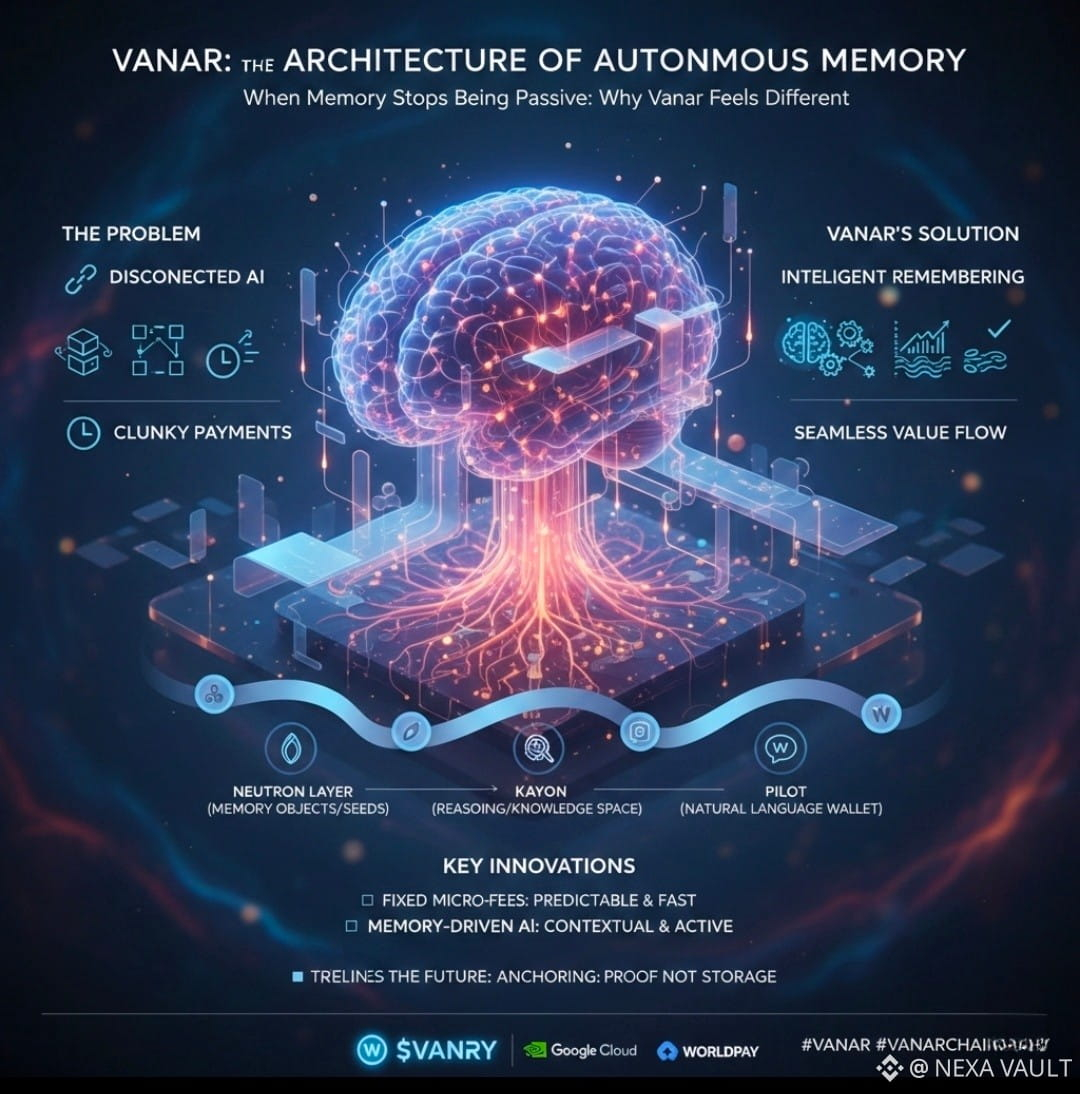
Payments are either too expensive, too slow, or too unpredictable to feel “normal.”
Vanar starts from that discomfort.
Not from price charts.
Not from speed benchmarks.
But from a simple question:
What if intelligence could remember, and what if remembering could be paid for—cheaply, predictably, and continuously?
That question shapes everything Vanar is building.
A Blockchain That Assumes Life Is Ongoing
The people behind Vanar Chain describe it as a living infrastructure. That’s not marketing fluff — it’s a design choice.
Most blockchains treat activity as isolated events:
send
receive
execute
forget
Vanar assumes interaction never really stops.
An AI agent doesn’t wake up fresh every time.
A game world doesn’t reset after each action.
A business relationship doesn’t start from zero with every email.
So why should the infrastructure underneath behave that way?
Vanar is built for constant interaction:
lots of small transactions
ongoing data updates
agents reacting in real time
memory that carries forward
That’s the foundation.
Why Micro-Payments Matter More Than People Admit
Small payments sound boring — until you realize they’re how real life works.
You don’t pay for electricity once a month because it’s elegant.
You do it because metering usage continuously is fair.
Now imagine:
a smart meter paying every second
an AI paying for a slice of data it just used
a game NPC charging tiny fees for services
machines settling value without asking permission
This only works if fees are:
tiny
predictable
stable under pressure
Vanar fixes fees instead of auctioning them. Even when demand rises, costs don’t spiral. Settlement lands in a few seconds. Payments feel smooth, not stressful.
That predictability is what turns micro-payments from theory into habit.
Memory That Isn’t Just Storage
Here’s where Vanar quietly breaks away from normal chains.
The Neutron layer doesn’t treat data as dead files.
It treats data as memory objects, called Seeds.
A Seed can represent:
a document
a conversation
an AI embedding
structured business information
By default, Seeds stay off-chain so everything stays fast.
But when ownership, proof, or auditability matters, users can anchor them on-chain.
That anchoring doesn’t expose the content.
It locks the truth about the content:
who owns it
that it hasn’t been altered
when it existed
The key stays with the user.
This is the difference between storage and trust.
When Memory Becomes Useful, Not Just Preserved
Because Seeds include AI embeddings, memory becomes searchable by meaning, not filenames.
Instead of:
> “Where did I save that file?”
You ask:
> “What did we decide about this client last quarter?”
That sounds small — but it’s the moment memory turns active.
This is what allows autonomous agents to behave like they understand context, not just commands.
Kayon: The Layer That Thinks With Your Data
If Neutron is memory, Kayon is reasoning.
It pulls together scattered information from tools people already use — email, documents, chats, dashboards — and turns them into a single, encrypted knowledge space.
The important part isn’t the integration list.
It’s control.
You choose what connects.
You can remove it anytime.
Nothing becomes permanently trapped.
Once connected, Kayon lets you talk to your own data in plain language — and get answers that are traceable, not mysterious.
That matters if AI is going to be trusted in real decisions.
Personal Memory: AI That Doesn’t Forget You
Vanar doesn’t stop at companies.
With MyNeutron, the same memory logic comes to individuals.
Notes you wrote months ago don’t disappear into the void.
Preferences you expressed aren’t lost between sessions.
Context carries forward.
Over time, your AI agent stops being a tool you prompt — and starts feeling like something that knows where you’ve been.
That’s not flashy.
It’s deeply human.
Talking to Blockchain Like a Person
Pilot, Vanar’s natural-language wallet experiment, is another small but revealing step.
Instead of:
commands
interfaces
technical syntax
You just say what you want.
Send.
Mint.
Interact.
It sounds obvious — which is usually a sign that UX is finally catching up.
Gaming as Proof, Not Promotion
Vanar uses games as a testing ground because games expose weaknesses fast.
In large, persistent worlds with AI-driven characters:
interactions are constant
users are unforgiving
micro-payments are everywhere
If memory breaks, players notice.
If fees spike, players leave.
The fact that Vanar’s stack runs inside live gaming environments shows it’s being stressed in the real world, not just demoed in labs.
Partnerships That Reduce Risk
Infrastructure only matters if people trust it.
Vanar works with:
NVIDIA for AI acceleration
Google Cloud for validator operations with renewable energy focus
Worldpay to bridge on-chain assets with real payment rails
These aren’t hype multipliers.
They’re friction reducers.
VANRY: A Token That Follows Usage
VANRY isn’t designed to scream for attention.
It secures the network.
It powers advanced tools.
It pays validators.
It’s burned through usage.
As Neutron and Kayon move into paid, usage-based access, demand ties directly to adoption — not noise.
That’s slower.
And healthier.
What Comes Next
Vanar is moving toward:
automation layers
agent-driven workflows
packaged industry solutions
At the same time, they’re researching quantum-resistant cryptography — not because it’s urgent today, but because infrastructure should outlive trends.
Why Vanar Exists, Really
Vanar exists because the future isn’t just digital — it’s autonomous.
Agents will act.
Data will negotiate.
Payments will flow constantly.
And all of that requires memory, trust, and predictability working together.
Vanar is trying to build that quietly, layer by layer.
One Honest Takeaway
Vanar isn’t promising to change everything overnight — it’s trying to make intelligence feel continuous, memory feel useful, and payments feel invisible.