AI is getting smarter every day. Models can reason, automate decisions, and operate at speeds humans never could. But here’s the uncomfortable truth I keep coming back to: intelligence alone doesn’t create real-world impact. Without payments, AI is just thinking in a vacuum.
For me, payments are what turn AI from a clever system into an actual participant in the economy. And that’s where Vanar starts to stand out not because of loud promises, but because of how fundamentally it treats payments as part of infrastructure, not an afterthought.
Why Payments Actually Matter
Payments aren’t just about money moving from point A to point B. They’re about trust, coordination and closure. When something is paid for, it’s final. That finality matters a lot in an AI-driven world.
AI systems are designed to run constantly. They don’t sleep, they don’t pause, and they don’t wait for manual approvals. If we expect them to function at scale, they need a native way to settle value just as seamlessly as they execute logic. In my opinion, trying to run AI on top of slow or fragmented financial systems is like putting a jet engine on a bicycle frame, it just doesn’t work.
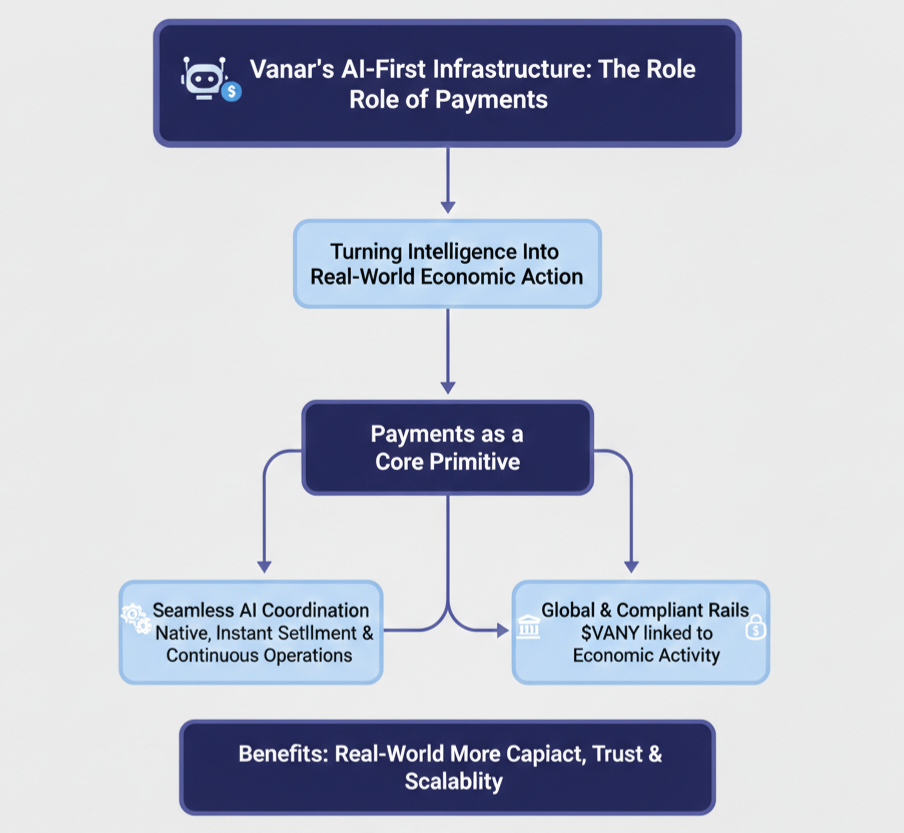
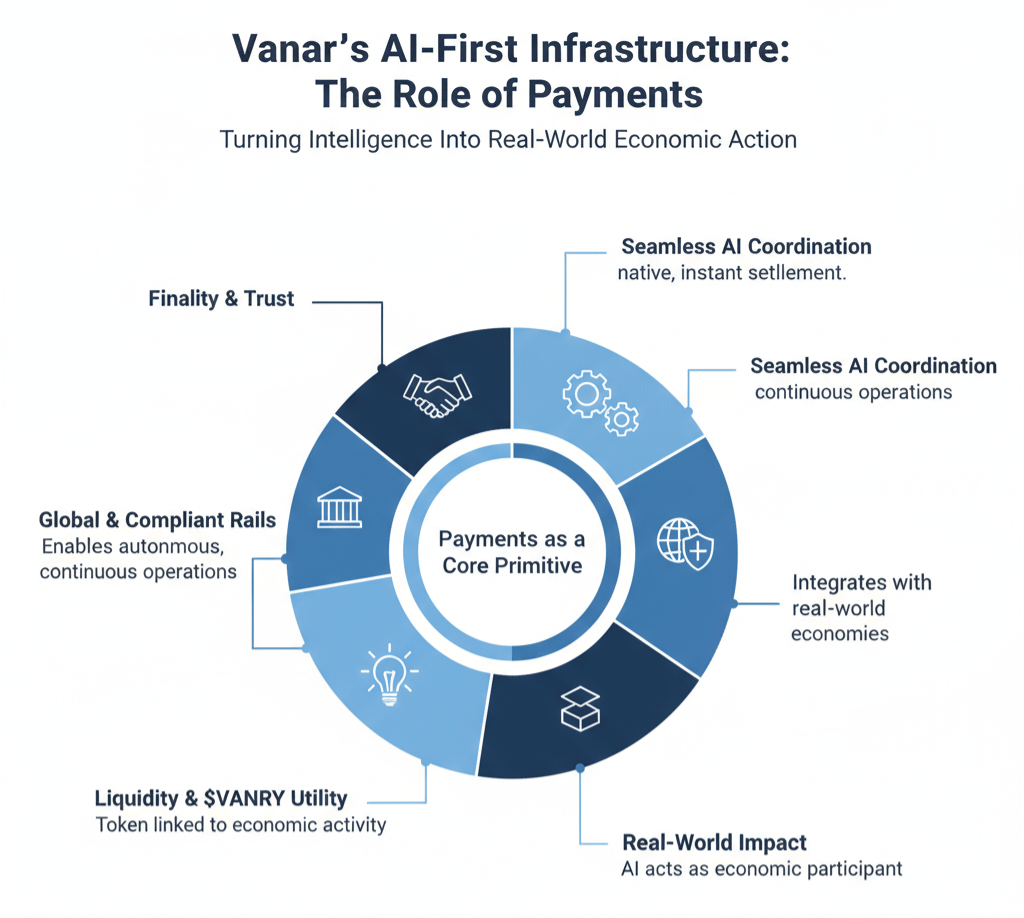
Vanar seems to understand this mismatch. Instead of treating payments as a secondary feature, it places them right at the core of how the system operates.
Settlement Isn’t an Extra, It’s a Primitive
One idea I genuinely respect about Vanar is how it treats settlement as a first-class primitive, not a plug-in. In most systems today, settlement happens later. You do the action first, then figure out the money side afterward.
That approach completely breaks down with AI. AI workflows need certainty. They need to know that when something happens, value is settled instantly and deterministically. No waiting, no external dependencies, no manual reconciliation.
From my perspective, this is one of those quiet design choices that separates experimental tech from real infrastructure. When settlement is native, AI systems can act with confidence and that’s a big deal.
Compliance and Global Rails: The Reality Check
A lot of crypto conversations avoid compliance like it’s a dirty word. I don’t see it that way. If AI is going to interact with real economies, it has to operate within real-world constraints. Ignoring that reality doesn’t make a system more decentralized, it just makes it fragile.
What I like about Vanar’s direction is that it acknowledges this upfront. Global rails and compliance aren’t obstacles; they’re foundations. AI systems that can’t move value across borders in a compliant way will always be limited, no matter how advanced the models are.
To me, this is another sign that Vanar is building for longevity, not just attention.
How Vanar Fits Into the Bigger Picture
Vanar doesn’t feel like a project chasing the AI narrative for hype. It feels like infrastructure designed for what AI actually needs to function economically. That difference matters.
When payments are native, developers don’t have to reinvent financial logic every time they build something. They can focus on intelligence, automation and outcomes, knowing that value transfer is already handled beneath the surface.
In my view, that’s what real infrastructure does: it disappears into the background while everything else builds on top of it.
Payments as Infrastructure, Not a Showcase
I’ve seen too many projects treat payments as a demo feature something flashy to show in a presentation, but not something designed for constant, real usage. Vanar takes the opposite approach.
Here, payments are assumed to be always on. They’re meant to handle volume, edge cases, and long-term demand. That tells me the team is thinking beyond demos and into production reality. And for AI-first systems, that mindset isn’t optional, it’s necessary.
Where $VANRY Fits Into Real Economic Activity
A token only has meaning if it’s connected to actual usage. Otherwise, it’s just a story people tell themselves. What makes $VANRY interesting to me is that its relevance grows alongside real economic activity on the network.
As AI systems transact, settle value, and coordinate resources, the token becomes part of that flow. It’s not just speculation, it’s participation. I personally believe this alignment between usage and value is what separates sustainable ecosystems from temporary ones.
Final Thoughts
AI without payments is incomplete. It can think, predict and automate but it can’t finish the job. Payments are what close the loop, and Vanar understands that at a structural level.
From where I stand, Vanar isn’t trying to be flashy. It’s building the quiet, necessary foundation that AI systems will eventually depend on to operate in the real world. And in infrastructure, that kind of thinking is where the real value lives.