
Plasma feels like a project that’s built with a very specific kind of patience, the kind you only see when a team is aiming for real usage instead of quick hype. The whole identity sits around one clear mission: stablecoin payments at scale, where sending value is fast, cheap, predictable, and simple enough that it doesn’t feel like “crypto,” it just feels like moving money. That focus matters because most networks are designed to be general-purpose first and payment-optimized later, while Plasma is doing the opposite, treating stablecoin settlement as the main product and everything else as supporting infrastructure.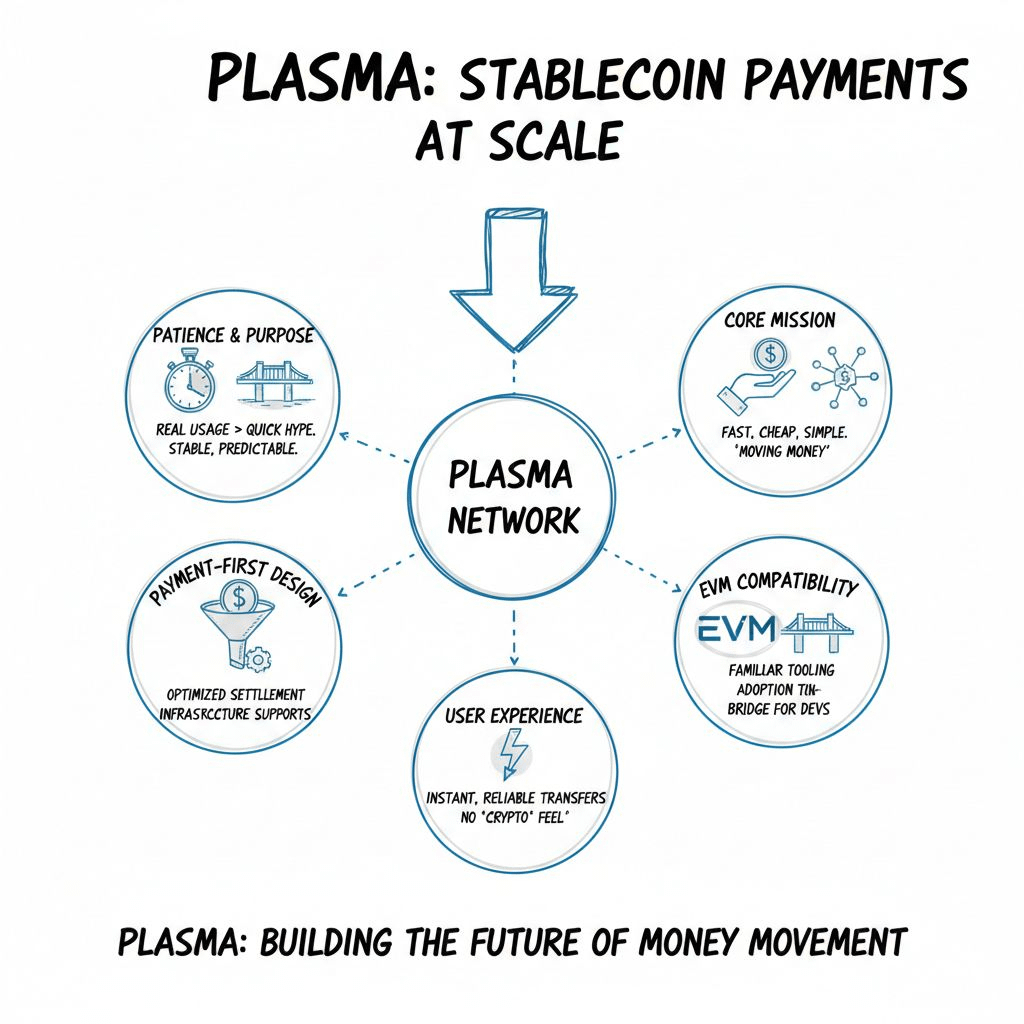
When you look at what Plasma is actually trying to deliver, it’s not just “another EVM chain.” It’s an EVM environment tuned for the kind of throughput and consistency stablecoins demand, where you can build like you’re building on familiar tooling, but the chain itself is engineered around payment realities. That combination is important because builders don’t want to re-learn their entire stack, and users don’t want to learn anything at all, they just want the transfer to work instantly and reliably without extra steps. Plasma’s EVM compatibility is basically the adoption bridge for developers, while the payment-first mechanics are the adoption bridge for normal users who care about speed and cost, not narratives.
The part that makes Plasma stand out is how directly it targets friction that stablecoin users experience every day. In most places, stablecoin transfers still inherit the chain’s quirks, sometimes fees spike, sometimes the user needs a separate token just to pay gas, sometimes the experience feels inconsistent under congestion, and sometimes finality is not fast enough to feel “done” in the way payments need. Plasma’s design direction tries to remove those sharp edges by baking stablecoin-centric behavior into the chain’s core approach, including ideas like gasless stablecoin transfers and stablecoin-first fee models, which are ultimately about one thing: letting apps onboard users without forcing them to think about gas or manage extra balances just to send a dollar-denominated asset.
Under the hood, Plasma positions its consensus around very fast finality, because for payments the difference between “confirmed” and “final” is not academic, it’s the difference between trust and hesitation. A payment experience that settles quickly and decisively changes how businesses and users behave, because it allows merchants, services, and everyday senders to treat the transfer as completed rather than waiting around hoping nothing changes. This is why Plasma keeps leaning into sub-second finality as part of its core story, because in the stablecoin settlement world, the best product is the one that feels immediate and certain, especially when you start thinking about high-volume corridors, retail transfers, payroll-style flows, merchant settlement, and the kind of repeated activity that can’t tolerate unpredictable delays.
Plasma also frames its longer-term security direction around being Bitcoin-anchored, which signals an ambition to be taken seriously as settlement infrastructure rather than a temporary app playground. The idea behind anchoring is credibility and neutrality over time, where the chain’s history and state integrity lean on a widely trusted base layer, and the roadmap language suggests this is part of a staged rollout rather than something that must exist instantly on day one. That staged approach is usually what you see when a team is prioritizing reliability first, because stablecoin settlement isn’t forgiving, and the fastest way to lose trust is to ship too many complex systems before the base chain proves it can handle real load consistently.
If you want to understand what Plasma is doing behind the scenes, the cleanest way is to view it as sequencing rather than a single big launch moment. First, the chain has to run smoothly and predictably, meaning explorers show consistent block production, contracts deploy cleanly, and developers can work without friction. Then, stablecoin-native mechanics need to move from “concept” to “default path,” meaning apps actually integrate them and users start experiencing stablecoin transfers without fee anxiety or onboarding confusion. After that, the heavier infrastructure pieces, like bridging architecture and deeper security anchoring, become the compounding layer that turns a useful network into a settlement-grade network. That progression is what separates serious payment infrastructure from projects that rely on temporary attention, because long-term stablecoin settlement is won through reliability, integrations, and repeat usage, not by short bursts of marketing energy.
The token story around XPL is best understood through the lens of ecosystem alignment rather than pure speculation. If Plasma becomes a chain that clears large stablecoin volume, then XPL sits close to the center of that economic environment, and its market behavior will naturally be influenced by network growth, supply schedules, and the pace at which adoption becomes real. This is also why unlock structure and distribution timelines matter, because in early networks supply dynamics can shape market sentiment as much as product progress does, especially when the broader market is sensitive and liquidity rotates quickly. People who treat this kind of token as “set and forget” often get surprised, while people who track supply events and adoption signals tend to navigate it with a clearer head.
The benefits Plasma is chasing are practical and easy to visualize once you stop thinking like a trader and start thinking like a payments product manager. Fast finality creates confidence and smooth merchant settlement behavior. Stablecoin-native fee mechanics reduce onboarding friction and make the user journey simpler. High-volume readiness makes it viable for repeated daily transfers, not just occasional DeFi usage. EVM compatibility helps the ecosystem form faster because builders can deploy familiar contracts, reuse tooling, and move quicker, while the chain’s payment-first design gives them a strong reason to build there if their end users are stablecoin-native. Taken together, the promise isn’t that Plasma will be “the best chain for everything,” the promise is that Plasma can become the chain where stablecoins feel like they were always meant to feel, fast, cheap, and certain, without the user having to understand what’s happening under the hood.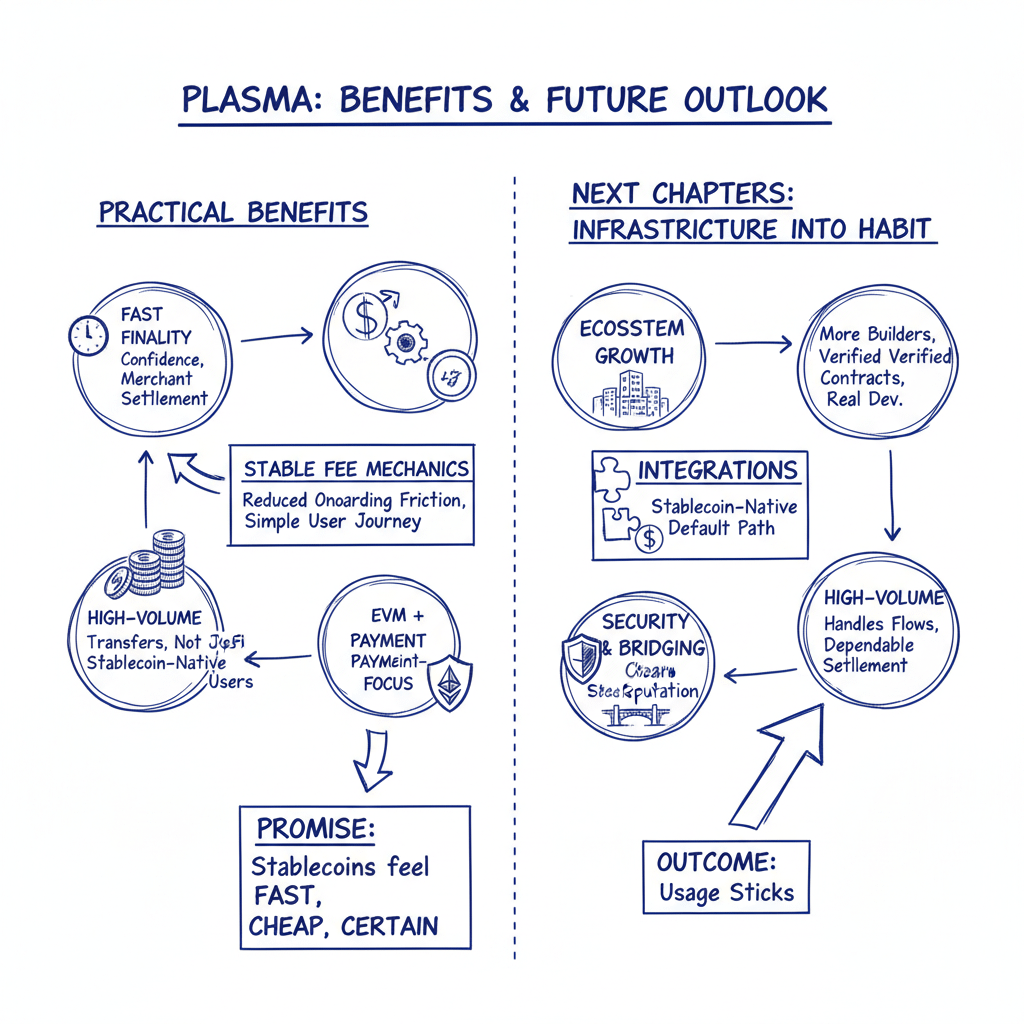
When you ask what’s next, the most realistic answer is that Plasma’s next chapters are all about turning infrastructure into habit. More builders deploying, more contracts verified, more activity that signals real development rather than simple experimentation. More integrations that use the stablecoin-native rails as the default user path, not an optional feature. More progress on bridging and security roadmap items, rolled out carefully so the network’s reputation stays clean. More visible proof that the chain can handle high-volume flows without compromising the experience stablecoin users care about, which is not a flashy metric but a very powerful one, because once stablecoin settlement becomes dependable, usage tends to stick.
My takeaway is that Plasma’s strongest edge is its clarity. It’s not chasing ten narratives at once, it’s building around stablecoin settlement like it actually wants to win in the real payments category, and that category doesn’t reward noise, it rewards consistency. If Plasma executes on fast finality, smooth stablecoin UX, and staged security improvements without breaking developer familiarity, it can grow into something that people use daily without even thinking about the chain name, which is exactly how the best payment rails operate, quietly, reliably, and at scale.

