
As of early 2026, the narrative has shifted. The question is no longer "What can AI do?" but "Who owns the hardware that runs it?" We have entered the era of "Compute Geopolitics," where software is no longer the primary moat. Instead, the global power balance is defined by access to three sacred resources: Processing Power (Compute), Verified Data, and Sustainable Energy.
In this landscape, DePIN (Decentralized Physical Infrastructure Networks) has emerged as the only structural rebellion against the "algorithmic dictatorship" of Big Tech. This is the definitive roadmap to the most critical convergence in the history of technology.
I. The Functional Triad: The Physical Foundation of Intelligence
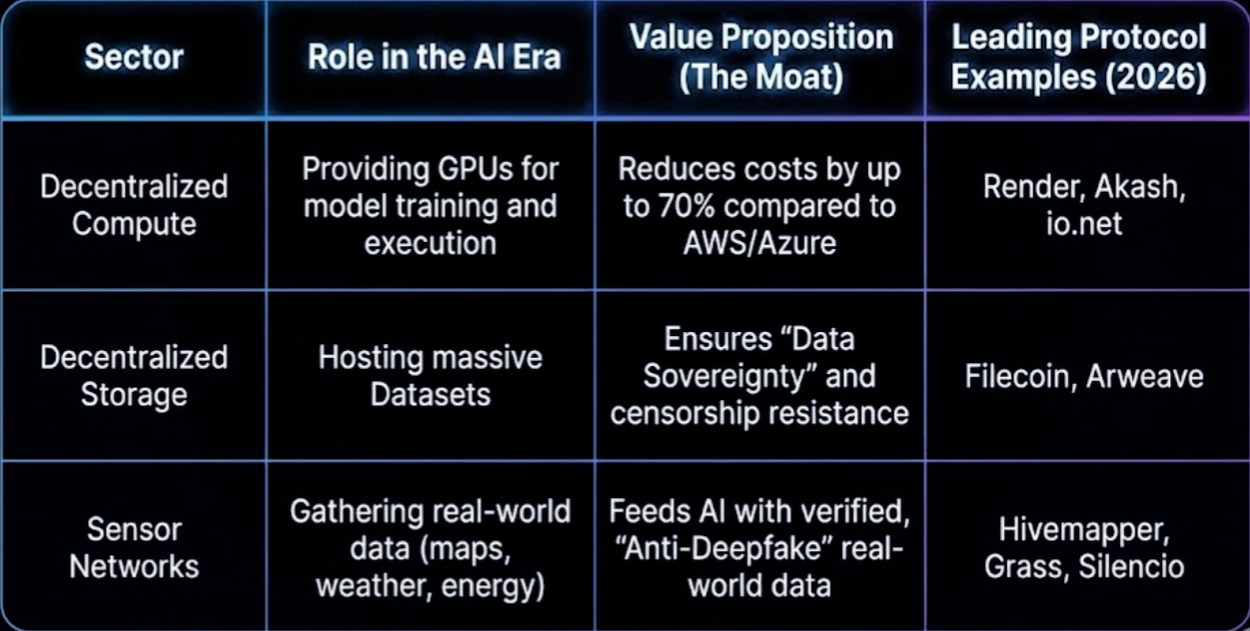
For AI to exist, it requires a "physical body." DePIN provides this infrastructure with an efficiency that centralizing scaling can no longer match.
II. The Verification Dilemma: Enter ZK-ML
In centralized systems, you trust Google because of their brand. In DePIN, you interact with thousands of anonymous contributors. How do you ensure a remote GPU provider hasn't faked the AI output to save electricity?
The solution is ZK-ML (Zero-Knowledge Machine Learning). In 2026, this became the "cryptographic seal" of the industry. It allows a provider to submit a mathematical proof that the "Inference" was executed correctly on a specific model without revealing the underlying data. Protocols like Bittensor and Modulus Labs are leading this shift, moving the world from "Trust in Corporations" to "Trust in Mathematics."
III. The Inference Economy vs. The Training Myth
Mainstream media remains obsessed with "Training" large models. However, professional insiders know that the real, recurring wealth lies in "Inference"—the process of an AI generating an answer, an image, or a code snippet for an end-user.
While Training requires ultra-low latency found in centralized clusters, Inference is inherently distributable. DePIN has become the global backbone for the "Inference Economy," allowing AI to be served at the "Edge" (closer to the user), which is faster and significantly cheaper.
IV. Economic Engineering: The Burn-and-Mint Equilibrium (BME)
Transparency in 2026 means admitting that a token without a closed economic loop is worthless. Successful DePIN projects now utilize the BME Model:
The Burn: When an AI company needs compute power, they must purchase and "burn" the native token to access the service. This creates deflationary pressure.
The Mint: The network mints new tokens to reward the hardware providers (GPU owners).
The Outcome: As AI demand scales, the "Burn" outpaces the "Mint," driving organic value based on actual industrial utility rather than speculative hype.
V. Addressing "The Latency Wall"
To be truly transparent, we must acknowledge DePIN’s greatest hurdle: the speed of data transfer between nodes. The winners in 2026 solved this via "Geographic Clusters." Advanced protocols no longer distribute tasks randomly. They form clusters of GPUs within the same city or region, connected by high-speed local fiber, effectively mimicking the performance of a centralized data center while maintaining decentralized ownership.
📋 The Professional Investor’s Checklist (DePIN)
Before allocating capital to any DePIN project, it must pass these five rigorous tests:
Hardware Agnosticism: Does it run on existing consumer hardware (RTX 4090s/Macs) or require expensive, proprietary "black boxes"? (Ease of adoption is key).
Verified Demand: Are there actual AI agents or enterprises using the network, or is it just "miners" recycling tokens?
Verification Protocol: Does the project utilize ZK-Proofs or Proof of Compute to prevent fraud?
Tokenomic Loop: Is there a "Burn" mechanism directly tied to the consumption of the physical resource?
Latency Strategy: Does the project have a roadmap for geographic clustering to compete with centralized providers?
The Strategic Bet: The Bet on Physics
AI is the "Spirit" of the age, but DePIN is its "Physical Body." In 2026, value is no longer found in empty promises, but in the number of Teraflops and Petabytes a network actually controls. We aren't just building digital currencies; we are building the Decentralized Operating System for the Physical World.