
The blockchain industry has spent years chasing mainstream adoption with limited success, often blaming user education or regulatory uncertainty for slow progress. Vanar emerged from a different diagnosis of the problem. The barrier to enterprise blockchain adoption wasn’t lack of understanding or regulatory clarity but rather a fundamental mismatch between what existing blockchain platforms offered and what global brands actually needed. This insight drove Vanar’s development philosophy: rather than building another blockchain hoping enterprises would adapt to its limitations, they engineered infrastructure specifically designed around how major brands operate in practice.
The challenge Vanar identified manifests clearly when brand executives evaluate blockchain opportunities. These leaders understand that digital ownership could transform customer relationships. They recognize that transparent supply chains build consumer trust. They see how novel engagement models might create competitive advantages. Yet when these same executives examine existing blockchain platforms, they encounter systematic obstacles making adoption impractical. Transaction costs that seem negligible in crypto contexts become prohibitively expensive at consumer scale. Performance adequate for decentralized applications feels broken for mainstream users expecting instant responsiveness. Technical complexity suitable for blockchain developers becomes insurmountable for brand operations teams lacking specialized expertise.
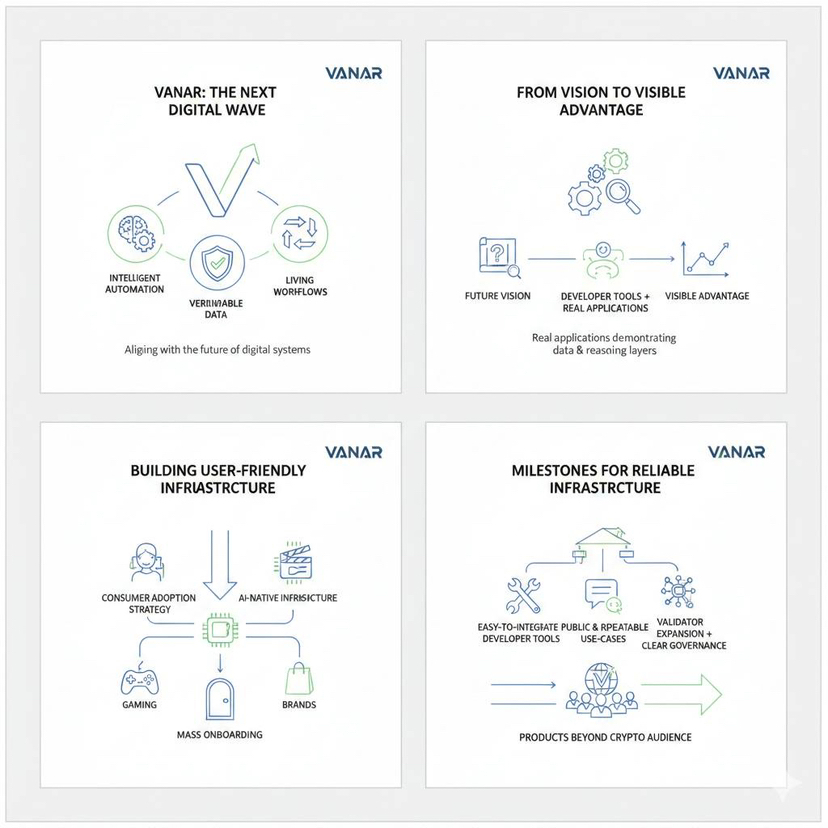
Vanar’s architecture addresses these disconnects through deliberate design choices prioritizing enterprise requirements. The proof-of-stake consensus delivers transaction finality in approximately two seconds, meeting consumer expectations shaped by instant digital experiences everywhere else. Network throughput processes thousands of transactions per second, creating capacity margins for viral campaigns or product launches that generate unpredictable traffic spikes. Transaction fees measured in fractions of cents enable business models where brands can offer blockchain experiences without forcing users to understand cryptocurrency or pay noticeable costs. These aren’t arbitrary technical specifications but carefully calibrated capabilities addressing specific enterprise adoption barriers.
The Google Cloud integration represents Vanar’s most strategically sophisticated architectural decision. Major enterprises already run substantial infrastructure on Google Cloud with teams trained on those platforms and processes built around them. By constructing Vanar natively on Google Cloud, the project eliminates enormous adoption friction. IT departments evaluating Vanar examine blockchain functionality layered on infrastructure they already operate rather than confronting exotic technology requiring new expertise. This familiarity dramatically accelerates evaluation and approval processes while reducing perceived implementation risk.
Carbon neutrality embedded in Vanar’s foundation addresses another critical enterprise concern. Brands face increasing stakeholder pressure around environmental responsibility. The blockchain industry carries perception baggage from proof-of-work systems consuming massive electricity. While proof-of-stake inherently requires less energy, Vanar committed to complete carbon neutrality across operations. This positioning allows internal brand conversations to focus on business value rather than defending against environmental criticism that has killed promising Web3 initiatives before launch.
Vanar’s partnership strategy demonstrates disciplined focus on quality over quantity. Rather than accumulating partnerships indiscriminately for announcement value, they’ve cultivated deep relationships with brands serving as proof points across industry verticals. Luxury brand participation carries particular significance because these companies conduct exhaustive due diligence examining technical capabilities, security guarantees, and long-term viability before selecting infrastructure. Their decision to build on Vanar validates enterprise readiness more convincingly than hundreds of crypto startups could achieve. Entertainment and gaming partnerships showcase different capabilities, demonstrating infrastructure that handles complex digital economies and high transaction volumes while delivering seamless experiences to audiences with zero tolerance for technical friction.
The VANRY token coordinates economic incentives across ecosystem participants. Validators stake VANRY to participate in consensus, creating economic commitment to honest operation through capital at risk. Transaction fees paid in VANRY generate utilization-driven demand correlating with network activity as brand applications serving millions of users create substantial aggregate consumption. Governance rights enable community participation in protocol evolution while creating tensions between brands valuing stability and crypto communities valuing decentralized control. Vanar must navigate these competing preferences while maintaining legitimacy with both constituencies.
Developer experience receives substantial investment because talented builders determine platform success. Smart contracts use Solidity, enabling developers experienced with Ethereum or EVM-compatible chains to transition with minimal retraining. Comprehensive documentation extends beyond API references to guides for common brand use cases including digital collectibles, loyalty programs, and customer engagement applications. The ecosystem encompasses individual developers and agencies specializing in blockchain applications for brand clients. These agencies become powerful advocates bringing multiple brand projects over time when they can confidently recommend reliable infrastructure.
We’re seeing network effects beginning to compound as Vanar demonstrates success. Each brand implementation makes the platform more attractive to subsequent brands evaluating Web3 infrastructure. Developer expertise building brand-focused applications transfers efficiently to new projects, creating experienced talent pools. Infrastructure and tooling improve through real-world production feedback rather than theoretical requirements. These positive feedback loops are essential for infrastructure success where early advantages become self-reinforcing through increasing returns.
The competitive landscape includes numerous layer-one blockchains and layer-two solutions competing for attention and transaction volume. Vanar distinguishes itself through strategic focus on brand and enterprise adoption rather than attempting to serve every conceivable use case. This specialization enables deeper understanding of specific customer requirements and targeted feature development addressing what matters most for those particular applications. The focus on enterprise value creation rather than token speculation potentially provides buffer from crypto market volatility, though complete independence remains impossible given interconnected dynamics.
Looking forward, Vanar’s success will be measured by how naturally blockchain capabilities integrate into brand experiences without demanding user attention. The ultimate vision isn’t consumers constantly aware of blockchain but rather blockchain enabling better experiences and novel engagement while remaining invisible. New application categories will emerge beyond current use cases as brands discover possibilities. Identity solutions might enable personalization while preserving privacy. Supply chain tracking could build trust through verified transparency. Entirely new business models might emerge from capabilities blockchain uniquely enables.
If major brands incorporating blockchain into customer experiences becomes standard practice, Vanar’s early positioning around enterprise needs creates substantial advantages. Partnerships established now, expertise developed supporting implementations, and infrastructure optimizations addressing real requirements all compound over time. The journey from vision to ubiquitous infrastructure spans years navigating countless challenges. Competitors will emerge with alternative approaches. Technology will evolve creating new possibilities. Through these dynamics, Vanar’s clarity around who they serve and what problems they solve provides strategic direction. They’re building infrastructure making blockchain genuinely accessible for brands serving mainstream consumers through thoughtful optimization addressing real adoption barriers. Whether this succeeds at envisioned scale depends on execution and market acceptance, but the strategic logic reflects sophisticated understanding of what blockchain needs to transition from niche technology to mainstream infrastructure powering next-generation digital brand experiences.